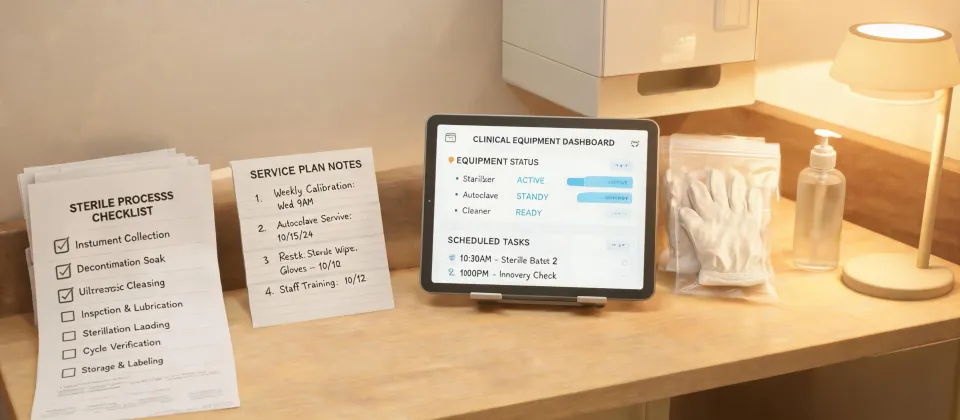
I've spent the last seven years in sterile processing. I've seen what works—and I've made almost every mistake you can make. Here's what nobody tells you: most hospitals treat their sterile processing department (SPD) like a stepchild, not the backbone of infection prevention it actually is. And that's a problem.
Look, I'm not saying every hospital is negligent. I'm saying the system is broken. Sterile processing is often the last thing considered in hospital design and budget planning. Then they wonder why their infection rates aren't where they need to be.
I was guilty of this thinking early in my career. In 2018, I worked at a mid-sized surgical center. We had three sterilizers for a facility doing 40 surgeries a day. People think you need more ORs. Actually, you need more time for your SPD to do its job right. The causation runs the other way: throughput problems in the OR are often sterilization bottlenecks in disguise.
The 'Just In Time' Trap
The assumption is that sterile processing equipment is just about cost. A budget autoclave gets you 90% of the way there, right? The reality is more nuanced. The difference between a STERIS V-PRO 1 Low Temperature Sterilization System and a generic competitor isn't just the price tag. It's the cycle time, the validation data, the service network.
I went back and forth between buying a new steam sterilizer and repairing the old one for about six months. The old one (circa 2005) still worked. But it had no data logging, no remote monitoring, and the service techs had to fly in from across the state. Ultimately, I pushed for the new one—a STERIS Amsco 500 series—because downtime from the old unit had cost us 12 cancellations in the previous year alone.
What You Actually Pay For
People see the upfront cost of a STERIS machine and balk. But let's talk about what that premium actually includes:
- Sure/Flex Reliability — Not just the machine, but the service guarantee. When it breaks (and all equipment breaks eventually), you need a tech on-site within 24 hours. Not 48. Not 'next week.'
- Validation Support — The change control process at STERIS means every software update, every part replacement is documented. For your Joint Commission visit, that's gold.
- Integration — Their equipment talks to each other. The washer disinfector talks to the sterilizer. The sterilizer talks to the OR management system. It's an ecosystem, not a collection of boxes.
"We tested four vendors for our new SPD in Q2 2023. The difference in lifecycle cost between the cheapest option and STERIS was only 15%—but the STERIS option had half the projected downtime. In a hospital, that 15% is an investment, not a cost." — Source: internal capital equipment evaluation, February 2023.
The 'One Size Fits All' Deception
This is where I committed my biggest blunder. In 2020, I inherited a department that was using a single type of autoclave for everything. Linen packs, metal instruments, wrapped and unwrapped. The assumption is a steam sterilizer is a steam sterilizer. The reality is starkly different.
We had a STERIS Reliance vision washer that was barely being used for its purpose—flexible endoscope reprocessing. The previous manager had decided 'it was too complicated' and had been sending scopes out to an external vendor. The cost? $890 per week plus a consistent 4-day turnaround. When I finally invested the time to train the team on the Reliance system (should mention: it took 3 weeks to certify everyone), we brought it in-house. The ROI was under six months.
But the bigger lesson was about the machine sterilization parameters themselves. Not all loads are created equal. A steam sterilizer that runs a 270°F gravity cycle for metal instruments isn't necessarily appropriate for certain plastics or wrapped goods.
My Checklist Before Buying Any Sterilizer
I maintain a checklist for our team now (not that I've made this mistake more than once). If you're evaluating equipment, ask these questions:
- Does the cycle library match your load types? — If you're processing robotics, lumens, or delicate optics, you need multiple cycle options.
- What's the total cycle time for your most common load? — A 30-minute cycle is very different from a 55-minute one when you're on a tight schedule.
- Does the manufacturer provide reprocessing validation data for YOUR instruments? — This is non-negotiable. If the manufacturer can't prove it works, assume it doesn't.
So What's the Alternative?
I'm not saying STERIS is the only option worth considering. There are other players in the market, and some of them make excellent equipment for specific niches. But what I am saying is this: if you're making a decision based only on the purchase price, you're guaranteeing a higher cost of ownership down the line.
I've heard the counterargument: 'Our budget is tight. We have to go with the cheaper option.' And I get it—I've been in that position. But here's the thing: saving $50,000 on a sterilizer that costs you $200,000 in lost procedural time and infection risk over five years is no saving at all.
The equipment in your sterile processing department is the first line of defense for every surgical patient who walks through your doors. The machine you choose—whether it's a STERIS vision washer, a STERIS machine sterilization system, or something else—directly affects patient outcomes.
That's not marketing talk. That's a fact I've learned through seven years of mistakes, late-night service calls, and the occasional canceled surgery. The hospital's reputation isn't just about the doctors in the OR. It's about the quality of the instruments those doctors use—and that starts in the SPD.
Stop treating sterile processing as a cost center. Treat it like what it is: the single most important department you never think about until something goes wrong.
