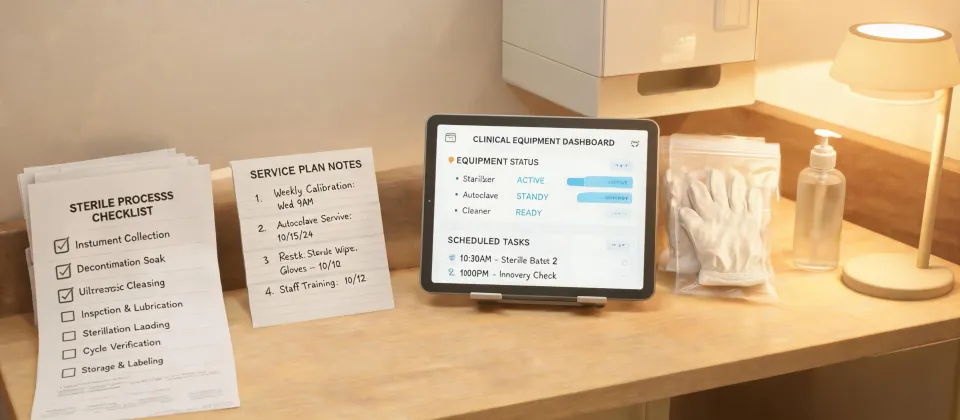
If you're the person signing off on sterile processing purchases — a procurement manager, surgery center administrator, or SPD director — this checklist is for you. I've managed our reprocessing budget for six years at a 320-bed hospital. I've compared the quotes, chased the overruns, and made enough mistakes to know which numbers actually matter.
There are 5 checks here. Give yourself about two weeks to gather the data. Do it anyway, because the decisions you'll make from this data are easier to defend than a gut call in a budget hearing.
Check 1: Count Your Real Instrument Volume
You cannot evaluate any sterilization system until you know what you're actually reprocessing. When I started, I used surgical case volume as a proxy for instrument set volume. That was wrong. Our orthopedic surgeons routinely opened three or four trays per case, so our true set volume ran about 38% higher than my initial estimate.
The first step is basic tracking, for at least 30 days:
- Rounds per day through your washer disinfectors
- Sets per surgical case, broken down by service line
- Sterilization trays sitting in holding because instruments are short
- Peel-pack and wrap volume, if you still use them
Checkpoint: you can answer "how many sets do we reprocess per week" without hesitating, and you have a spreadsheet to prove it.
This step costs nothing. But every decision after it depends on the answer. If a vendor tries to skip past this and jump to a product demo, treat that as a red flag.
Check 2: Build the Full Cost Picture for Your Sterilizer
When people say "steris machine," they're usually talking about the steam sterilizer or washer-disinfector at the heart of the department. It's the biggest purchase in this budget, and the sticker price is less than half the story.
In 2023, I compared quotes to replace one steam sterilizer and one washer-disinfector. The base prices came in within 8% of each other. That part looked like a no-brainer. But once I added installation, steam line upgrades, water treatment, validation testing, and the first-year service contract, the gap widened to 19%. The difference was buried in fine print.
Here's the cost checklist I run on every sterilizer quote:
- Base equipment price
- Installation and rigging
- Steam, water, and electrical infrastructure changes
- Validation and performance qualification testing
- First-year preventive maintenance contract
- Staff training — including overtime for backfilling shifts
- Estimated utilities consumption over 10 years
I went back and forth between two vendors for weeks on that project. The first one was $9,000 cheaper on the unit but charged separately for validation. The second priced everything together. When I ran the totals, the second came out $3,200 lower over the first 12 months. The cheaper machine was the more expensive buy.
Checkpoint: you have a defensible line item for each category above, and one total number you'd present in a budget meeting.
Check 3: Run the Numbers on an Instrument Counting System
Manual counting errors are a real financial risk. A retained surgical item is a CMS never event, and the costs are brutal — unreimbursed care, penalties, legal exposure.
The STERIS Count surgical instruments system attacks that risk at the instrument level. Coded markers go directly on each instrument, so your team can scan and verify a complete set in seconds rather than counting pins and graspers one at a time. You get a more reliable picture of what is actually in every tray.
Now the honest part. This system is not the right investment for every facility. If you're a small ambulatory surgery center running fewer than 1,000 sets a year with simple instrument sets, manual counting might still be your best cost option. An automated tracking system at that scale is overkill — and I'll say that even though it means admitting the tool I rely on daily isn't a universal fit.
The upside of a tracking system is preventing a retained item, an event that can cost seven figures. The downside is the upfront investment and a real workflow change. Which risk matters more depends on your volume. For high-complexity orthopedics, spine, or cardiac cases with 50-plus instruments per set, a miscount means a late case, a flash sterilization cycle, or worse. The math flips fast.
Before you talk to any vendor, build a baseline. Pull 24 months of incident reports. Count every late case caused by a count discrepancy, every missing instrument report, every set that got flash-sterilized because a tray was incomplete. Then ask the vendor to run a trial on your two highest-volume service lines and compare against that baseline.
Checkpoint: you know your current counting error rate, and you know what one minute of OR time costs at your facility. Without those two numbers, you cannot evaluate any counting system.
Check 4: Don't Forget the Imaging Suites and Sterilization Trays
Two costs tend to slip through the cracks. I missed both in my first budget cycle.
The first is the CT scanner suite. My first instinct was to treat that as "radiology's problem." Then I learned the instruments used in CT-guided biopsies and hybrid OR cases come right back to the same decontamination room — RF needles, biopsy devices, scopes. It's kinda everybody's problem. The labor and consumables for this equipment often get scattered across multiple cost centers, which means nobody owns the total.
The second is sterilization trays. There's no universal tray that fits every set. Orthopedic instruments need heavier containment; microsurgery instruments need finer retention. Buy the wrong tray system and you'll run half-empty loads or buy more trays than you need. Instead of counting trays on a shelf, calculate turns per day. A tray that turns three times a day earns its space. A tray that sits idle for a week does not.
Checkpoint: you know which rooms in your facility feed reprocessing, and your tray inventory matches actual surgical volume, not shelf space.
Check 5: Budget for the Quality Assurance Side
Every sterilization load needs a biological indicator. Every biological indicator needs an incubator. It's a small line item, but it's always under-budgeted.
AAMI ST79, the main standard for steam sterilization in healthcare facilities, recommends routine biological monitoring at least weekly — many facilities run it every load. That means the cost of biological indicators is not optional. And the incubator that reads them has to match the test you use.
Not every incubator fits this job. Look at the types of laboratory incubators on the market and you'll find:
- Dry heat incubators — simple, economical, and adequate for reading biological indicators in SPD.
- CO2 incubators — control carbon dioxide and humidity for cell culture. You do not need one for sterile processing.
- Shaking incubators — designed for microbiology research, not for running biological indicator strips.
- Refrigerated incubators — for temperature-sensitive samples. Also not an SPD requirement.
What you want is something that holds the biological indicator type you use (typically around 55–60°C for steam sterilization BIs) and gives you fast results. Do not let a sales rep upsell you to a multi-purpose lab unit. It eats bench space and budget.
Checkpoint: your QA budget has line items for biological indicators per cycle, the incubator itself, and the labor to read and document results.
Common Mistakes and Cautions
Looking back at six years of purchase orders, the worst errors were not equipment choices. They were process errors around the equipment.
Do not chase the lowest base quote. "Free setup" is often hiding something. I've seen a quote with "installation included," and then freight, vibration isolation, and connection kits appeared as separate charges.
Do not size equipment for the average month. Size it for your 95th percentile day. A department that runs at average capacity gets buried on high-volume days, and the overtime will exceed the price of a larger unit.
Do not decide from the demo room. Watching a vendor present the STERIS Count system in a quiet conference room is not the same as watching your staff use it on a 14-case day. Ask for a live site visit or an in-house trial. If they hesitate, that's another red flag.
Do not ignore training. I don't have hard data on industry-wide training expenses, but in our case, bringing the SPD team up to speed on new tracking software cost about 74 hours of combined labor. That number never shows up in the sales quote.
One last thing: the sales rep is not your accountant. Their number includes their margin and their quota. Your job is to look at it with a cold spreadsheet.
This checklist worked for us. But our situation is specific: a 320-bed hospital with 9 operating rooms and an active orthopedics service. If your facility is smaller or the case mix is different, the same steps apply — but your numbers will be different, and every large purchase has to be tested against your own data.
Start with data, do the math on total cost, and make the vendor prove their numbers under your real conditions. It's not flashy, but it's how you avoid the budget surprises that show up mid-year.