The No-Universal-Answer Truth About Hospital Sterilizers
If you're reading this because you need to buy a hospital sterilizer—or maybe you're trying to figure out if your current one is the right fit—here's what I wish someone had told me before I made my first mistake: there is no single 'best' sterilizer. Not for everyone. Not even for most people. The right one depends entirely on your specific situation.
I've been handling sterile processing equipment orders for about seven years now. In that time, I've personally made—and documented—five significant mistakes, totaling roughly $23,000 in wasted budget. The worst one? That was in September 2022. I'd approved a purchase for a high-capacity steam sterilizer because it had the best price per unit and the fastest quoted delivery. It seemed perfect. Until it arrived and we realized it required a different steam line pressure than our facility had. The 'fast' delivery turned into a two-month delay, we had to pay for emergency re-plumbing, and—this is the part that still makes me cringe—we'd already pre-ordered consumables that were incompatible. The cheapest quote ended up costing us 40% more than the one we'd dismissed as 'too expensive.'
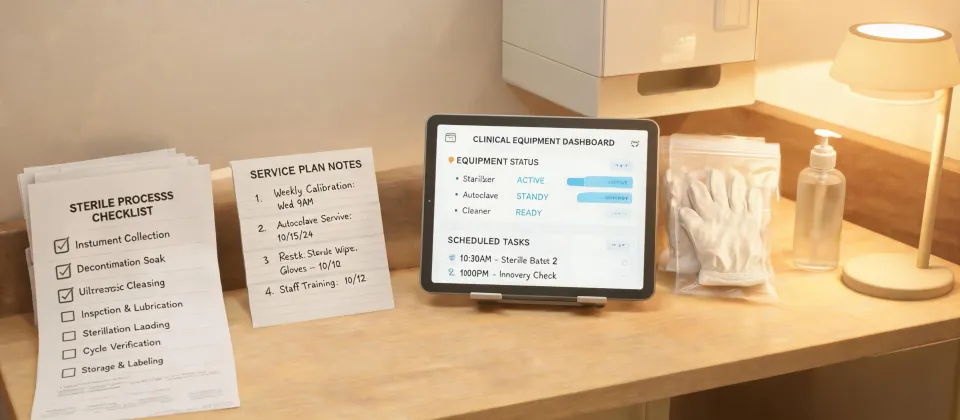
After the third such disaster, I started maintaining our team’s checklist to help others avoid repeating my errors. This article is based on that checklist. It’s not a list of model numbers. It’s a framework for figuring out which category your facility falls into, then matching the right solution to that scenario.
Scenario A: Large Hospital with High Volume & Diverse Needs
If you're in a 200+ bed hospital with a central sterile processing department that handles everything from surgical instruments to complex endoscopes, you're in Scenario A. Your volume is high, your mix is varied, and your biggest risk is a bottleneck during peak hours or a major equipment failure.
What matters most:
- Throughput and reliability: You need machines that can handle multiple loads per hour with minimal cycle interruptions. The system should have redundancy options or a fast service access.
- Flexibility: You'll likely need both steam and low-temperature sterilization (e.g., for heat-sensitive scopes). An integrated system that can handle both is a huge plus.
- Service and support: In a large facility, downtime isn't just inconvenient—it’s a risk to patient schedules. You need a vendor that offers 24/7 technical support and a national service network. (This is where the global network becomes a differentiator, but I'm not naming names.)
The mistake I made here (and how to avoid it):
In my second year, I chose a system with the fastest cycle time. I thought that was the only metric. What I didn’t account for: it had a complicated pre-cycle setup that slowed our operators down. When we calculated total cost of ownership (TCO), including the time spent by three technicians each morning, the 'fast' machine wasn't saving us time—it was costing it. (Oh, and that vendor's service response was regional, not national. That came back to bite us.)
My advice: in this scenario, prioritize a vendor with a strong national service footprint and a proven track record in large hospitals. The initial price might be 10-15% higher, but the TCO is usually lower because of fewer disruptions. Also, ask for a trial or a site visit to a similar facility. I should add that I've found asking for a maintenance history summary from the vendor's recent installations is far more valuable than any brochure.
Scenario B: Mid-Size Hospital or Surgical Center with Standard Workflow
If you're a community hospital or a busy surgical center with a consistent mix of cases—mostly general surgery, some ortho, maybe a few endoscopies—you're in Scenario B. Your volume is moderate. Your biggest challenge isn't diversity of needs; it's budget. You have to make every dollar count.
What matters most:
- Reliability & ease of maintenance: You don't have a massive engineering team. You need equipment that's easy to operate and maintain, with parts that are readily available.
- Compatibility: Your existing setup matters. If you already have a certain brand’s washers, it's usually smart to stick with that brand for sterilizers to ensure seamless integration and shared service contracts.
- Total cost of ownership, not just price: In this scenario, a slightly higher capital cost might be okay if it saves you ongoing consumables costs or reduces service visits.
The mistake I made here:
I once ordered a low-temperature sterilizer from a brand I hadn't worked with before because it was $4,000 cheaper than the incumbent's quote. We didn't check the consumable cost. Turns out, the cheap machine required single-use wraps that cost three times as much as the competitor's wraps. Over three years, that 'savings' turned into a $6,000 loss. Everyone told me to check specifications before approving. I only believed it after skipping that step once and eating that $800 mistake—well, $6,000 actually.
My advice: list all the recurring costs—consumables, maintenance, service contracts—over a projected 5-year period. Compare those numbers side-by-side. The machine with the best TCO is the one that wins, not the one with the lowest upfront price. (And yes, I know it's tempting to go cheap. Trust me, I learned that one the hard way.)
Scenario C: Small Clinic or Specialty Practice (e.g., Urology, GI)
If you're a small clinic, a single-specialty practice, or a doctor's office that does basic procedures in-house, you're in Scenario C. Your volume is low. Your biggest concerns are space, complexity, and cost. You probably don't even need a full-sized autoclave.
What matters most:
- Footprint and installation: You likely have limited space. Look for compact, tabletop or stackable units that plug into standard electrical outlets.
- Ease of use: The staff might not be full-time sterile processing techs. The machine should be intuitive, with clear error messages and minimal daily maintenance.
- Cost efficiency: Your budget is tight. But be careful—the cheapest machine might not be the best value if it's unreliable or has poor consumable costs.
The mistake I made here:
I saw a small, cheap steam sterilizer online and thought, 'Perfect for a clinic.' I ordered it without checking if it had a valid FDA clearance for the intended cycle types. It didn't. The unit arrived, we couldn't use it for sterilizing certain instruments, and we had to sell it on the secondary market for a third of what we paid. The loss: about $2,500. The most frustrating part: the listing didn't mention the limitation, and the customer service said, 'You should have checked.' After the second time dealing with that vendor (ugh), I was ready to give up on the whole project.
My advice: look for brands that specifically serve the 'small facility' market. They often have integrated service plans for settings like yours. And before you buy, verify the unit's intended use with your state's health department or a reliable infection control consultant. This is one area where it's worth paying a bit more for a known, reputable brand with a local service agent.
How to Know Which Scenario You're In
Here's a simple decision guide I use with our team now, based on experience (not theory):
- Answer these three questions:
- What's your average daily surgical volume? (Less than 15 = Scenario C; 15-50 = B; 50+ = A)
- How many different types of sterilization (steam, H2O2, gas plasma) do you need?
- Is your facility part of a larger health system with existing infrastructure support?
- If you're on the fence between B and C: Consider B as a rule, but with a strong emphasis on ease-of-use. You can always scale down, but scaling up from a 'clinic' unit to handle surgical center volume is painful.
- If you're between A and B: Go with A if you anticipate growth or if your case mix is already complex. Otherwise, B—with the caveat that you invest in a good service contract.
Final thought (and one more lesson):
This framework has saved our team from at least four major purchasing errors in the last 18 months. It's not foolproof—the market changes fast. These pricing guidelines were accurate as of Q4 2024, so verify current rates before making any commitment. (And for the love of all things sterile, never, ever skip the trial or site visit. I did it once. The 'once' was enough.)
—Based on experiences from 2017 through Q1 2025.