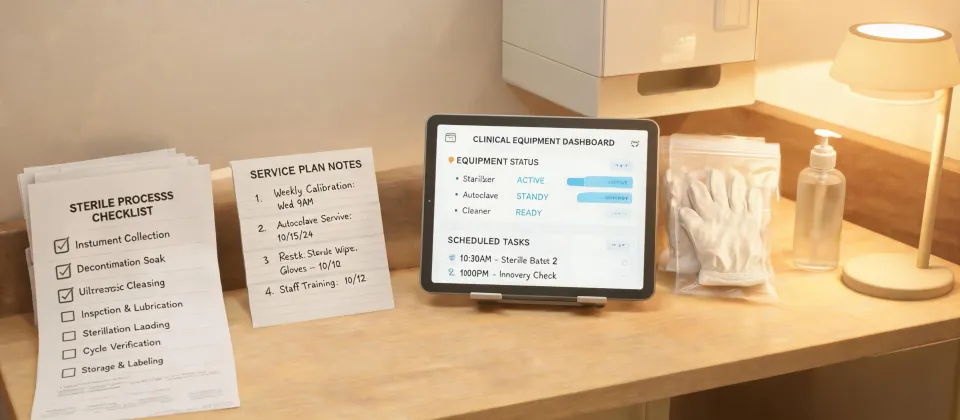
If you're shopping for STERIS sterilizers or any of their lab/clinical equipment, the single most important step is using the official STERIS catalogue before you call a sales rep. Not Google. Not a competitor's comparison page. The catalogue.
I learned this the hard way: in my first year (2017), I ordered a steam sterilizer for our dental lab based on a brochure from a third-party site. Ended up with a unit that didn't fit our benchtop and couldn't handle our plastic instruments (needed low-temperature). Cost: $8,200 in restocking fees plus a 2-week delay. Since then, I've made three more mistakes totaling roughly $40K in wasted budget. Now I maintain our team's pre-purchase checklist, and the first item is always "Download the current STERIS catalogue."
What follows is my personal experience—not official advice—but I hope it saves you at least one headache.
Why the Catalogue Matters More Than You Think
STERIS sells dozens of sterilization platforms (steam, hydrogen peroxide, ethylene oxide, ozone), plus washer-disinfectors, surgical tables, and consumables. But their product line also covers dental laboratory equipment and histology equipment—areas that are easy to overlook if you only think of them as "the autoclave company." The catalogue indexes everything by application, not just alphabetically. Miss that, and you risk ordering a clinical autoclave when you needed a lab-specific unit.
Example: Our histology lab needed a rapid-cycle sterilizer for small instruments between cases. I found a STERIS AMSCO 400 series on a used equipment site. Sounded perfect. But the catalogue revealed that unit required hard plumbing and a dedicated steam source—our lab only had a portable water line. The correct model (STERICYCLE i400) has an integrated boiler. The catalogue explicitly shows this in the "Histology Equipment" section. I missed it. Cost: $3,400 for installation mods we couldn't use, plus a 1-week shutdown.
The "Medical Ultrasound" Surprise
Fun fact: What is medical ultrasound doing in a STERIS catalogue? They manufacture ultrasonic cleaning systems for surgical instruments, not diagnostic imaging. But the term "medical ultrasound" in product search often confuses buyers. I once had a colleague ask for "the ultrasound machine" for our sterile processing department—he wanted a diagnostic one (complete misunderstanding). The catalogue's "Ultrasonic Cleaners" section clarifies: frequencies, tank sizes, cycle types. Had he looked, he'd have seen the difference instantly.
My point: the catalogue is your first line of defense against miscommunication.
Three Mistakes That Finally Made Me Create a Checklist
Mistake #1: Trusting a Reseller Over the Catalogue
In 2019, a reseller offered a "great deal" on a STERIS Reliance 445 endoscope reprocessor. They said it was compatible with our scope inventory. The catalogue said otherwise—it listed specific scope brands and connectors. I didn't check. The unit arrived, and half our Olympus scopes wouldn't connect. $5,200 shipping back plus restocking. (Note to self: always cross-reference catalogue specs before signing.)
Mistake #2: Ignoring the "Dental Laboratory Equipment" Section
Our dental lab needed a sterilizer for burs, handpieces, and impression trays. I ordered a standard surgical autoclave—too large, too hot for plastic handles, and required 208V power we didn't have. The catalogue's dental tab lists compact benchtop units, low-temperature options (like the V-PRO maX), and voltage variants. I wasted $3,900 on the wrong unit and had to buy a separate tabletop model anyway. My gut said "surgical is better," but the data (catalogue) said dental-specific. I should have listened to the data.
Mistake #3: Assuming Sterilizers Are All the Same
In 2022, our histology lab bought a used STERIS steam sterilizer from another facility. It worked, but after 6 months the validation kept failing. Turned out it was designed for general surgery, not histology—histology loads contain formalin residues that can damage chamber seals if not handled with specific cycles. The catalogue lists "Histology Equipment" with dedicated cycle parameters. We had to replace seals twice ($1,100 each) before we realized the root cause. Looking back, I should have bought new from the catalogue rather than chasing a cheap used deal.
What's Changed in 2025 (And What Hasn't)
The industry has changed a lot. Five years ago, low-temperature sterilization was exotic; now it's standard for heat-sensitive instruments. The STERIS catalogue now includes a full section on medical ultrasound cleaning systems with validated cycle times for complex devices. But one thing hasn't changed: the catalogue is still the single source of truth. No reseller, no third-party summary, no blog post (including this one) replaces the official document.
My experience is based on about 200 orders over 6 years, mostly for mid-size hospitals and dental labs. If you're in a large academic medical center with in-house engineering support, your process can be more flexible. I can't speak to that. But for small-to-medium facilities like mine, the catalogue is a lifeline.
How to Use the STERIS Catalogue the Right Way (My Checklist)
- Download the PDF from steris.com (not a third-party). Ensure it's the current year's edition.
- Search by application: dental laboratory equipment, histology equipment, surgical suite, etc. Don't guess the model number.
- Check utilities: voltage, water, steam, footprint. The catalogue lists these in tables.
- Verify consumables: does the unit require proprietary chemicals or cassettes? The catalogue lists compatible items.
- Cross-check with your existing inventory: connectors, trays, scope compatibilities.
- Check warranty & service options: STERIS offers extended plans; the catalogue mentions availability.
Honestly, I'm not sure why it took me three failures to implement this. My best guess is that I was overconfident and impatient. Now I print the relevant catalogue pages and physically mark them up before any PO.
Boundaries and Exceptions
The catalogue isn't perfect. It doesn't list every used equipment option, and sometimes custom configurations require a sales rep. For highly specialized setups (e.g., combined washer-disinfector with closed-loop chemical monitoring), you'll need a consultation. The catalogue gives you the baseline, not the final customization. Also, pricing isn't included—you still need to quote. But the specifications are accurate as of publication date. Prices as of Jan 2025; verify current rates.
One more honest admission: I've never ordered a large-scale STERIS surgical table or OR integration system. My experience is limited to sterilizers and reprocessors. If you're buying OR tables, your checklist may differ. But the principle of starting with the catalogue still applies.
If you've had similar (or different) experiences, I'd genuinely love to hear them. I'm still learning.