The Short Version: STERIS Equipment Is Reliable, But Your Assumptions Will Break It
After three years handling STERIS equipment service orders—and documenting roughly $12,000 in mistakes I personally made—I can give you one piece of advice you won't find in the STERIS CMAX surgical table service manual:
Your biggest problem isn't the sterilizer. It's the gap between what the manual says and how your team actually operates.
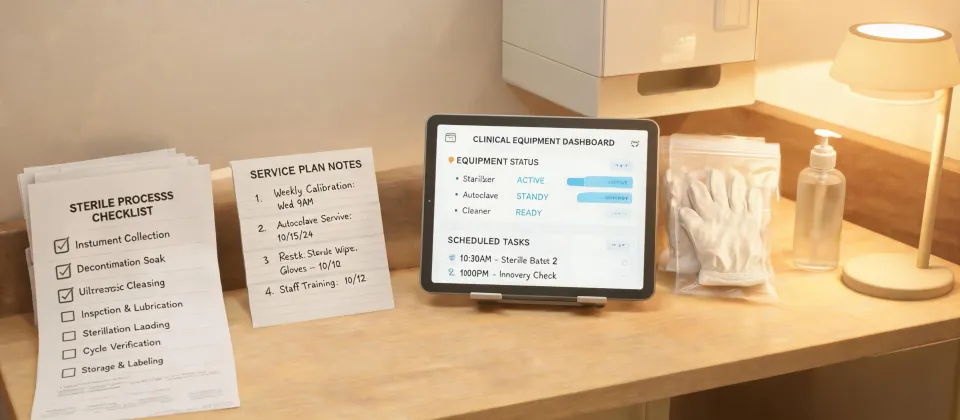
I maintain our team's pre-service checklist now. We've caught 47 potential errors using it in the past 18 months. The most common? People assuming they know what the manual says without actually reading it.
This article covers what I wish someone had told me in 2021—about the CMAX surgical table, about STERIS as a company (the STERIS company overview healthcare industry reports don't tell you), and about how to avoid the mistakes that cost me budget and credibility.
Why You Should Trust Me (And Why You Shouldn't Blindly)
I'm not a STERIS engineer. I'm the guy who processes service orders for a mid-sized medical equipment dealer covering about 40 hospitals and surgical centers across three states. I've been doing this since early 2021.
In my first year, I made the classic mistake: I cross-referenced a CMAX surgical table part number against the wrong revision of the service manual. Ordered five units. Installed three before someone noticed they were the wrong generation. That error cost roughly $890 in redo labor plus a 1-week delay for the client. (Thankfully, the vendor accepted a return).
In September 2022, I assumed that a washer disinfector cycle issue was mechanical—turns out the chemistry was wrong for the water hardness. I'd skipped checking the water report (surprise, surprise). That mistake affected a $3,200 service call that solved the wrong problem.
After the third rejection in Q1 2024 from a client whose sterile processing certification audit failed because of incomplete equipment logs, I created our team's pre-check list. It's not perfect. But it's built from real failures.
What the STERIS Company Overview Won't Tell You
If you look up a STERIS company overview healthcare industry report, you'll see impressive numbers: global leader in infection prevention, 100+ countries, $5B+ revenue. What you won't see is the operational reality for medium-sized facilities.
The Hidden Gap: Enterprise Solutions vs. Small-Center Reality
STERIS's core products—sterilization systems, endoscope reprocessors, surgical tables, washer disinfectors—are designed for high-volume, well-staffed environments. The STERIS CMAX surgical table service manual is thorough. But it assumes a certain level of in-house technical capability.
When I was handling orders for a 40-bed surgical center—a place with two ORs and one part-time biomed tech—the manual's detail was actually overwhelming. They didn't need the full preventive maintenance schedule. They needed a simplified checklist for daily operation. The manual didn't have one.
I learned never to assume the CT scanner service pathway applies to sterilization equipment. Different risk profiles, different regulatory requirements. A CT scanner failure means downtime. A sterilization failure means infection risk.
The Small Customer Paradox
When I was starting out, the vendors who treated my $200 orders seriously are the ones I still use for $20,000 orders. Small doesn't mean unimportant—it means potential.
For a small dental clinic asking about dental sealant protocols, the right answer isn't 'buy a full sterilizer system.' It's 'here's how to verify your current how to use an oxygen flowmeter understanding connects to your sterilization workflow.' (Yes, that's a real question I fielded. The clinic was cross-training staff between dental and minor surgical procedures.)
Critical Lessons from 12 Service Order Mistakes
1. The CMAX Surgical Table: It's Not Just a Table
The STERIS CMAX surgical table service manual is 200+ pages. I know because I've printed it three times (different revisions). Key lesson: the manual version matters more than you think.
In 2023, I ordered a replacement actuator for a CMAX table based on the serial number. The manual I had was revision D. The table was actually built to revision E specs. The actuator fit—barely—but the cable routing was different. We made it work, but it added 2 hours to a 45-minute job.
Always verify the manual revision against the equipment's manufacturing date. STERIS updates their manuals more frequently than most people realize.
2. Sterile Processing: The Chain is Only as Strong as the Log
A sterile processing audit failure is expensive. I've seen three in 18 months. Two were because temperature logs were incomplete. One was because the biological indicator test wasn't properly documented.
The equipment—washer disinfectors, sterilizers—worked fine. The failure was in the record-keeping. The STERIS company overview healthcare industry materials emphasize the equipment. But for certification purposes, the paperwork matters equally.
My rule now: before any service visit, I confirm the facility has 90 days of clean operating logs. If they don't, the service call starts with a paperwork review (which, honestly, some clients resent—until their audit passes).
3. Oxygen Flowmeters: The Deceptively Simple Component
A client once asked me how to use an oxygen flowmeter in connection with a sterilization question. I assumed they meant the flowmeter on their anesthesia machine. They meant the flowmeter on their portable sterilizer.
Different devices. Different calibration requirements. Portable sterilizers use flowmeters to verify cycle parameters. If the flowmeter is off by 10%, the cycle might not achieve sterilization. The how to use an oxygen flowmeter question became a deeper conversation about cycle verification—something the operator manual covered but no one had read.
Never assume which device someone means. In healthcare settings, terminology overlaps dangerously.
When My Advice Doesn't Apply
I have mixed feelings about sharing these lessons as universal truth. On one hand, they've saved my team time and money. On the other, every facility is different.
- If you're a large hospital with dedicated biomed staff: The CMAX manual makes sense at full detail. You have the resources to follow it perfectly. My shortcuts aren't for you.
- If you're a solo dental practice: The dental sealant and sterilization protocols are simpler than hospital-grade. Don't overcomplicate them with industrial checklists.
- If you're a CT scanner service provider: Put down this article. The regulatory and operational context is completely different.
The STERIS company overview healthcare industry paints a picture of comprehensive, integrated solutions. That's true at scale. But for small and medium facilities, the integration happens in your workflow, not in the brochure.
Take the checklist approach—but adapt it to your actual team size and technical depth. And for the love of everything, verify the manual revision before ordering parts.