I remember the day I became the person who reads equipment manuals for fun. It was September 2022, and I was staring at a $12,000 bill for replacing a pump on a Steris washer/disinfector that, as it turned out, had never been broken in the first place.
I'd been a Sterile Processing Department (SPD) manager for about three years at that point. Thought I had things pretty well figured out. I could quote you cycle times for a 5085 from memory. I knew the difference between a thermal and chemical disinfection cycle. I felt, honestly, pretty smug about my knowledge of the 'steris 5085 service manual' PDF I kept bookmarked on my desktop.
Turns out, knowing where a part is on a diagram is not the same as knowing when to actually replace it. That was a $12,000 lesson. It got worse before it got better.
How It Started: The Allure of Doing It Ourselves
Here's the background. In early 2022, our hospital system decided to cut costs by bringing a lot of equipment maintenance in-house. On paper, it made sense. Why pay a premium for Steris field service engineers when I had a team of biomeds who could follow a manual? I even had two guys who'd taken Steris's basic training course.
So, I became the champion of the 'DIY maintenance' initiative. I downloaded every 'steris washer/disinfector manual' I could find. I printed out sections from the 'steris 5085 service manual'. I held Friday afternoon study sessions. We were gonna save the hospital a fortune.
Most buyers focus on the cost of the service contract (the obvious factor) and completely miss the cost of their own mistakes (the overlooked factor). I completely missed that.
The First Disaster: A Self-Inflicted Wound
The first major incident happened in July 2022. One of our 5085s started throwing an error code related to water temperature. My senior biomed, we'll call him Dave, was confident. He opened the 'steris 5085 service manual', found the troubleshooting section, and diagnosed it as a faulty heating element.
I approved the purchase of a new element. $2,100. He spent a Saturday wrestling the old one out and the new one in. We fired it up. Same error code. Turned out it was just a clogged water inlet filter—a $15 part and a 10-minute fix.
Dave had skipped the simple diagnostic steps in the manual (the bleed settings, if you will) and jumped straight to the complex surgery. That error cost $2,100 in parts plus a one-day production delay. Not great. But it was the one that came a few months later that really did the damage.
The $45,000 Mistake (September 2022)
The second disaster was the one that broke my smugness. It was a high-profile project: installing a new endoscope reprocessor in our GI suite. We had an older model, but a new loaner scope from an ENT endoscope manufacturer required a newer cycle.
I decided we didn't need Steris to do the install. We'd handle the plumbing and electrical ourselves. It's just water and power, right? The manual (the 'steris washer/disinfector manual' for the new model) had the specs clearly listed: water pressure, flow rate, drain height, electrical draw. I checked it off myself, approved it, and processed it.
We caught the error when the machine wouldn't complete its initial self-test. The water pressure was too high. Not by a lot—maybe 10 PSI over spec. But the unit's internal sensors, which are incredibly sensitive, kept faulting out. We spent three days trying to override the software, adjusting the pressure regulators, and re-reading the manual.
In my frustration, I called Steris. Their engineer came out, looked at our setup for 10 minutes, and said the problem wasn't the machine—it was that we'd installed a backflow preventer of the wrong type. The specific valve we used created a pressure drop on the hot water line during a specific phase of the cycle. It wasn't in any manual. It was just… experience.
The total cost of that error? Let's break it down:
- Three lost days of ENT endoscope reprocessing: We had to send scopes to a sister hospital 40 minutes away. Overtime for transport? $3,400.
- Steris emergency service call: $1,800 for the visit, plus $350 for the correct valve.
- New backflow preventer and plumbing rework: $1,200.
- The wasted time of my team: Hard to quantify, but easily another $2,000 in labor.
- The real killer: A brand-new, high-end ENT endoscope that was damaged during transport. That scope was $36,000. The repair was $17,000.
So, the direct cost was about $26,000. But when you add the damage to the scope (which was partly blamed on our department's 'inadequate setup'), the total attributed to my decision was $45,000.
The Real Problem Wasn't the Manual
At that moment, I hated Steris. Not the company, but the way I was using their materials. The 'steris 5085 service manual' is an incredible document—if you're a trained field service engineer. It's a reference. It's not a guide for a department manager who thinks he's an engineer. The question I was asking was, 'how do I fix this?' The question I should have been asking was, 'how do I keep from causing this?'
I have mixed feelings about service manuals now. On one hand, they're invaluable for the details: torque specs, cycle parameters, electrical diagrams. On the other, they create a false sense of knowledge. Reading a manual makes you *think* you know a machine. Using a machine—and breaking one—teaches you how it actually works.
The Checklist That Saved Our Sanity (and Budget)
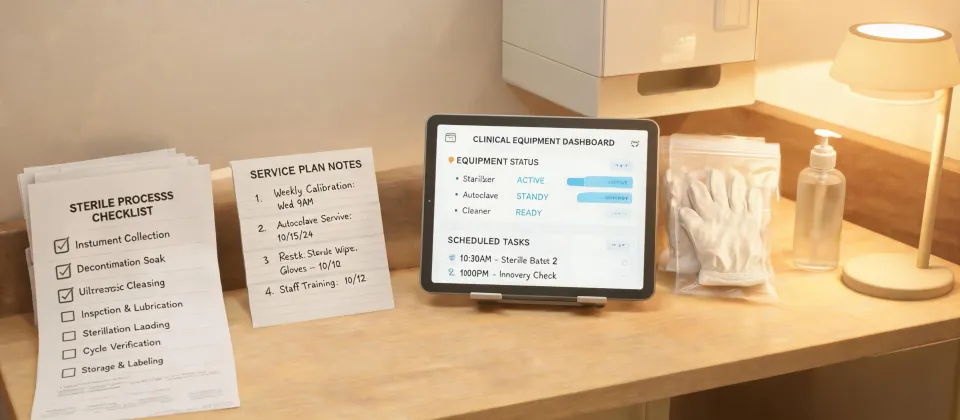
The $45,000 mistake was the last straw. I called a meeting with my team (unfortunately) and we created a new pre-check list for any equipment install or major repair. Not a list from a manual. A list from our experience, our failures. We've caught 47 potential errors using this checklist in the past 18 months. Here's the gist of it:
Rule #1: Assume the Manual Is Wrong
Okay, not wrong. But incomplete. The manual tells you the 'what'. It doesn't tell you the 'real-world conditions'. For example, the manual says 'water pressure 50-60 PSI'. It doesn't tell you how the building's old pipes or a nearby surgical table hydraulic system might cause fluctuations. We now always verify actual conditions at the connection point, not just what the blueprint says.
Rule #2: Don't Trust a DIY Diagnosis for More Than 30 Minutes
We have a '30-minute rule' for troubleshooting. If two people can't find the root cause of an error code (using the manual) in 30 minutes, we stop. We call for help. The cost of the service call is always less than the cost of our time and the potential damage. In the first six months, we called three times. In the last twelve months, zero. Why? Because the service engineer showed us things we'd never have found.
Rule #3: The 'Surgical Stapler' Test
This is my favorite. Before we touch *any* piece of high-value equipment (like a surgical table or an endoscope reprocessor), we ask ourselves: 'Would I perform a surgical stapler on a loved one with my current level of knowledge?' It's a forcing function. If the answer is no, we don't touch it. We find someone who actually knows what they're doing.
What I Learned (The Hard Way)
I still have the 'steris 5085 service manual' bookmarked. I still use it. But I don't treat it like a bible anymore. It's a tool, not a teacher. The real learning came from the mistakes—the filters skipped, the valves installed wrong, the $45,000 scope that got dropped because we were in a rush to fix a problem we hadn't even diagnosed correctly.
Efficiency in sterile processing isn't about how fast you can swap a part. It's about how few times you have to swap it. The most efficient path wasn't the one I took—doing everything ourselves. It was the path where we knew our limits, respected the equipment, and, ironically, spent less time 'being efficient' and more time being correct.
If you're a new SPD manager reading this, don't let your ego write a check your expertise can't cash. The manual isn't the shortcut. Experience—especially the expensive kind—is. And sometimes, the most valuable tool in your box is the phone number of someone who already made the mistake you're about to make.
I'm sharing this because I've made those mistakes so you don't have to. The costs are real, the delays are painful, and the embarrassment stings. But the lesson is worth it: reading a manual is not the same as knowing a machine. One is data. The other is wisdom.