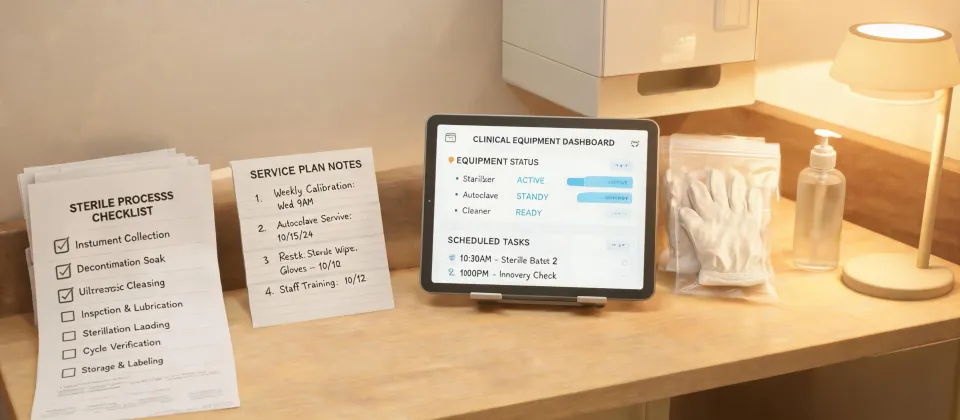
When our group finally got approval for a larger sterile processing room in late 2024, the first equipment request on my desk made sense at first glance: compare the STERIS 600 sterilizer and the STERIS 444 washer, and tell us which one we should order. It sounds straightforward. Two big stainless steel boxes. Two model numbers. One purchase decision.
But after managing purchasing for a three-location outpatient group for five years, I have learned that the easiest requests are usually the ones hiding a workflow problem. I oversee roughly $1.4 million in annual spending across maybe 30 vendors for two GI/endoscopy clinics and one oral surgery/dental facility. I report to operations and finance, and I am not a sterile processing expert. I am the person who gets called when clinicians know what they need but need someone to buy it, schedule it, and make sure it does not blow up the capital budget.
So if you are an administrator staring at the same sort of comparison, here is what I wish someone had told me before I started comparing STERIS products: these two machines are not really competitors. They are adjacent steps in the same process. But the way you sequence them, install them, and budget for them still matters more than most people expect.
STERIS 600 Sterilizer vs. STERIS 444 Washer: The Framework I Used
The key distinction is one that took me way too long to appreciate: clean is not sterile, and sterile is not clean. The STERIS 444 washer is a washer-disinfector. It removes blood, tissue, fluids, and other soil from instruments, then applies a thermal disinfection step. The STERIS 600 sterilizer uses saturated steam under pressure to kill microorganisms on instruments that are already clean. In other words, the 444 removes what you can see. The 600 destroys what you cannot see.
That sounds basic, but the paperwork and facility planning around each machine were completely different in my experience. So when someone asks me which one is better, I now ask them to walk through four dimensions first.
Dimension One: What the Machine Actually Does
A STERIS 444 washer is built for the dirty side of reprocessing. It flushes debris, uses detergent, and reaches high temperatures to achieve disinfection. It is not a sterilizer. A STERIS 600 sterilizer, by contrast, is built for the clean side. It assumes the instruments coming in are free of soil, because steam cannot reliably penetrate blood or biofilm.
That distinction drove everything else in our planning. I remember one request where a department wanted to replace an aging sterilizer and asked whether the new STERIS 600 could also handle heavily soiled instruments. The honest answer was no. Soiled instruments need cleaning first. That means the washer-disinfector is not an optional upgrade. It is the prerequisite.
Dimension Two: Where It Sits in the Workflow
The conventional wisdom is that the sterilizer is the most important piece of equipment in central sterile, because sterilization is the final barrier before a patient. My experience with our 2024 project suggests otherwise. The STERIS 444 washer was the actual bottleneck.
Here is the thing: every surgical instrument in our network has to go through cleaning before it can be wrapped and sterilized. If the washer-disinfector goes down, the whole line stops. If the sterilizer goes down, we can sometimes shift loads or use another cycle, but if the washer is down, instruments never even reach the clean side. The sterilizer gets the glory. The washer-disinfector does the heavy lifting.
That is the kind of operational reality that does not show up in a product brochure. It shows up after you have watched staff manually decontaminate instruments for two days and realized how much time that wastes.
Dimension Three: Validation and Routine Monitoring
This is where the comparison between a STERIS 600 sterilizer and a STERIS 444 washer gets interesting from a compliance perspective. According to AAMI ST79, the steam sterilization standard most U.S. healthcare facilities follow, sterilizers require routine monitoring that includes physical cycle data, chemical indicators, and biological indicators.
The STERIS 600 sterilizer gives you a clear, established monitoring path. You run a Bowie-Dick test for air removal, you use external and internal chemical indicators, and you periodically run biological indicators to confirm spores were killed. It is rigorous, but it is also familiar to every sterile processing tech I have worked with.
Washer-disinfectors are a little less standardized. They are covered by standards like ISO 15883 and AAMI ST90 for flexible endoscope processing, and they typically rely on temperature logs, detergent concentration, and cleaning indicators. What caught me off guard was how much cleaning verification depends on human diligence. You cannot just trust that the wash cycle worked because a light turned green. You need to make sure the machine is dosing detergent correctly, the spray arms are spinning, and the load is loaded properly.
From a buyer's perspective, this means the STERIS 444 washer requires more attention to training than a sterilizer does. That is not a reason to avoid it. It is a reason to budget for it.
Dimension Four: Installation and Hidden Costs
The STERIS 600 sterilizer needs a reliable steam supply. I learned this the hard way. We had a quote ready to sign for a new sterilizer, and then the facilities team realized our steam lines were undersized for the capacity we wanted. That single issue added weeks to the project and required a separate steam generator upgrade.
Meanwhile, the STERIS 444 washer needed different utilities. It needed hot water, treated water, drainage, and detergent. The room layout had to account for the dirty side and clean side separation. Honestly, the washer-disinfector was not cheaper to install once we included water treatment and the extra plumbing. It was just different.
If you are comparing these two machines only on sticker price, you are missing the real comparison. The real cost is in steam quality, water quality, ventilation, floor space, and the labor required to keep the workflow moving. I almost learned that the expensive way, and I am glad our biomed team caught it before we signed.
When the Decision Shifts: Endoscope Storage Cabinets Belong in This Conversation
Here is the part that surprised me most. In an endoscopy-heavy facility, neither the STERIS 600 sterilizer nor the STERIS 444 washer is necessarily the first equipment purchase I would recommend. Flexible endoscopes are heat-sensitive. They cannot be routinely steam sterilized. They require high-level disinfection, thorough drying, and proper storage.
That is where the endoscope storage cabinet debate enters. I remember being handed a requisition for a simple metal cabinet for scope storage, and it looked like a reasonable budget choice. But our infection preventionist asked one question that changed everything: does the cabinet force air through the scope channels and dry them continuously?
The answer was no. A basic cabinet just hangs scopes in a closed box. Moisture can remain inside the channels overnight, and that moisture creates a perfect environment for waterborne organisms. Under AAMI ST91, which addresses flexible endoscope processing, drying and storage are not optional details. They are part of the reprocessing cycle.
So when people compare a STERIS 600 sterilizer vs. a STERIS 444 washer, I now ask a broader question: what are you reprocessing? If you are reprocessing mostly rigid surgical instruments, the answer is usually both a washer-disinfector and a sterilizer. If you are reprocessing flexible endoscopes, you might need an automated endoscope reprocessor plus an endoscope storage cabinet with HEPA-filtered forced air drying. The sterilizer might not be the priority at all.
I was one purchase order away from buying the wrong thing. So glad I double-checked. That cabinet purchase would have passed inspection and still failed patients, because it would have stored wet scopes. Dodged a bullet on that one.
Other Equipment Questions That Land on a Purchaser's Desk
Once you become the person who buys clinical equipment, you also become the default answer person for every adjacent request. Two questions come up more often than I expected.
What Is a Dental Air Compressor?
A dental air compressor is not the same thing as a general-purpose shop compressor. It supplies clean, dry compressed air to dental handpieces, scalers, air-water syringes, and some dental equipment. The word dry matters. If moisture or oil gets into the air lines, it can affect dental equipment performance and create contamination risks.
I have seen buyers compare oil-lubricated and oil-free dental air compressors like they are interchangeable. They are not. Oil-free designs are easier to maintain in a small office and avoid the risk of oil mist in the air stream. Oil-lubricated units can be durable and quiet, but they require more disciplined maintenance. For a dental clinic, the real question is not just horsepower. It is whether the compressor provides dry, clean air at the flow rate your chairs actually need.
What About Peritoneal Dialysis Machines?
Peritoneal dialysis machines come up when a renal program is deciding between automated peritoneal dialysis and manual exchanges. In simple terms, a peritoneal dialysis machine is often a cycler that performs multiple fluid exchanges automatically, usually overnight while the patient sleeps. Manual peritoneal dialysis, sometimes called CAPD, uses gravity and manual bag exchanges throughout the day.
If that comparison lands on your desk, do not treat it like a sterilizer versus washer decision. The machine is only part of the picture. The bigger variables are patient training, home environment, clinical support, and whether the patient is a candidate for automated therapy. From an administrative standpoint, the durable equipment cost matters, but the ongoing consumables and training costs often matter more.
I mention these two because they show how broad a healthcare buyer's life can be. Some days I am comparing the STERIS 600 sterilizer and STERIS 444 washer. Other days I am answering what is a dental air compressor or reviewing peritoneal dialysis machine specifications. The common thread is not the technology. It is the workflow behind the equipment.
So Which Do You Buy?
If you are building or renovating a reprocessing area for surgical instruments, plan for both the STERIS 444 washer and the STERIS 600 sterilizer. They are not either-or machines. The washer-disinfector cleans. The sterilizer makes sterile. You need both to process rigid instruments safely.
If you can only fund one machine right now, I would sequence the washer-disinfector first, assuming you already have a way to sterilize or outsource sterilization. That recommendation surprised my operations director, but it came from a simple observation: staff can manually clean instruments in an emergency, but it is slower, less consistent, and harder to validate. Automating the cleaning step removes the biggest variable in reprocessing.
If your facility is mostly endoscopy, start with an automated endoscope reprocessor and an endoscope storage cabinet that provides forced-air drying. Add a steam sterilizer only if you also reprocess reusable surgical instruments. And if you are buying for a dental clinic, remember that a dental air compressor is a separate category with its own requirements.
The bottom line is that comparing the STERIS 600 sterilizer and the STERIS 444 washer is a fair exercise, but only if you compare them on the work they do and the stage they support. The more efficient path is to look at your entire reprocessing workflow first. That is what made my job easier, and it is what I would tell any administrator trying to make the same decision without a clinical background.