There is no "best" STERIS configuration. I know that's not the convenient answer you wanted, but after seven years of managing capital equipment budgets, I've learned that the right purchase is the one that fits your actual workflow, volume, and building infrastructure.
I'm a procurement manager at a 180-person healthcare services organization. I manage an annual equipment budget of roughly $1.8 million—maybe $1.9 after the recent renewal, I'd have to check. I've negotiated with 40-plus vendors and tracked every order in a system that's probably older than the interns who use it. This article is the framework I use when a department asks me to buy a STERIS endoscope reprocessor, histology equipment, or even something as simple as a medical trolley.
I'm not a clinician, so I can't speak to clinical outcomes. What I can tell you from a procurement perspective is how to compare these systems without getting buried in hype.
Three Scenarios, One Budget
Before you look at product brochures, ask which scenario you're in:
- Acute care / hospital sterile processing: High volume, mixed endoscopes, 24/7 workload, and multiple staff trained for complex reprocessing.
- Ambulatory surgery center, dental clinic, or small multispecialty practice: Moderate volume, limited space, smaller team, and a greater need for simple, repeatable workflows.
- Histology, pathology, or research lab: The focus is tissue processing and instrument prep, not just endoscope reprocessing.
There is no universal answer. The best STERIS setup for one location can be the most expensive mistake in another.
Scenario A: Acute Care and Central Sterile Processing
If your facility is running a busy GI suite plus a central sterile department, the STERIS endoscope reprocessor decision is fundamentally about capacity and data traceability.
Don't just compare cycle time. Compare how many endoscopes you need to turn around per hour at peak, not at average. That is the number that will decide single-basin vs. dual-basin. In our 2024 capacity review, a 10% increase in peak volume created a 22% increase in required reprocessing capacity when we measured by minutes of occupied basin time. That's the kind of math that prevents regret.
Also check installation requirements. The hidden costs are real: water quality, drains, IT placement, room ventilation, floor drains. One project I reviewed carried an $11,000 facility prep estimate that nobody mentioned until after the quote was accepted.
Before you approve the purchase, pull the FDA 510(k) database listing for the specific reprocessor. It doesn't tell you which device is "better," but it tells you exactly what the manufacturer was cleared to claim. Then cross-check the cycle parameters against your facility's AAMI ST79 or ISO 15883 protocols.
Scenario B: Ambulatory Surgery Centers, Clinics, and Dental Groups
For low- to mid-volume settings, the smartest STERIS purchase may be smaller than you think. A dual-basin endoscope reprocessor is attractive, but if your peak workload is four scopes a day, it's a lot of expensive stainless steel sitting idle.
The more common problem I see is the opposite: tiny departments buying a system with no room to grow. If you're planning to add a second operating room or a new gastroenterology service in the next 18 months, buy the capacity now. Retrofits after you move in are three times more disruptive.
And before anyone signs off on an intraoral scanner, ask this: "What does the manufacturer's reprocessing instruction say, and does it match our disinfection workflow?" I'm not a dental equipment specialist, so I can't tell you which optical technology is better. What I can tell you from a procurement standpoint is that a scanner that takes 10 minutes to reprocess might actually increase staff time more than a slightly slower scan.
An intraoral scanner also needs a home. "What is a medical trolley?" is a question I hear from budget managers who suddenly discover that this device needs to move between rooms. At its core, a medical trolley is a mobile workstation for supplies and equipment. In a sterile processing environment, it also has to be easy to clean, stable, and sized for the loads you actually move. The difference between a $600 utility cart and a $1,500 medical trolley is not just the price—it's the load rating, caster quality, and surface resistance to disinfectants. We tested one "budget" trolley with a plastic handle that started cracking after three wipes with hospital disinfectant. Replacing it cost more than buying the better trolley upfront.
Scenario C: Histology, Pathology, and BioPharma Labs
Histology equipment is a different animal. If someone tells you to "just buy the same brand as the rest of your lab," ask for their maintenance records.
Refurbished histology equipment can make sense. It worked for us when we bought a refurbished tissue processor for $24,600 versus $31,200 new. But we only did that because we had a local service engineer who could respond within 24 hours. Then the pump failed—repair cost $1,400 and we lost about 18 hours. Still a reasonable deal, but only because we planned for the failure. If your facility doesn't have service coverage, don't roll the dice on refurbished capital equipment.
When you're comparing any equipment with a service component, go to the STERIS login portal and check the actual service records and product documentation. If a seller can't provide the last three PM records or IFU revision history, that's a red flag.
How to Tell Which Scenario You're In
Use your peak week, not your quiet month. If your maximum one-day endoscope volume is 22 and you're planning for a 15-per-day average, that average is a trap. Use the max.
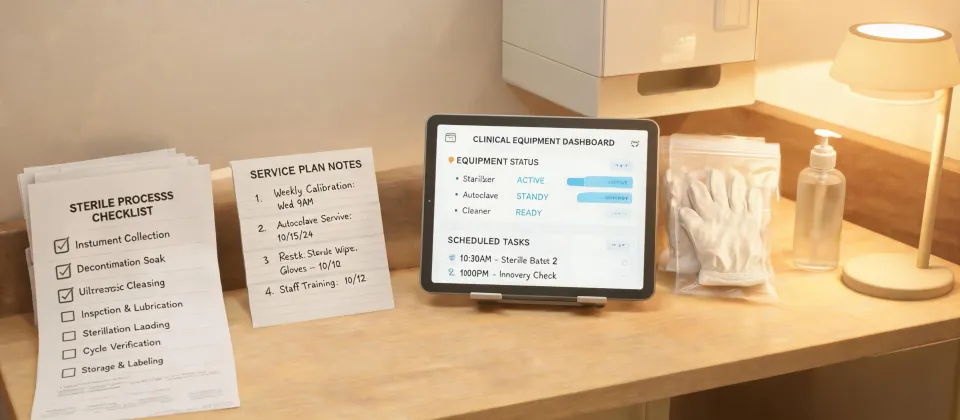
Here's the checklist I use on every STERIS-related purchase:
- Count the actual peak volume. Don't calculate from annual numbers; go look at the daily log. If you have 32 scopes a day at peak, choose the reprocessor that handles that number in one shift.
- Map the room. Confirm dimensions, utilities, floor drains, and doorways. A medical trolley that doesn't fit through the door is not a bargain.
- Collect IFUs for every connected device. For an intraoral scanner, that means the reprocessing instructions for sleeves and attachments. For a washer-disinfector, that means the load configuration validation.
- Ask for installation costs in writing. The lowest equipment quote is not the lowest total cost if setup is extra. In one comparison, the difference between two quotes was $4,200; the "low" quote had $7,850 in unspecified setup, while the "high" quote included site prep. The higher initial quote was $3,650 cheaper in total.
- Check service contract terms before pricing. Response time is not the same as uptime guarantee.
- Use STERIS login before you sign. Pull the service records and documentation for the exact product you're considering. That 20-minute check has saved us from more than one expensive purchase.
- Do a failure-mode review. Ask "If this unit goes down, what happens to our schedule, and what does the backup plan cost?" That's prevention over cure, and it's cheap compared to a cancelled procedure.
Five minutes of verification beats five days of correction. When the failure is compatibility, the rework is always more expensive than the check.
What most people don't realize is that "compatible" and "validated" are not the same word. A device may physically fit on a trolley. That doesn't mean the trolley is rated for the load. A disinfectant may say "safe for plastics." That doesn't mean it won't degrade the plastic over 200 cycles. Ask for written validation data from the manufacturer. If they don't have it, ask why.
I should add a caveat: my experience is based on about 45 capital equipment purchases, mostly in mid-sized facilities. If you're at a 1,000-bed academic center or a large biopharma campus, the weight of these criteria will shift. You might value integration with existing monitoring systems more, or you might have a team that can handle more complex installations. The framework still works, but the numbers will be different.