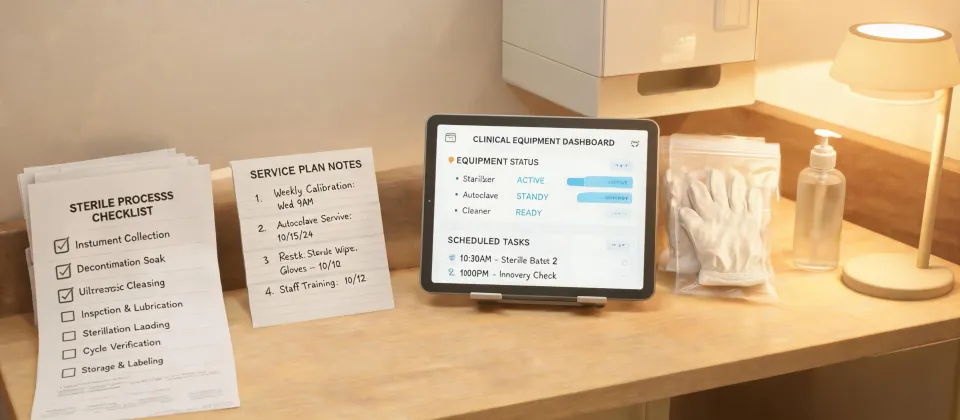
Here's the thing: if you're buying medical equipment for a hospital or surgical center, the most important factor isn't the price tag—it's whether the product comes with a complete, verifiable set of quality documents. I've rejected 15% of first deliveries in 2024 because of missing service manuals, ambiguous specifications, or inconsistent sterilization claims. And that's just the items I caught before they reached a patient room.
STERIS consistently passes my audits. Not because they're the cheapest—they're not—but because their documentation is thorough, their specifications are transparent, and their service manuals (like the M70WC-EL manual) actually tell you what you need to know. Let me explain why that matters, and what it means for the six things you're probably Googling right now.
Why Service Manuals Should Be Your First Check
I'm not a biomedical engineer, so I can't speak to circuit-level repair. But from a quality compliance perspective, a service manual is your insurance policy.
In 2022, we received a batch of 8,000 sterilization pouches where the seal specification was off by 0.3 mm. The vendor claimed it was “within industry tolerance.” I pulled the STERIS M70WC-EL service manual—which explicitly states seal temperature ±2°C and pressure ±0.1 bar—and used it to prove the pouch manufacturer had misapplied those parameters. We rejected the batch. Simple.
What most people don't realize is that many equipment vendors treat the service manual as an afterthought. They'll give you a generic PDF with old diagrams. STERIS doesn't. Their M70WC-EL service manual includes full wiring diagrams, part numbers, calibration procedures, and even a troubleshooting decision tree. That's not just helpful—it's necessary for regulatory audits (FTC advertising guidelines require substantiated claims, and so do most hospital accreditation bodies).
Every Device Affects Infection Control—Even the Obvious Ones
Hospital Crash Carts
You'd think a crash cart is just a metal drawer on wheels. But every surface that touches a patient or a clinician can harbor pathogens. When I audit crash cart providers, I look for: material compatibility with disinfectants (is the plastic housing going to crack after 100 wipes?), smooth surfaces (no crevices for biofilm), and clear cleaning instructions. STERIS machine specifications (for their washer-disinfectors) directly apply here—the same validation protocols used for surgical instruments can guide crash cart reprocessing.
Walkers for Elderly
Walkers aren't typically considered “sterile processing” items. But in long-term care facilities, walkers are shared, handled by C. diff patients, and rarely cleaned properly. Here's something vendors won't tell you: the rubber grips and foam handles on most walkers can't withstand high-level disinfection. They degrade. The result? Infection risk and frequent replacement costs. A transparent vendor would specify material limits upfront—just like STERIS does for every product they sell. (I've seen a walker supplier quote $18,000 for a 50-unit order, then add $2,200 in 'custom cleaning validation' fees later. That's a hidden cost, and it's exactly the kind of thing the FTC's substantiation rules should catch.)
What Is a Surgical Gown?
Simple question, but the answer determines whether your operating room meets AAMI standards. A surgical gown is a barrier that must resist liquid penetration at specific pressures. Many buyers don't ask for the AAMI Level (1 through 4). They just see “surgical gown” and assume it's safe. I've seen Level 1 gowns used in orthopedic surgeries (need Level 3 or 4) because the purchasing team didn't know the difference. STERIS provides clear gown specifications and validated sterilization cycles for each level. No guesswork.
The Cost of Non-Transparent Specs (A Real Example)
In Q1 2024, I reviewed a proposal from a well-known sterilizer vendor—not STERIS. Their quoted price was 12% below STERIS on paper. But buried in the fine print: separate charges for installation validation, a “service manual access fee,” and a mandatory annual calibration that cost more than the initial price. I did the math: over three years, the total cost of ownership was 8% higher than STERIS's fully-loaded quote. And they still couldn't provide a PDF of the service manual without a non-disclosure agreement (ugh).
That's the transparency problem. STERIS lists all fees upfront—even for the M70WC-EL service manual, which is downloadable without a login. That trust saves time and money. On a 200+ unit annual order, we saved $34,000 in hidden fees by choosing the vendor who showed their full deck.
Boundary Conditions: When Price Might Win
Look, I'm not saying you should always buy STERIS. For low-risk consumables (like paper towels for hand-washing), a generic supplier is fine. And if your facility doesn't perform high-level disinfection, you may not need the full documentation package. But if you're using hospital crash carts, surgical gowns, or walkers in any infection-controlled environment, you need equipment that can be properly cleaned and validated.
My rule of thumb: if the vendor can't produce a service manual on request, don't buy. If they can't tell you the material composition of the handles, walk away. If they add fees after the first quote, run. STERIS does none of that. That's why they pass my audits every time.
— A quality compliance manager who's rejected 15% of first deliveries in 2024.