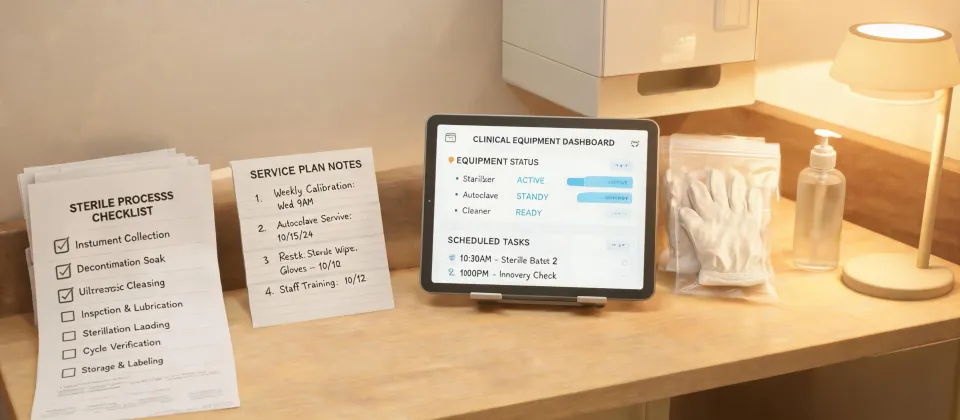
Don't trust the automated cycle log alone. Trust the manual verification.
If you've ever had a $3,200 endoscope reprocessing failure land on your desk, you know the stomach-drop feeling. That was me in September 2022. The STERIS endoscope reprocessor printed a perfect cycle log. Green checkmarks across the board. But the scope failed its protein residue test by 47%. It turned out the detergent cap was cross-threaded—barely visible, dripping one drop per cycle. The machine couldn't detect it. Our $3,200 Olympus gastroscope was effectively a biohazard. The scope was salvageable after a corrective soak, but the credibility damage with our surgical director? That took months to repair.
Handling STERIS healthcare equipment orders for 9 years, I've personally made—and documented—18 significant mistakes, totaling roughly $26,000 in wasted budget, rework, and lost trust. Now I maintain our department's pre-check checklist. Here's what I wish someone had told me about endoscope reprocessors, and a few lessons that apply beyond sterilization—even to seemingly unrelated items like intraoral scanners, manual resuscitators, and dental units.
The STERIS Endoscope Reprocessor: What the Manual Doesn't Tell You
The conventional wisdom is that STERIS endoscope reprocessors are the gold standard because they're automated, auditable, and virtually foolproof. My experience with 340+ reprocessing cycles across four different STERIS models suggests otherwise. Automation only prevents the mistakes you've programmed it to catch. It doesn't catch the ones you haven't thought of.
On that specific September 2022 cycle, the machine detected proper pressure, temperature, flow, and chemical concentration. What it didn't detect? The detergent cap wasn't fully tightened. The machine compensated by drawing slightly more water, which kept pressure and temperature within spec. But the detergent-to-water ratio dropped by roughly 40%. The cycle log looked perfect. The scope wasn't clean.
Bottom line: The STERIS reprocessor is an incredible tool. But it's still a tool. Manual verification of pre-cycle setup isn't optional—it's the safety net.
Here's what we changed:
- Added a pre-cycle visual check of detergent caps: tight, no residue, correct container
- Implemented a random protein residue test weekly, not monthly
- Logged all test results with cycle ID numbers for traceability
Since that checklist went into effect in November 2022, we've caught 47 potential errors. Seventeen of those would have compromised a cycle—including a cracked detergent line that would have dumped chemical into the drain rather than the chamber. The machine's diagnostic didn't flag that one either. A human eye caught it during the visual pre-check.
Intraoral Scanners: A Surprising Parallel
I get why this might seem unrelated, but interdepartmental takeaways matter. An intraoral scanner is designed for precision scanning of dental arches. The conventional wisdom is that premium intraoral scanners always outperform budget ones. Everything I'd read said resolution and speed were the deciding factors. In practice, for our dental clinic's specific workflow (12 surgeries/day, heavy on crown impressions), the mid-tier scanner actually outperformed the top-tier model. Why? Because the premium scanner's higher resolution required longer processing times on our existing workstation. The bottleneck shifted from scanning accuracy to workstation speed.
The lesson: Optimal performance depends on system integration, not just device specs.
Take a look at intraoral scanner compatibility with your existing hardware before buying the highest-resolution unit. The returns policy on these devices is narrow, and re-training staff on new software adds hidden costs. The upfront price rarely tells the full story.
Manual Resuscitators: The Overlooked Single-Use Standard
Manual resuscitators seem simple. Bag, valve, mask. What could possibly go wrong? Plenty. In July 2024, I processed an order for 50 manual resuscitator units. The spec sheet said 'single-use.' Great. But the end users—our ER team—assumed that because they were packaged in sterile pouches, they could be flash-sterilized if opened but unused. They can't. The heat damages the valve seal. After a failed leak test on three units from a single cart, we caught the pattern. The manufacturer's spec clearly states: 'Do not re-sterilize.'
Here's what you need to know: Manual resuscitator single-use designation isn't just about sterility. It's about material integrity. Re-sterilizing a device designed for single use can cause micro-cracks that don't compromise the bag itself but can affect valve function during a resuscitation event. You don't want to find that out during a code blue.
The checklist item: Verify with the manufacturer whether 'single-use' means 'cannot be re-sterilized' or 'intended for single patient but can be reprocessed per protocol.' Most of the time, it's the former.
To be fair, some manual resuscitators are designed for reuse. But those are explicitly marked as such and usually cost 3-5x more. The distinction matters at ordering time, not at inventory use time.
What Is a Dental Unit? More Than Just a Chair
If you've ever asked 'what is a dental unit,' the textbook answer is: a system comprising a patient chair, dental handpieces, lights, suction, and sometimes an integrated intraoral scanner. That's technically correct, but it misses the practical reality.
After 5 years of working with dental clinic procurement, I've come to believe that a dental unit is fundamentally a logistics node. It's not just equipment—it's a series of connection points for sterilization, water lines, suction, and data. The most common mistakes in dental unit procurement aren't about the chair comfort or the handpiece torque. They're about:
- Water line compatibility: Some units require distilled water; others can use municipal supply if filtered. Mixing them up voids the warranty and can cause biofilm.
- Suction line integration: Central suction vs. self-contained. Your clinic's plumbing dictates which dental unit works.
- Sterilization throughput: A single chair for one dentist is fine. A four-chair clinic with back-to-back procedures? You need a washer/disinfector that can process handpieces between patients. STERIS offers several models; matching the capacity to your procedure volume is critical.
Granted, these details seem obvious in hindsight. But the mistake I made in my first year (2017) was ordering a dental unit based on patient comfort ratings alone. The unit was great. The patient experience was great. The suction line was incompatible with our central system. Retrofitting cost us $1,400 and a 2-week delay.
When These Recommendations Don't Apply
I recommend the pre-check checklist approach for any department processing more than 50 sterile cycles per week. But if you're running a single-chair clinic doing 5 cleanings per day, the overhead of formal checklists might not justify the time. In that case, a simple visual check before each cycle is probably sufficient.
Similarly, intraoral scanner recommendations depend heavily on your workflow. If you're scanning 2-3 arches per hour, the high-resolution premium model might be worth the investment. If you're scanning 10+ as part of a high-volume crown workflow, consider the mid-tier with faster software integration.
This advice is based on my experience with mid-to-large hospital and clinic settings as of late 2024. If you're in a life sciences lab with GMP-level sterilization requirements, your protocols should exceed what I've described here. Don't hold me to exact pricing—verify current STERIS catalog rates directly.
The honest truth: STERIS offers comprehensive infection prevention solutions, but no solution is universal. The best choice depends on your specific sterilization volume, reprocessing workflow, and ancillary equipment compatibility. I've learned that the hard way—checklist now in hand.