If your question is “what is a surgical light?”, here's the shortest answer: it's not just a bright lamp. It's a specialized illumination system designed to keep shadows out, keep tissue colors accurate, and keep heat away from the patient. If you're making a buying decision, that difference matters a lot more than the word “light” suggests.
Before I go deeper: I'm not a surgeon, and I'm not a sales rep. I coordinate urgent equipment and parts orders for hospitals, surgery centers, and clinics. For the past eight years, I've handled—I'd estimate—more than 300 rush requests, including overnight deliveries and same-day installations for facilities that couldn't cancel morning surgeries. I don't wear scrubs. But I do know where equipment fails, and I know what questions to ask before it does.
What a surgical light actually does
At the simplest level, a surgical light hangs above the operating table or procedure area and helps the team see. But good surgical lights solve several problems at once.
- Shadow control. When a surgeon's hands, an instrument, or someone's head gets in the way, the light has to keep working. Better designs reduce shadows by overlapping light from multiple directions.
- Color accuracy. Tissue color tells the team a lot—healthy versus compromised tissue, for example—so the light needs balanced color rendering. If colors look wrong, clinical judgment gets harder.
- Heat management. Older lighting technology could make the surgical site uncomfortably warm. Modern LED-based lights produce light without as much radiant heat, which is better for everyone involved.
- Stable positioning. The light should move easily into position and stay there without drifting.
These aren't just nice-to-have specs. Standards like IEC 60601-2-41 exist for surgical lights for a reason, and your biomed or facilities team can walk you through the details. What I can tell you from the operations side is simpler: no spec sheet tells you whether a light will be easy to clean, easy to maintain, and serviceable a few years from now. That's where real quality shows up.
What a surgical light has to do with sterile processing
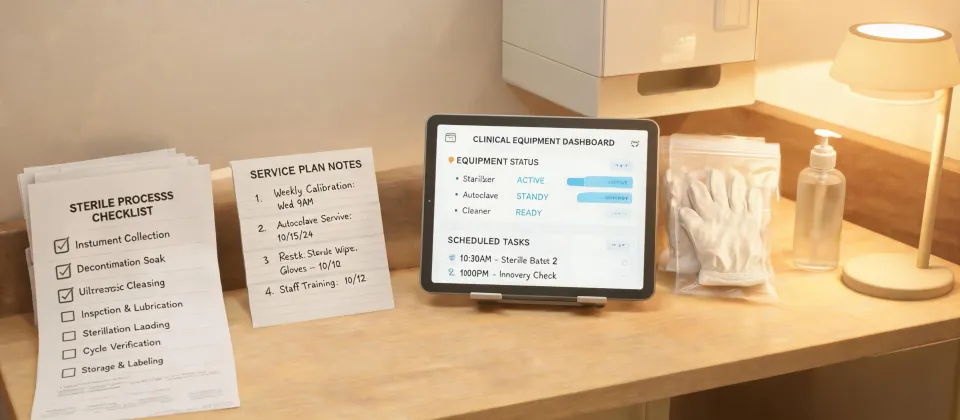
You don't hang a surgical light in a vacuum. It goes into a room where a sterile processing department is responsible for cleaning and sterilizing the instruments used under that light. In my experience, surgical equipment decisions work best when they're made with the whole chain in mind.
Here's an example. In March 2024, a client called me at 2 p.m. on a Wednesday. Their main OR surgical light was flickering, and they had a procedure scheduled for 7 a.m. the next morning. The surgeon had already said no cases until the light was fixed. We found a compatible replacement head, arranged an after-hours delivery, and had a technician finish the install around 11 p.m. Good outcome—but what stuck with me was a comment from the OR manager. She said, “The light was the crisis, but it's not the only thing that keeps us running.” She was thinking about scopes, washer-disinfectors, and instrument room staffing. All the links that have to work before a patient ever sees the light.
That's why I now put surgical lights in the same conversation as products that don't look related at first. The STERIS Scope Buddy Plus, for example, is a containment and transport system for flexible endoscopes. It lets staff secure a contaminated scope at the point of use and get it safely to decontamination while helping support leak testing. Not glamorous. But if scopes can't get from the procedure room to the sterile processing department safely, it doesn't matter how good your lighting is.
Questions I get about the rest of the chain
Since you may be here for a broader OR and SPD answer, let me cover a few related searches I see in my queue every week.
What is a sterile processing department?
The sterile processing department—often called SPD or central sterile—is the hospital hub that cleans, disinfects, checks, assembles, packages, and sterilizes reusable medical devices. Surgical instruments are decontaminated in automated washer-disinfectors, then inspected, assembled into sets, wrapped or contained, and run through sterilizers. It's not a glamorous department, but it's the engine room of every surgical program.
What about a lab washer in the SPD?
If you're searching for something like “STERIS parts lab washer,” you probably don't need a definition. A washer-disinfector in the decontamination area is down, and you're trying to get parts fast. When I'm triaging an urgent order like that, the first question is never the part number. It's the schedule: when is the next case, and can anyone install the part safely before then? Have your model and serial number ready, check whether your facility has a service contract, and confirm whether a trained tech can do the replacement. A part sitting in receiving doesn't restore your day.
Are disposable items like IV catheters reprocessed?
No. This is a common point of confusion. Single-use items—a peripheral IV catheter, for example—come sterile from the manufacturer, are opened for one patient, and are disposed of according to hospital policy. They don't go through the washer or sterilizer. Knowing which devices belong in the reprocessing loop and which don't is one of the most important boundaries in infection prevention.
The real quality lesson from my side of the counter
I didn't always think about quality in terms of perception. For years, my default answer to “which part should we order?” was the one that fits and ships fastest. In early 2023, a facility taught me the difference. They'd bought a discount replacement seal for a washer-disinfector to save about $400. The seal failed a leak test, the machine was down for an afternoon, and several surgical instrument sets had to be run through a backup unit. The total cost of that “saving” was many times the original amount. And the real damage wasn't just financial. The SPD manager told me her team felt like they couldn't trust the equipment anymore.
That's the thing about quality in healthcare. It's not about buying the most expensive option. It's about making equipment dependable enough that people don't have to think about it. When a surgical light works, nobody notices. When a washer-disinfector works, nobody notices. The moment it fails, everyone notices—and that's when you've spent more than money.
Where I'm going to stop
I'm not a surgeon, an infection preventionist, or a biomedical engineer, so I'm not going to tell you which specific surgical light model belongs in your OR. That decision depends on the size and layout of your room, the procedures you perform, your team's preferences, and a long list of clinical factors. What I can tell you from years of triaging urgent equipment needs is this: ask the cleaning and service questions early, buy from a partner that supports the whole workflow, and include the OR manager, SPD lead, biomed team, and infection preventionist from day one. The equipment choice gets easier when everyone is talking about the same chain.