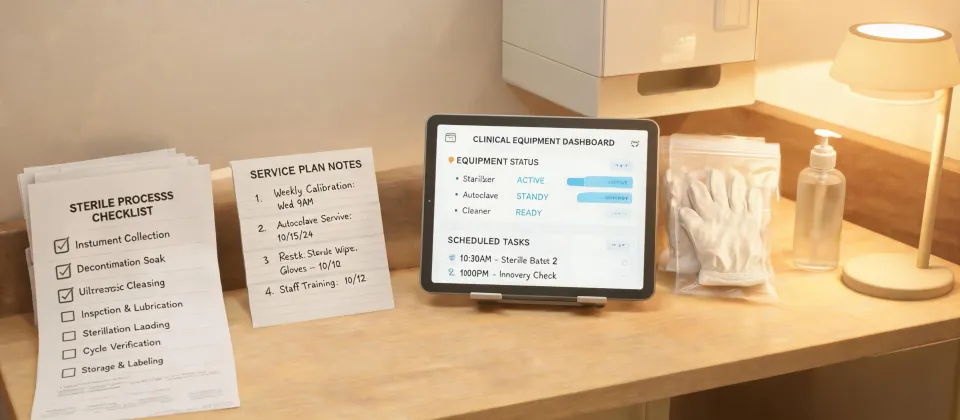
If you manage any STERIS warming cabinet, the most useful sentence I can give you is this: find the exact model number on the nameplate before you request or download a service manual PDF. The manual for one STERIS product family will not always cover another. I learned that after a failed temperature audit and a $2,900 service call, and it was not STERIS's fault.
This article is part STERIS company overview, part field checklist, and part apology to the technician who had to explain the difference. If you searched for a wearable ECG device, a continuous glucose monitor, or how to use a nebulizer instead, stay here for a minute. The core mistake is the same: people skip official instructions because they assume the device is simple enough that documentation does not matter.
Why I'm giving this advice
I don't sell medical equipment. I coordinate it. For seven years, I've handled service documentation, preventive maintenance schedules, and vendor visits for hospitals and outpatient surgery centers. Along the way, I've personally made and documented 11 significant mistakes. They added up to roughly $47,000 in wasted labor, delayed schedules, and repeat audits. That is not a credential I'm proud of, but it's why people now ask me to build checklists.
Please read that as field experience, not a fancy business title. I have had a STERIS tech on the phone explain, in a very patient voice, why the manual I downloaded did not match the cabinet in front of me. I don't want you to make the same call.
STERIS company overview, minus the marketing deck
If you need a STERIS company overview for healthcare industry decisions, this is the part I care about: STERIS is a global healthcare technology company with a large installed base in infection prevention and surgical environments. Its portfolio is not one machine; it is the set of machines around a patient before and after procedures.
In an average hospital, I see STERIS equipment in four main areas:
- Sterile processing and decontamination: steam and low-temperature sterilizers, washer disinfectors, and endoscope reprocessors.
- The surgical environment: surgical tables, surgical lights, booms, and related operating room equipment.
- Patient support areas: warming cabinets, case carts, and similar devices.
- The service layer: preventive maintenance programs, replacement parts, operator training, and service documentation.
You will also see older AMSCO badges on equipment in some facilities. That does not mean the equipment was made by an unrelated manufacturer. AMSCO is now part of STERIS, and legacy models are still supported through STERIS service channels. If a search returns only an operator manual for an older model, call STERIS support with the model and serial number. Don't assume the full service manual is public.
Why the STERIS warming cabinet service manual PDF matters
Warming cabinets look boring. They sit in hallways, hold basins and blankets, and their daily alarm usually means the door stayed open. That boring exterior hides a simple but important job: keep contents at the temperature the clinical staff expects. A failed temperature audit does not care whether the unit is only a warmer. It cares whether your process can be trusted.
The line between operator manual and service manual is important, too. An operator manual covers normal use and cleaning. A service manual covers calibration, alarms, parts, and preventive maintenance. If your facility has a biomed department, ask STERIS which documentation level your team qualifies to use. If you only need the operator manual, searching only for the phrase service manual PDF may give you a document that is more technical than your staff actually needs.
The specific mistake I made
In September 2021, my team was scheduled to do preventive maintenance on two warming cabinets in a newly renovated surgical suite. One unit had a legacy AMSCO nameplate; the other was a newer STERIS design. The two looked almost identical from the outside. I pulled the service manual for the older model and used it for both.
The newer cabinet failed a temperature audit two weeks later. The service tech found that the door gasket had lost its seal. That was not the worst part. I had already ordered the wrong replacement gasket because the parts list in my manual was for the older generation. The correct STERIS manual existed. I just hadn't verified the model revision.
That mistake cost $2,900 for an expedited service visit and delayed the start of a minor procedure schedule. The preventive maintenance checklist in the correct manual would have flagged the door gasket check during the PM.
What I do now
- Photograph the nameplate. I need the full product model and serial number, not just the word STERIS.
- Search the official STERIS product documentation or support site using the exact model string. I do not start with a random third-party PDF.
- Check the document revision and date. If a PDF is not controlled by the manufacturer, I do not rely on it for part numbers.
- Store the PDF with the model number and serial number in the filename. In the CMMS, I attach it to the correct asset so the next PM starts from the right document.
When I do not find a public PDF, I call STERIS support and ask who is authorized to receive the full service manual. That is not a defeat. It prevents the wrong-manual problem from coming back.
What wearable ECG, continuous glucose monitor, and nebulizer searches have in common
If a STERIS company overview brought you here but you actually need patient monitoring or home equipment information, I get it. Healthcare product research rarely stays in one category. The pattern that made me write all this down applies to almost every device in your building: read the official manufacturer instructions before you design training around a product.
A wearable ECG device is a good example. Some wearable ECG devices are cleared for detecting certain arrhythmias. Others are marketed as wellness devices and are not intended for diagnosis. The intended use statement in the instructions tells you which one you are holding. That distinction matters when a physician is deciding whether the data is clinically meaningful.
A continuous glucose monitor has its own language. A CGM sensor sits in interstitial fluid, not in blood, so its reading can lag behind a fingerstick glucose value during a rapid change. Some systems require user calibration; others are factory calibrated. The labeling states wear time, sensor placement, and conditions that can interfere. If you skip that part, you will discover the limitations later, usually at the worst possible time.
How to use a nebulizer, in outline
I am not the clinician who should teach your patient to inhale prescribed medication. But the documentation habit applies here too. If someone asks me how to use a nebulizer, I give them the steps that most manufacturer instructions share:
- Clean your hands and assemble the compressor, tubing, medication cup, mouthpiece, or mask.
- Put the prescribed dose of medication into the nebulizer cup. Use only the dose supplied by the pharmacy, and do not mix medicines unless the prescriber or pharmacist confirmed compatibility.
- Place the compressor on a hard, level surface. Sit upright, keep the nebulizer cup vertical, and attach the mouthpiece or mask.
- Turn on the compressor. Breathe calmly. With a mouthpiece, try slow, deep breaths. With a mask, a child can often breathe normally because the mist is generated continuously.
- Continue until the medication cup begins to sputter, which is usually after 5 to 15 minutes. Gently tap the cup to collect remaining drops.
- Clean the cup and mouthpiece after every treatment according to the device instructions. Let the parts air dry. Replace the compressor filter when the manufacturer says to.
The step people skip is the last one. I have seen more clinic equipment problems from poor cleaning than from an actual device failure.
Honest limits of my checklist
A service manual does not turn everyone into a technician. Some failures require a certified STERIS service representative, diagnostic software, or manufacturer test equipment. If the document says authorized service personnel only, respect that boundary. An in-house guess based on an unverified PDF can be worse than making no attempt at all.
Also, not every published manual is current. A scanned PDF from an old website may look official, but if you cannot verify the revision date, treat it as a reference, not as the source of truth for parts and procedures.
I am not saying STERIS is the only brand with good documentation. I have bought other equipment too. The pattern I trust is not the brand name on the brochure. The pattern I trust is whether the vendor will give me the manual without behaving as if I am wasting their time.
The size of the purchase order does not determine the size of the risk. A warming cabinet can be a $7,000 item and still cause a costly surgery delay. So find the model, find the current manual, and save it where the next person can actually find it. That one habit is worth more than any checklist template I can hand you.