The short answer: verify four things before you buy
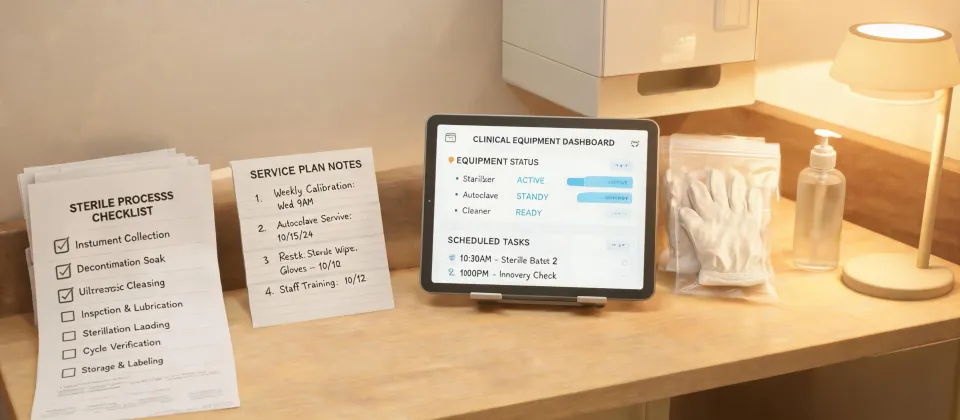
If you are specifying STERIS equipment for nuclear medicine, neonatal care, or patient movement, do not start with the catalog number. Start with four verification points: validated clinical compatibility, audit-ready documentation, written service response, and workflow fit across departments. A STERIS warming cabinet, a STERIS RESI Test, a patient transfer device, and a neonatal incubator may sit at different points in care, but they fail for the same reason: someone assumed the spec instead of verifying it.
What is a neonatal incubator? It is a closed, temperature-controlled bed that maintains a premature or ill infant's thermal environment, humidity, and often oxygen concentration. That matters because it is not a warming cabinet. A warming cabinet warms blankets or fluids. An incubator is a life-support environment. Mixing those categories in a purchase order is how quality problems start.
Why you should trust this checklist
I am a quality and brand compliance manager at a medical equipment distributor. I review every specification sheet, IFU, and delivery packet before it reaches a customer—roughly 200 items annually. Over four years of reviewing deliverables, I have rejected about 22% of first deliveries in an audit year because labeling, documentation, or configuration did not match the approved requirement.
In our Q1 2024 quality audit, we received a batch of warming cabinets where the advertised temperature range was correct on the spec sheet but the recovery time after door openings was not. The vendor called it within industry standard. We rejected the batch and they redid the validation documentation at their cost. Now every contract includes a recovery-time requirement and a documentation checklist.
Here is the thing: most of those problems were not defective devices. They were gaps between what the buyer assumed and what the supplier documented. That is an efficiency problem, not just a quality problem.
The four-point verification checklist
1. Sterilization and STERIS RESI Test: cycle compatibility before price
A STERIS RESI Test is not a stand-alone pass or fail. It is part of a monitoring system. Before you standardize on it, verify the incubator, the cycle, the load configuration, and the lot traceability your sterile processing team will actually use. If the IFU does not clear the cycle you run, the indicator is the wrong tool—no matter how good the unit price looks.
According to the CDC's Guideline for Disinfection and Sterilization in Healthcare Facilities, sterilization monitoring should include physical, chemical, and biological indicators. A biological indicator is one part of cycle validation, not a replacement for it.
In my experience, the overlooked question is not whether the RESI Test works. It is whether our documented cycle matches the validated cycle for this indicator, this load, and this sterilizer. That is where audits get uncomfortable.
2. Nuclear medicine: hot lab workflow and contamination control
Nuclear medicine adds a layer that general surgery does not: radiopharmaceutical handling, shielding, and sterile compounding under USP <825>. Equipment choices that work in a standard sterile processing department may not work in a hot lab. The question everyone asks is what does the warming cabinet cost. The question they should ask is where does it sit in the workflow, who cleans it, and what documentation proves it does not interfere with radiopharmaceutical quality.
Look, I am not saying every nuclear medicine department needs a custom setup. I am saying the risk is higher, so the verification should be tighter. In our 2023 hot lab project, we standardized on STERIS-compatible accessories, but we still created a separate sign-off for anything that entered the radiopharmaceutical prep area.
3. Patient transfer devices and neonatal incubators: the overlooked interface
A patient transfer device is often bought for ergonomics. That is fine, but the hidden risk is the interface: bed height, surface compatibility, brake layout, and cleaning instructions. If the transfer device does not match the incubator or the imaging table, staff improvise. Improvisation is an infection control and injury risk.
The same logic applies to a neonatal incubator. Most buyers focus on the obvious factors—temperature range, humidity, and alarm limits—and completely miss the accessory ecosystem: probe compatibility, warming cabinet procedures, and transfer to the patient bed. What is a neonatal incubator if it cannot safely hand off a patient to the next device? It is a silo. Silos create rework.
We did not have a formal approval chain for accessory purchases. That cost us when a transfer surface arrived with a cleaning agent that was not compatible with our incubator canopies. Not ideal, but workable after a replacement. A lesson learned the hard way.
4. Documentation, training, and service response
Digital efficiency is real. A standardized asset list, digital IFU access, and a single service portal cut our turnaround from five days to two days on routine equipment requests. The automated process eliminated the data-entry errors we used to have. But efficiency only works if the documentation is accurate. I would rather have a slower quote with a complete validation packet than a fast quote with a missing certificate.
From my perspective, the service contract is the most under-read document in capital equipment. Verify response time, parts availability, and who signs off on repair validation. If it is not in writing, it is probably not a commitment.
What I got wrong
I assumed a warming cabinet set to the correct temperature would recover quickly after a door opening. Did not verify. Turned out recovery time mattered more than the set point for our high-volume OR schedule. We kept the units, but we changed the specification for the next cycle.
I went back and forth between standardizing on STERIS and keeping a mixed fleet for two weeks. Standardization offered training, service, and documentation simplicity. The mixed fleet offered a lower initial quote. Ultimately chose standardization because the project was too important to risk. The downside felt catastrophic if validation slipped; the upside was a cleaner audit trail.
Real talk: the cheapest first quote is rarely the cheapest ownership decision. The upside was about $18,000 in first-year savings. The risk was a validation delay in nuclear medicine that could have pushed the hot lab opening by a month. I kept asking myself: is $18,000 worth potentially delaying patient access? In that case, no.
Boundaries: when this checklist is too much
If you are a small clinic buying one warming cabinet for blanket storage, you probably do not need a four-point verification meeting. A simplified check of temperature range, cleaning instructions, and service contact is likely enough. If you are equipping a nuclear medicine hot lab, a Level III NICU, or a multi-department surgical center, the full checklist is the minimum.
Also, this is not a substitute for regulatory review. According to FDA, neonatal incubators are regulated as Class II medical devices and require 510(k) clearance before marketing in the U.S. Verify current requirements with official sources before you sign a purchase order.
Prices? Request a current quote from STERIS or an authorized distributor. Do not use blog pricing for capital medical equipment. Pricing as of January 2025; verify current rates. The same goes for service contracts and validation packages.
If you ask me, the efficient move is not rushing the purchase. It is reducing the number of assumptions. That is what quality compliance really is: fewer surprises after the truck leaves.