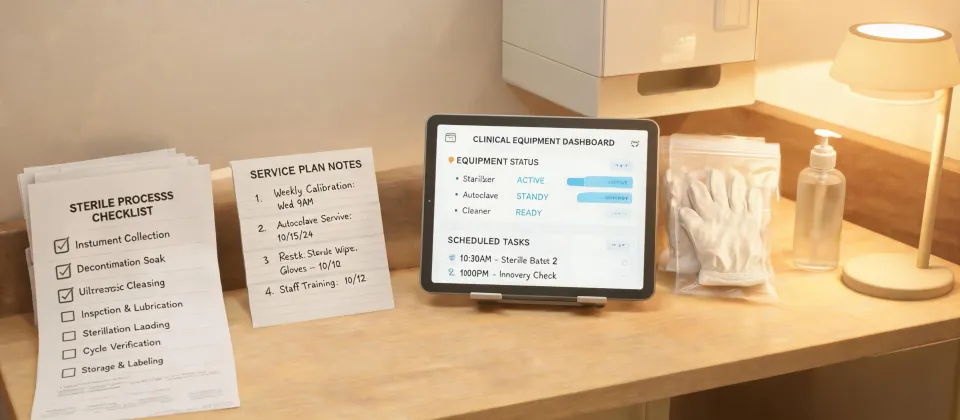
I manage a surgical services procurement budget, and I get the same question from smaller clinics and large IDNs: should we buy a STERIS sterilizer, upgrade our instrument count system, switch surgical gowns, or add medical imaging and an ultrasonic aspirator? There’s no single answer. The right choice depends on your case volume, tray complexity, scope volume, uptime tolerance, and how much regulatory documentation you can absorb.
What I can tell you is that sticker price is the worst way to decide. TCO (total cost of ownership) is the only comparison that hasn’t burned me. But even TCO has to be weighted differently depending on your scenario.
I’m not a sterile processing microbiologist, so I can’t tell you which cycle kills which organism. What I can tell you is how to compare quotes without getting blindsided by service, consumables, utilities, and downtime.
For steam sterilization, AAMI ST79 is the reference most sterile processing managers live by. For device reprocessing instructions, ISO 17664 and FDA guidance are the baseline. The CDC disinfection and sterilization guideline is also there when someone asks why we can’t just wipe something down and call it sterile. I don’t argue with those documents. I argue with vendors about what’s included in the quote.
The three scenarios (and one shortcut)
Shortcut: if your annual surgical volume is under 500 cases, you’re probably Scenario A. If you’re between 500 and 5,000, Scenario B. If you’re above 5,000 or part of an IDN, Scenario C. But volume alone isn’t enough. A 1,200-case neuro/spine center can have more reprocessing complexity than a 4,000-case general surgery center.
Scenario A: Low-volume clinics and office-based surgery
What usually makes sense
For low volume, don’t buy a large STERIS sterilizer just to have the logo on the wall. A tabletop steam sterilizer, validated outsourcing, or a shared service agreement may have lower TCO. A STERIS sterilizer used for terminal sterilization of reusable instruments is excellent—but only if you have the volume, utilities, and trained staff to run it.
My first clinic almost signed an $18,000 steam sterilizer lease because the sales rep made it sound plug-and-play. Then we added installation, water softener, ventilation, annual service, and staff training. The real first-year number was closer to $26,000. That’s not STERIS’s fault; that’s the category. Every sterilizer has hidden infrastructure costs.
Where TCO bites
- Service contract. If I remember correctly, the service plan was around 10–15% of capital per year.
- Utilities and water quality. Steam sterilizers don’t like hard water.
- Validation and documentation. Even small clinics get inspected.
- Surgical gowns. At low volume, disposable surgical gowns usually win. Reusable gowns only pay off with laundry contracts and enough turns.
What I’d do differently
I’d ask for a 5-year TCO sheet before signing anything. I’d also verify that the sterilizer can handle your longest tray, not just your average tray. If you’re doing scopes, don’t assume steam works. Check the device IFU (instructions for use) and ISO 17664. At least, that’s been my experience with low-volume clinics that tried to save money by buying the smallest unit available.
Scenario B: Medium surgical centers and specialty hospitals
This is where the decision gets interesting. You have enough volume to justify capital equipment, but not enough to absorb downtime. You also probably have a mix of steam, low-temperature, and point-of-use reprocessing.
What usually makes sense
Standardize trays and instrument sets before you buy a bigger sterilizer. I know that sounds boring. But a STERIS count surgical instruments system—or any robust instrument tracking/count system—often reduces more cost than a faster autoclave. Missing instruments cause OR delays, and OR delays cost more per minute than most people think.
We went back and forth between a larger steam sterilizer and a low-temperature STERIS V-PRO style unit for two months. The steam unit was cheaper per cycle. The low-temp unit handled heat-sensitive devices. Every spreadsheet analysis pointed to the cheaper steam-only option. Something felt off. Turns out the heat-sensitive scopes would have to be sent out, and the courier cost erased the savings. We ultimately bought both—not because we had money to burn, but because sending scopes out was killing our schedule.
For surgical gowns, AORN surgical attire guidelines matter, but your laundry contract matters more. This is the volume where reusable gowns start to make sense. Run the math with actual laundry cost, replacement rate, and staff compliance. Disposable gowns are simpler; reusable gowns can be cheaper if utilization is high.
Medical imaging is a different beast. If you’re adding a C-arm or MRI, the service contract and uptime guarantee belong in the same TCO model as your sterilizers. A cheap imaging quote with a slow service response can shut down your OR schedule faster than a sterilizer failure.
What usually doesn’t make sense
Buying an ultrasonic aspirator just because it’s on a capital list. If you’re asking what is an ultrasonic aspirator, it’s a surgical device that uses high-frequency vibrations to fragment and aspirate tissue. It’s not an ultrasonic cleaner. If you don’t do neuro, spine, or select hepatic cases, you probably can’t justify the capital, service, and disposable tips. We evaluated one for our general surgery center and the numbers said no. My gut agreed, which is rare.
Another trap: the ‘all-inclusive’ quote that isn’t. The vendor is ‘flexible.’ What I mean is they’ll negotiate if you push. One vendor quoted $42,000 for a sterilizer, then added $3,800 for installation, $2,200 for a year of service, and $1,900 for training. The other quote was $47,000 but included all of it. The ‘cheaper’ option was actually $1,100 more in year one. That’s the kind of fine print TCO is designed to catch.
Scenario C: Large acute-care hospitals, IDNs, and bio-pharma
At this scale, TCO is less about the machine and more about uptime, integration, and compliance. A one-hour sterilizer outage in a large hospital can cancel a day of cases. In bio-pharma, a validation gap can delay a batch.
What usually makes sense
Redundancy. Service response times. Parts availability. Training. If you’re comparing STERIS sterilizers against other vendors, don’t just compare chamber size and cycle time. Compare uptime guarantees, preventive maintenance intervals, and how quickly a tech can be on site. The lowest bid loses when the service tech is four hours away and your only autoclave is down.
Instrument count and traceability systems become non-negotiable. A STERIS count surgical instruments system, or a comparable tracking platform, should integrate with your EHR and sterile processing workflow. If it doesn’t, you’ll pay for it in manual reconciliation and lost trays.
Surgical gowns: standardize across facilities. You can negotiate better pricing on either disposable or reusable if you stop letting every department choose its own. Medical imaging: get service level agreements in writing. Uptime credits matter.
Where the lowest bid loses
I’ve seen a low bid for sterilizers win a contract, then lose $180,000 in OR downtime over two years. The equipment was fine. The service was not. That’s why my procurement policy now requires a service response matrix for any capital equipment over $50,000. It includes response time, parts availability, escalation path, and downtime credits.
For bio-pharma, add validation documentation to the TCO. ISO 17664 and FDA reprocessing guidance are not optional reading. If the vendor can’t provide validation support, your internal costs go up.
How to tell which scenario you’re in
Ask these six questions before you request quotes:
- How many surgical cases do you run per year, and how many involve implants or complex trays?
- How many flexible endoscopes or heat-sensitive devices do you reprocess daily?
- What’s your tolerated downtime? One hour? One shift? One day?
- Do you have an instrument count/tracking system, or are you still using paper?
- Are you buying surgical gowns by department or as an organization?
- Do you need medical imaging, ultrasonic aspirator, or other specialty capital that shares service and uptime risk?
Then build a 3-year TCO spreadsheet. Include purchase price, installation, utilities, consumables, service contract, repair parts, training, validation, downtime risk, and disposal. I use a simple weighted score: 40% TCO, 25% uptime/service, 20% clinical fit, 15% compliance/documentation. That’s not science. It’s just better than arguing about sticker price.
If you’re still unsure, start with the bottleneck. Is your bottleneck sterilization capacity, instrument counting, OR turnover, or specialty case capability? Buy for the bottleneck, not for the brochure.
The bottom line
There’s no universal answer. A low-volume clinic should not buy the same STERIS sterilizer as a 20-OR hospital. A medium surgical center may get more value from a count system than a faster autoclave. A large IDN should care more about service response than a 5% discount. And an ultrasonic aspirator? Only if the case mix supports it.
If you want a place to start, calculate TCO per case, not per machine. That one shift has saved me more budget than any negotiation tactic.