-
1. Which STERIS contact should I use, and what details should I have ready?
-
2. Why do I need the STERIS sharpness test kit? I can see if a blade is dull.
-
3. How do I build cleaning checks for equipment that isn’t autoclaved—like a dental CBCT or an infant warmer?
-
4. What are dental loupes, and why do they belong in a sterile processing conversation?
-
5. What one quality habit has made the biggest difference in reducing rework?
I’m a quality reviewer at STERIS—not the person who installs equipment, but the person who reviews the manuals, service workflows, and verification steps that come with it. Over the past four years, I’ve gone through roughly 200 equipment files per year. This FAQ collects the questions people usually ask after the sales demo is over, once they’re trying to actually put a quality plan into practice.
1. Which STERIS contact should I use, and what details should I have ready?
The fastest way to get a useful answer is to go to the official STERIS contact page and choose the category that matches the request: service, capital equipment, documentation, or consumables. That sounds like a minor detail, but the routing matters. When a request goes through the wrong general form, it usually ends up with the wrong queue, and you lose a day or two of email tag.
What I tell every customer is to have the model number and software version in the first message. Attach a photo if the question is about an installation or a physical connection. The service representative will ask for those anyway, so the photo simply makes the first response more specific. If you don’t know the model number, you can find it on the device label or in the original quote—before contacting, not after.
2. Why do I need the STERIS sharpness test kit? I can see if a blade is dull.
Visual inspection is necessary, but it isn’t enough. Some problems are visible at one angle and invisible at another: a rolled edge, a small burr, an uneven cutting jaw. The classic failure is a biopsy forcep that “looks fine” under a light and still tears tissue because the jaw doesn’t cut cleanly along the whole edge.
We tested this in our QA lab a while ago. Two experienced inspectors evaluated twenty used biopsy forceps by sight. They flagged one as questionable. When the same forceps went through the STERIS sharpness test kit, six failed the cutting test. Six out of twenty. I won’t pretend every facility will see the same percentage, but it changed how we think about visual checks.
Sharpness testing is not a substitute for cleaning and inspection. It’s an extra point in the workflow, usually after cleaning and before sterilization. The goal is prevention: if a blade is failing, you catch it before the tray leaves the department, not after a clinician opens a kit.
3. How do I build cleaning checks for equipment that isn’t autoclaved—like a dental CBCT or an infant warmer?
This is one of the most common gaps I see. An instrument like forceps goes through a washer-disinfector and sterilizer, so it’s obvious that there’s a reprocessing step. But a dental CBCT machine and an infant warmer aren’t immersed in anything; people tend to wipe them down and call it done. That can work, but only if you follow the right protocol.
For both types of equipment, the starting point is the manufacturer’s IFU. A dental CBCT has patient contact surfaces—the chinrest, the bite block, the positioning handles—that need cleaning and low- to intermediate-level disinfection, not steam sterilization. An infant warmer has a mattress, mattress accessory, and temperature probe that may require similar treatment. Some accessories can be sterilized; many cannot. You need to know which is which.
In our review process, we ask for the specific disinfectant and contact time listed in the IFU. I often see people wiping a surface and then immediately wiping it dry before the required dwell time. That defeats the disinfection step. The fix isn’t a fancier chemical; it’s a checklist that says “leave wet for the time printed on the label.”
4. What are dental loupes, and why do they belong in a sterile processing conversation?
Strictly speaking, dental loupes are magnifying lenses worn like eyeglasses. They’re common in dentistry and microsurgery, usually with 2.5x to 6x magnification. Ask most people what they’re for, and they’ll say “seeing better during treatment.” That’s true, but the same principle applies to instrument inspection.
I recommend loupes to sterile processing technicians as much as to dentists. A 2.5x loupe reveals the small stuff that regular eyesight misses: leftover adhesive under a hinge, a hairline crack in an insulated instrument, discolored residue on a serrated edge. It’s the cheapest quality upgrade I know. You don’t need to buy expensive surgical loupes for inspection; a basic pair with good working distance is enough.
To be fair, loupes are not a replacement for cleaning verification or sharpness test kits. But when we added them to our inspection bench, our technicians caught visible debris on instruments that had already passed under standard ceiling lights. That’s the kind of small fix that prevents a larger failure later.
5. What one quality habit has made the biggest difference in reducing rework?
A release checklist. It sounds boring until you’ve lived through a week of rework caused by a missed cleaning step.
Early on, I was skeptical of adding another form to the workflow. A colleague warned me to always verify the finished tray against the order sheet before releasing it. I didn’t watch closely enough, one tray went out with a bent scissor blade, the OR called within two hours, and the case had to be paused. That small skip cost us an entire afternoon and a very uncomfortable email.
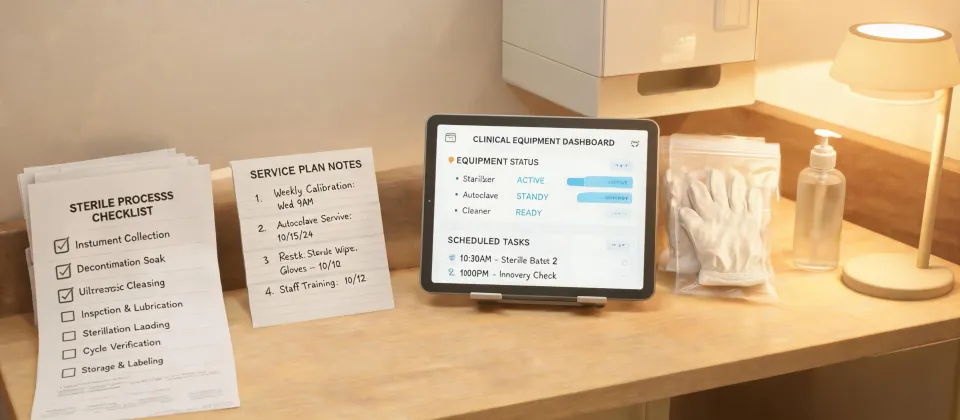
The checklist doesn’t have to be long. For a typical load, it can cover: cycle parameters, load contents, visual inspection under magnification, sharpness test for cutting instruments, and confirmation that non-autoclaved equipment—like a CBCT or warmer—has been wiped with the correct contact time. Five minutes of verification beats five hours of correction. I’ve seen the difference in our error logs; I’d rather check one extra time.