Most Quality Problems Are Designed In, Not Shipped In
Here's a position that doesn't win me friends at trade shows: if a defective product reaches your dock, you already failed somewhere upstream. Not the vendor. You.
Look, I've been on the receiving end of bad shipments for most of my career. Sterilizer components with misaligned door gaskets. A batch of surgical staplers where the firing trigger tension was off by 12% against our Internal Standard QS-14. A pulse oximeter run that passed functional testing but failed our cosmetic uniformity audit. Every single one of those rejections traces back to a spec document that was vague, rushed, or copied from a previous order without review.
That's the thing about prevention versus cure in medical equipment: by the time the cure is needed, you're already eating the cost.
The $18,000 Spec I Approved in 20 Minutes
The event that changed how I think about verification happened in March 2023. We were onboarding a new line of endoscope reprocessing accessories, and I had a window of about two hours to approve the technical specifications before the purchasing team locked the PO. Normally I'd walk the spec against three reference documents—our internal standard, the manufacturer's data sheet, and at least one historical order with known-good outcomes. There was no time.
Went with the manufacturer's spec as written. Didn't cross-check the connector threading dimensions against our existing reprocessor fleet.
You can probably guess what happened next. The first delivery was 200 units of what turned out to be a thread pitch that was "compatible" on paper but required an adapter we didn't stock. That adapter cost $11 per unit and added four days to every install. Total rework and delayed deployment: roughly $6,400, plus a very uncomfortable conversation with the clinical engineering team.
Looking back, I should have pushed back on the timeline. But with the department head waiting for Q1 numbers, I made the call with incomplete information. The 20 minutes I didn't spend checking the spec cost us a full week of schedule slip.
The Checklist That Shouldn't Have Been Necessary
After the third rejection in eighteen months, I stopped treating spec verification as a bureaucratic step and started treating it as the actual work.
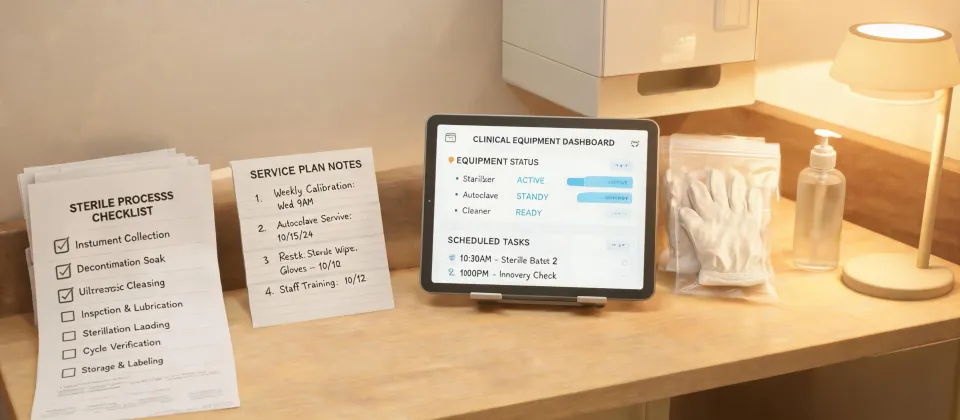
I built a 12-point verification checklist. Nothing sophisticated. It asks the questions that seem obvious until you're under time pressure: Does the model number in the spec match the model number in the quote? Are the dimensional tolerances expressed in the same units across both documents? Does the referenced standard—ISO 17664 for reprocessing validation, for instance—actually apply to the intended use case?
That checklist has caught at least four near-misses in 2024 alone. One involved a sterilization system order where the spec referenced the Steris AMSCO 250LS manual, but the operators had been trained on an earlier revision of the manual's load configuration section. The difference was a shelf placement pattern that affected cycle validation. We caught it before the order went to production. Had we not, we would have been looking at a re-validation study costing somewhere in the five-figure range.
5 minutes of verification beats 5 days of correction. Every time.
Why "It's Within Industry Standard" Is Not Reassurance
The single most common pushback I get when I reject a spec is the phrase "this is within industry standard."
Here's the thing: industry standard is a floor, not a ceiling. If your specific application requires the handle of a dental handpiece to survive 500 autoclave cycles without surface degradation, and the manufacturer's data sheet only confirms 250 cycles, you're not covered by "industry standard." You're covered by your own spec, or you're not covered at all.
The Steris surgical instrument catalogue is a good example of how this plays out in practice. The catalogue lists product families and general capabilities. It does not—cannot—account for every hospital's specific sterilization protocol, water quality, or throughput demands. Those variables live in your spec, and if your spec is vague, the catalogue becomes the default. That's a problem.
I've rejected spec submissions where the entire description of a stainless steel instrument tray read "stainless steel tray, standard size." That's not a spec. That's a wish.
The Cost of Being "Difficult"
To be fair, the pushback isn't always wrong. I've been called a bottleneck. I've been told I'm over-engineering the process. Once, a vendor's rep asked me—genuinely, I think—whether I understood that most customers accept the first version of a spec.
I do understand that. Those customers also tend to be the ones calling me six weeks later asking how to handle a rejection they didn't see coming.
I ran a rough internal analysis in late 2024. Based on eighteen months of rejection data, the average cost of a spec-related rework event—including expedited replacement, clinical engineering time, and schedule impact—was $4,200. The average cost of the verification process that prevented those events? Somewhere between 45 minutes and two hours of my time per spec.
You don't need a spreadsheet to see which number you'd rather manage.
What About Speed?
The most legitimate objection to my position is that thorough verification slows things down. In medical procurement, slower can mean delayed patient care. I take that seriously.
But I'd argue the opposite is usually true. The rework cycle is slower. The rejection-and-reorder cycle is slower. The clinical validation cycle triggered by an unapproved substitution is slower. Verification is the fastest path to a working order, because it's the only path that doesn't include a detour.
That said, I'm not suggesting every order needs the same level of scrutiny. A repeat order for a known-good consumable that hasn't changed specs in three years gets a lighter touch. A first-time order for a new-to-market surgical stapler with a novel firing mechanism gets the full checklist, no exceptions.
Context matters. But the default assumption should be: check first.
What I've Actually Learned
It took me about four years and somewhere north of 200 rejected spec submissions to internalize something that sounds obvious but isn't: the spec is the product. Everything downstream—manufacturing, inspection, shipping, receiving, clinical use—is just a reflection of what you wrote down.
If you write it vaguely, you'll get something vague. If you write it precisely, you'll usually get something precise. And if you think checking the spec is a formality, you're about to pay for that belief in a currency that isn't money.
I've stopped apologizing for the checklist. I've stopped worrying about whether I'm slowing things down. And I've stopped approving specs I haven't read against the actual operational context they'll live in.
Simple. Not always popular. But simple.