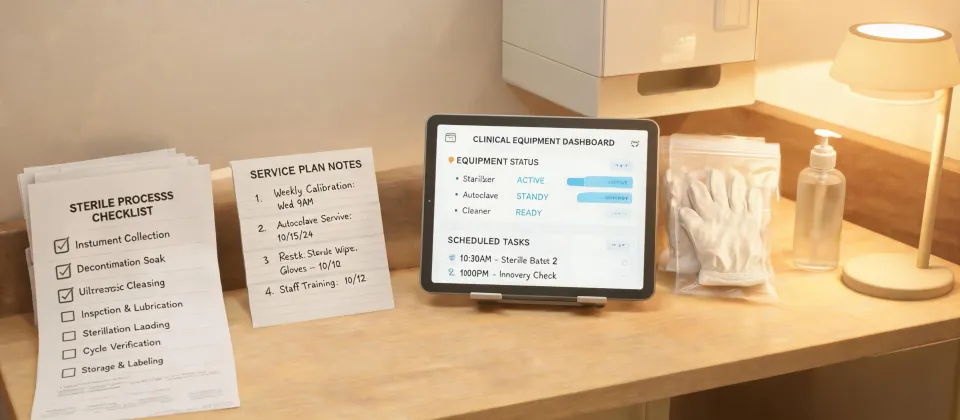
If you're searching for a STERIS dual compartment warming cabinet service manual online, don't. A random PDF is not a service plan. I say this as the person who manages equipment maintenance contracts for a mid-sized surgical hospital and learned the difference after a mistake that cost the hospital roughly $4,800 in avoidable spending.
I'm not a biomedical technician. I'm an administrative buyer. Each year I manage about $1.3 million in equipment service, replacement parts, and vendor contracts across 15 departments, and I report to both operations and finance. I don't open the machines, but I own the purchase order and the follow-up. That matters because a lot of equipment decisions look reasonable in a spreadsheet before anyone looks at the device.
How I learned this the expensive way
Our hospital uses STERIS equipment across the building: washer-disinfectors, steam sterilizers, warming cabinets, and the surgical lights above OR tables. In 2024, during a capital maintenance review, I realized we didn't have the current official service manual for our dual compartment warming cabinet.
The cabinet appeared to be working. Temperature logs looked normal. Daily checks were done. The manual had disappeared during a biomed turnover and supply room reorganization. Rather than request official documentation and schedule a preventive maintenance visit, I did what too many of us do: I searched online, found a scanned copy, and decided it was good enough.
Looking back, the clues were there. The page numbering didn't match the actual control board. But the diagrams looked close, so I pressed forward. When our team tried to perform a preventive maintenance step from that manual, the calibration routine didn't work.
We spent half a day chasing a problem that the official current revision would have prevented. Then we called STERIS service anyway. Accounting for the emergency service call, the replacement sensor, and the lost schedule time, that free manual cost us somewhere around $4,800. The word free was doing a lot of work.
Why official documentation matters in sterile processing
When I hear the phrase STERIS sterile processing, I don't think only about the sterilizer. I think of all the supporting devices that make sterile processing consistent: washers, carts, heat sealers, inspection lights, and warming cabinets. A dual compartment warming cabinet is not just a metal box with a heater. One compartment may hold fluids at one temperature while the other holds supplies at another. It has sensors, timers, alarms, and safety limits. The service manual is the reference for all of them.
In health care, this documentation is not optional decoration. Standards like AAMI ST79 tell facilities to follow the manufacturer's written instructions. If you don't have the right revision, you don't actually know the manufacturer's written instruction. You're guessing.
The same mistake showed up with a surgical light
This lesson isn't limited to a warming cabinet. A few months after the service manual episode, I nearly repeated it with a surgical light. We had a STERIS surgical light in a minor procedure room that needed a new LED board. My first instinct was to search for a compatible replacement part from an online medical parts marketplace because the price was about $2,800 lower than the STERIS quote.
Our clinical engineering director stopped me. He put it simply: “It's not the part that costs you. It's the unknown state of a medical device after you put in the part. If that light flickers in the middle of a deep case, nobody will remember the $2,800 you saved.”
He was right. The immediate result of a non-certified component might be fine. But the risk is not the average result. It's the case where light color, intensity, or focus changes in a way that affects the surgeon's view. At that point, you no longer know whether you're using a STERIS surgical light. You're using a device that was altered outside its intended configuration.
Standards such as IEC 60601-2-41 exist for surgical luminaires for good reason. They address basics like photobiological safety, shadow management, and electromagnetic compatibility. A replacement part that is almost right can still change the performance of the complete device.
The most practical lesson for me: if I'm tempted to buy the cheap version of a component in a medical device, I should ask why the official version costs more. Sometimes it's brand markup. Sometimes it's the engineering and liability that comes with knowing the part actually works inside the device.
What quality actually looks like to a patient
This might sound like an engineering lecture. But consider how quality perception works at the sharp end of health care. A patient who searches for how much are dental implants is comparing more than price. They are also comparing whether the facility feels trustworthy. The procedure room, the staff, and the equipment all influence that feeling. One rattling cart, one flickering surgical light, or one delay caused by an equipment failure can undermine a provider's brand faster than a bad online review.
The same is true for a patient about to receive a prosthetic limb. That is not just an elective piece of hardware. It is a life-changing procedure, and the patient wants the whole system to feel reliable. The surgeon and care team also want the sterile processing chain to be boringly consistent. They don't want an alarm on a warming cabinet to interrupt a case.
For an administrative buyer, this is the case for investing in quality beyond the cost per unit. You can measure the service contract price. You can measure the quote for the original part. You can't easily measure the value of nothing going wrong today. But the absence of failures is exactly what builds a facility's reputation.
What I would do differently
If you are responsible for procurement or maintenance contracts, I'd suggest making a small list before the next equipment review.
- Know where the current manual and IFU live. If you own a dual compartment warming cabinet, a surgical light, or any piece of STERIS sterile processing equipment, one person should be able to locate the current official manual in under five minutes.
- Use official channels to get documents. Call STERIS support or your authorized service provider. Ask for the current service manual and service schedule. If a PDF site is the only place you can find a manual, treat that as a red flag, not a win.
- Calculate the cost of being wrong. Before you approve a third-party manual or part, ask what happens if the device behaves differently during a procedure. The answer will tell you whether the price difference matters.
One more boundary condition: I am not saying every OEM service contract is worth buying. Some independent biomed teams do excellent work and are properly trained. The issue is not who touches the equipment; it's whether that person has the correct manufacturer documentation and knows how to use it.
And a final caveat: this article is not the STERIS service manual for a dual compartment warming cabinet. It's also not a substitute for a qualified service engineer. If you're staring at a website that promises a free STERIS dual compartment warming cabinet service manual, step back. The file that looks free at nine in the morning can turn into a very expensive problem by the end of the month. I learned that the boring way, from the purchase-order side of the table.