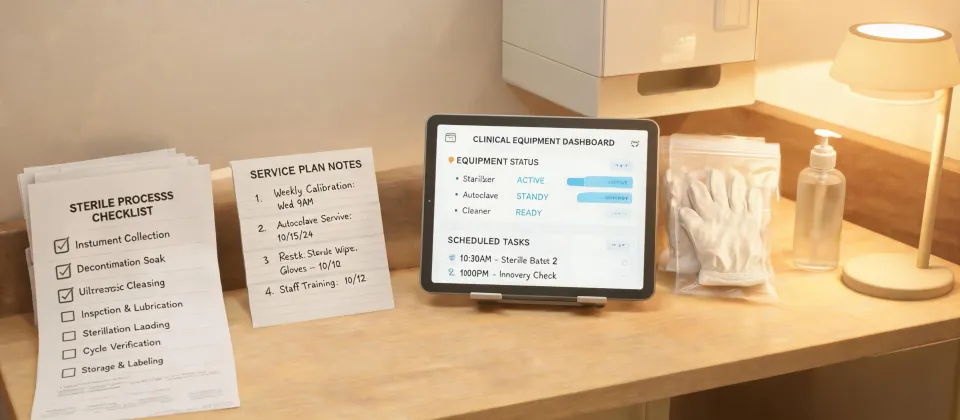
In my role coordinating sterile processing equipment for hospitals and surgery centers, I've taken that early-morning phone call enough times to know it instantly. A charge nurse on the line, a surgeon's voice in the background, and the same question every time: "When will that tray be ready?"
The answer depends a lot on which reprocessing path you've built. Basically, you've got two options:
Manual reprocessing — hand-washing instruments at a sink, assembling trays, loading a steam sterilizer, and trusting your tech's training and attention at every step.
Automated sterile processing — washer-disinfectors, integrated sterilizers, tracking. Equipment that does the heavy lifting and documents what happened in each cycle.
This article answers a question I hear constantly — how to sterilize surgical instruments the right way — and it compares the two approaches that actually exist in practice. The choice affects cleaning effectiveness, turnaround time, real cost, compliance, and how you handle emergencies. I'll put the two methods head-to-head on each dimension and give you a direct answer at the end of every one.
Dimension 1: Cleaning and Decontamination
Cleaning comes before sterilization, and it's where the biggest gaps show up. A steam sterilizer can't make a dirty instrument sterile — bioburden physically blocks steam from reaching the surface. So how you clean matters as much as how you sterilize. Maybe more.
Manual cleaning happens in a sink. Someone brushes each instrument, maybe runs them through an ultrasonic bath, and inspects by eye. The variable here is the person holding the brush. Their day, their training, whether they're rushing. When you hand-wash a set of 35 instruments, the tenth forceps gets less attention than the first. Not because anyone is careless — because that's how attention works.
Automated cleaning uses a washer-disinfector. Instruments go in on a tray, and the machine runs a validated cycle: cold rinse, enzyme wash, jet or ultrasonic wash, thermal rinse, drying. Same process every single time. STERIS sterile processing systems are built to work as an integrated chain — washers, sterilizers, and tracking software that share data. The unit in our facility prints out a cycle record with temperatures and wash stages. You're not relying on anyone's memory.
Does manual cleaning work? Sometimes. Can you prove it worked for every instrument, every time? Not really. The automated approach wins on cleaning consistency, no contest.
Dimension 2: Choosing the Right Sterilization Method
Once instruments are clean, actual sterilization happens. Steam under pressure is the workhorse — effective, affordable, and compatible with most surgical instruments. But not all of them. Flexible endoscopes, certain powered tools, and some plastics can't handle steam's heat.
For heat-sensitive items you have low-temperature methods: ethylene oxide gas, hydrogen peroxide gas plasma, or peracetic acid liquid chemical processing. The right choice depends on the device's materials and its intended use — not on whatever sterilizer you happen to own.
Here's a real misunderstanding I see constantly. Someone says, "Sterilize this ultrasound probe," and a newer staff member drops it in a steam sterilizer. Result: a destroyed probe, a $15,000 mistake, and a delayed case. Both people said "sterilize" but meant completely different things. That's a communication failure, and it's expensive.
The reality is that an ultrasound machine's probe, when it contacts mucous membranes, is a semi-critical device. It needs high-level disinfection in most cases, not terminal sterilization. Some probes are designed for sterile use — those require low-temperature sterilization. Different devices, different processes, and you need a written protocol that spells out the difference.
A slit lamp, meanwhile, is non-critical. It touches intact skin at most. It needs cleaning and low-level disinfection between patients. Not sterilization. Understanding these categories prevents both unsafe shortcuts and unnecessary equipment damage.
The conclusion: match the method to the device's risk classification, and build your workflow around both high- and low-temperature options if your inventory requires them.
Dimension 3: Turnaround Time — and the Emergency Factor
This is where the comparison gets interesting. Actually, counterintuitive.
If you have one dropped instrument and a surgeon waiting, manual processing with flash sterilization is faster. You can hand-wash a single instrument, wrap it, run a flash cycle, and get it to the OR in about 20–30 minutes. An automated washer-disinfector plus a standard wrapped cycle runs 60–90 minutes minimum. In that narrow scenario, manual wins.
But here's the thing: that's treating the symptom, not the disease. The more important comparison is how each approach performs across an entire surgical day. Automated reprocessing is a workflow. You run washer-disinfector loads overnight, sterilize trays before the first case, and keep a steady cycle going through the day. Manual processing is reactive — someone is always catching up.
People assume automated systems are slower because individual cycle times are longer. But the real bottleneck isn't the sterilizer. It's everything that happens before the door closes. An automated washer-disinfector runs while staff does other work. Manual cleaning occupies a person for the entire process — rinsing, brushing, inspecting, wrapping. Across ten instrument sets in a day, automated wins on total speed by a wide margin. And it wins on predictability, which matters more.
And in a genuine emergency? I'd rather have a validated workflow that prevents most emergencies, plus a clear protocol for the rare time one happens, than a "flexible" manual system where every urgent request becomes improvisation. So the surprise here: manual/flash is faster for a single incident, but automated is faster and safer across a full day. The situations where flash truly makes sense are rarer than you'd think.
Dimension 4: What It Actually Costs
Let me address the assumption that manual is cheaper. That thinking comes from an era when labor was cheap and reprocessing equipment was simple. The math has changed — drastically.
Manual cleaning costs are mostly labor. Every tray that gets hand-washed consumes technician hours, and technician time is the most expensive resource in sterile processing. At surgical volumes, those hours add up to more than the operating cost of an automated washer-disinfector, easily. And that's before factoring in the risk of errors: a missing instrument in a set, a processing mistake, a recalled tray.
Automated processing requires real capital. A washer-disinfector runs in the five figures, and a steam sterilizer adds similar cost. You also need preventive maintenance. I schedule our STERIS equipment service technician visits at planned intervals, with calibrated checks and documented results. It's an operating expense — or rather, an investment in uptime.
Why do I insist on preventive service? Because I've watched the alternative fail. In March 2024, a client called at 6:40 AM, 36 minutes before their first scheduled case. Their steam sterilizer had logged an error and wouldn't run. They'd skipped the service contract to save about $4,000 a year. The emergency repair, including the service call premium and expedited parts, ran close to $11,000. Plus two canceled procedures and rescheduling costs. The "savings" turned into a loss in a single morning.
Conclusion: automated is more expensive upfront but cheaper over time — if you maintain it consistently. Skipping service doesn't save money; it converts a predictable cost into a much larger emergency cost. The certainty of a maintained system is worth the premium, every time.
Dimension 5: Compliance and Documentation
Surveyors — whether you're under AAMI guidelines, JCI, CMS, or your state's health department — expect you to prove your sterilization process works. Not occasionally. Every load.
Manual documentation means handwritten logs and biological test records in a binder. It can work, but it depends on someone writing everything down, every time, legibly, without missing a step. And when a surveyor asks for the record from a specific date three months ago, you'd better find it fast.
Automated systems generate cycle records as a byproduct, not a chore. Load, date, cycle parameters, exposure time, operator. Traceability software links each instrument set to its exact sterilization cycle. Per ANSI/AAMI ST79 guidelines, sterilization records have to include load contents, exposure time, temperature, and operator identity. An automated system collects all of that without relying on anyone's handwriting.
One caveat: automation doesn't replace responsibility. You still run biological indicators on schedule, interpret chemical integrators, and load the sterilizer properly. But the documentation piece is night and day. Automated systems make compliance nearly effortless; manual systems make it fragile.
Which One Should You Choose?
Here's my practical take, from years spent standing in sterile processing rooms.
Manual reprocessing is defensible in a narrow set of situations:
- Very low procedure volume — five or fewer instrument sets per day
- A genuinely limited capital budget with no realistic path to equipment investment
- Simple, fully steam-stable instrument inventory
Automated sterile processing is the better answer for almost everything else:
- More than five instrument sets per day
- Mixed inventories with endoscopes, ultrasound probes, or powered instruments
- Any setting where documented traceability is required — and that's all healthcare settings
- Practices that expect to grow
For an ambulatory surgery center or hospital department, automation isn't optional anymore. That's not my opinion; it's where the regulatory environment has been heading for a decade.
Look, I'm not going to tell you that buying a washer-disinfector makes you safe. What makes you safe is having a process you can trust at 7:30 AM when the OR is waiting. From my seat, that certainty is worth paying for. The "cheap" path — manual processing, skipped maintenance, improvised workflows — only looks cheaper until it fails at the worst possible moment.
The real decision isn't manual vs. automated. It's whether you want a validated, documented process you can defend — or a hope that things will be good enough. Patient safety isn't a place for hope.