-
Where is the STERIS official site?
-
What is a STERIS Celerity incubator?
-
Does STERIS make blood pressure monitors or patient monitors?
-
What is wound care, and how does STERIS fit?
-
How do you verify STERIS sterilization equipment instead of just watching the screen?
-
What's the question most buyers forget to ask?
-
Why does prevention matter more for sterilization than for patient monitoring?
I'm a quality and compliance manager for a health system in the Midwest. I review around 150 sterilizer load records a month—maybe 160, I'd have to check our dashboard—and in 2024 I rejected roughly 8% of first-time vendor submittals because the paperwork didn't match our specs. This isn't an official STERIS marketing page. It's the FAQ I'd give a colleague who has to buy or verify STERIS equipment and who keeps hitting the same search terms: steris celerity incubator, steris official site, blood pressure monitor, patient monitor, and what is wound care. Here's what I'd tell you.
- Where is the real STERIS official site?
- What does a STERIS Celerity incubator actually do?
- Does STERIS make blood pressure monitors or patient monitors?
- What is wound care, and how does STERIS fit?
- How do you verify performance instead of trusting a green light?
- What's the question most buyers forget to ask?
Where is the STERIS official site?
Bookmark steris.com. That's the official site, and it's the only URL I'll use in a contract. If you search for 'steris official site,' you might see pages that look official but aren't. In 2023, I caught one supplier saying 'direct from STERIS' when the equipment actually came from a reseller. The product had a mismatched label. We rejected it before it entered our building.
Why does that matter? Per FTC advertising guidelines, a claim like 'new' or 'sterile' has to be truthful and substantiated, but your company shouldn't have to fight that fight after the fact. Start at steris.com. From there, you can find operator manuals, IFUs, safety data sheets, and customer support. If you can't find a document on the official site, ask a STERIS rep for it. If they can't provide it, that's your answer.
What is a STERIS Celerity incubator?
A STERIS Celerity incubator is a biological indicator incubator. You put a processed Celerity biological indicator, or BI, into the incubator after running a sterilizer cycle. The incubator holds it at the right temperature and makes it possible to read the BI in hours, not days. If the indicator shows no growth, the sterilizer 'passed.' If it shows growth, the sterilizer didn't kill the spores—and you stop using it until you find out why.
The word Celerity matters because the system is designed to be faster than a traditional spore test. If I remember correctly, our Celerity system gives a result in about three hours, but don't quote me on that—check the IFU for the exact BI lot. According to STERIS's official site, the Celerity line falls under biological monitoring, not sterilization. That distinction is important. The incubator doesn't sterilize anything. It verifies. A sterilizer is the performer; the incubator is the referee. Treat the referee well.
Does STERIS make blood pressure monitors or patient monitors?
Not in the way most people mean. STERIS doesn't make the bedside patient monitor or the standalone blood pressure monitor that a nurse wheels into a room. Their focus is infection prevention, surgical tables and lights, endoscope reprocessing, surgical instruments, and sterilization systems. In an operating room, you might see STERIS integration software pulling data from a patient monitor, but the monitor itself is typically built by a dedicated patient-monitoring company.
From the outside, a company that makes surgical lights and a company that makes patient monitors can seem interchangeable. They're not. That's not a negative. It's a good separation. I'd rather have STERIS spend its engineering time on cleaning and sterilizing surgical instruments than try to out-monitor companies that have spent decades on patient monitors. If you're searching for 'STERIS blood pressure monitor,' you'll probably land on a page about a different product. Look for the product category on the official site before you call sales.
What is wound care, and how does STERIS fit?
The short answer: wound care is the evaluation, cleaning, debridement, dressing, and monitoring of a wound until it closes. That includes surgical incisions, pressure injuries, diabetic ulcers, and trauma wounds. I'm not a wound care clinician, so I won't recommend a dressing or an ointment. What I can tell you from a sterile processing perspective is that wound care is impossible without infection prevention.
Every sterile towel, instrument, or dressing that touches a wound has to be sterilized, handled, stored, and opened correctly. STERIS makes sterilization systems, high-level disinfection systems, and surgical instruments used in procedures. The connection is simple: a wound can't heal if it's infected. That's why 'what is wound care' isn't just a clinical question—it's a quality and sterilization question too.
How do you verify STERIS sterilization equipment instead of just watching the screen?
Use a written load release protocol. For a steam sterilizer, the checklist includes cycle parameters, chemical integrators, and biological indicators. If you use a STERIS Celerity incubator, put it on a preventative maintenance schedule. The least expensive mistake is trusting a green light.
Most buyers focus on the sterilizer—the giant stainless steel box—and completely miss the incubator sitting next to it. That's the blind spot I see most often. If an incubator runs too cold, the BI might not grow even when the sterilizer didn't kill the spores. You release a load that should have failed. I'm not a biomedical engineer, so I won't tell you how to calibrate the thermistor. I'll tell you to keep the operator manual, log every load, and get the PM done on time.
5 minutes of verification beats 5 days of correction.
In my first year, I signed off on a new Celerity incubator because the field rep said it was calibrated from the factory. It wasn't. During the annual PM, the tech found the temperature offset was 1.8 degrees too cold. We had to retest every load released between the two dates. That's the kind of mistake that stays with you. I don't have hard data on how many facilities skip incubator PM, but from the audits I've been part of, I'd say it's more than we'd like to admit.
What's the question most buyers forget to ask?
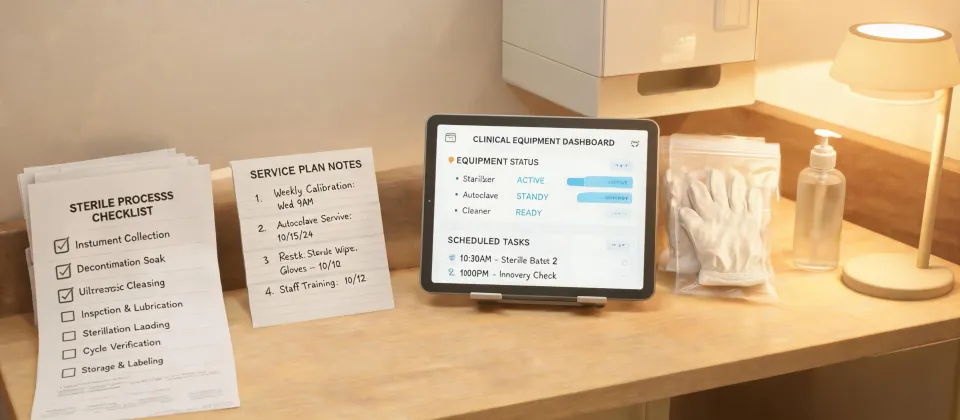
What service plan comes with it? A Celerity incubator is a sensitive instrument. It can be accurate on day one and drift later. Ask the manufacturer or your STERIS rep about calibration checks, annual PM, and loaner coverage if the unit goes down.
From the outside, it looks like you're buying an incubator. The reality is you're buying confidence. Every load you release depends on that confidence. If the service plan doesn't include annual PM, your load release process has a hole. The sales quote may be cheaper with no PM. That cheap price can become a $22,000 redo the first time a load is questioned.
Why does prevention matter more for sterilization than for patient monitoring?
Because patient monitors and blood pressure monitors have a backstop: a nurse, a doctor, or another vital sign. If a blood pressure monitor reads oddly, a clinician rechecks it. If an incubator gives a false pass, every instrument in the load is suspect. There is no undo button.
In our Q1 2024 quality audit, I found three biological indicator results that weren't recorded because the incubator's printer had failed silently. We fixed the printer and added a redundant paper log before running another load. Some people would call that overkill. I call it the cheapest insurance available.
STERIS equipment is good, but good equipment still needs verification. The official site, the Celerity incubator, the patient monitor, the blood pressure cuff—none of it matters if the process around it isn't controlled. Check first. Document always. That's the whole job.