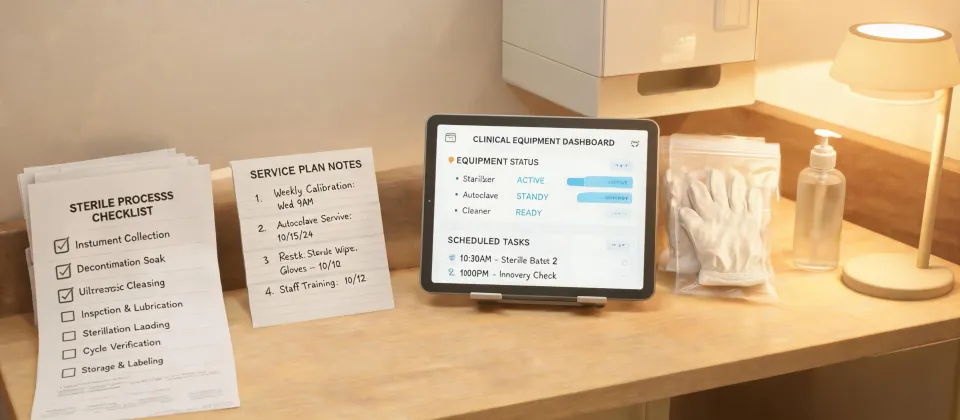
I've changed my mind about equipment, and I think you should too.
For the last few years, I've coordinated urgent equipment requests for hospitals and surgery centers. We've handled maybe 200 emergency calls. Maybe 180, I'd have to check the log. At least, that's been my experience with acute-care hospitals and surgery centers. The ones that stand out aren't the big installations. They're the small moments when someone realized a device was doing the wrong job—not because it failed, but because the process around it was never designed.
That's what the last five years have taught me. The industry has evolved from "buy the best tool" to "build the best workflow." The fundamentals of infection prevention haven't changed. But the execution has moved into every corner of the operating room—including corners most of us used to ignore.
The Opinion: Start Designing Workflows, Not Equipment Menus
I believe STERIS equipment is excellent. I also believe it gets evaluated the wrong way. Hospitals ask: "Is the STERIS AMSCO warming cabinet reliable?" Or: "Does the STERIS 4085 table fit our surgical mix?" Or: "What's the right suction unit for this procedure room?" Those are the wrong questions. Not because they're irrelevant—but because they treat each device as an end product. They don't treat it as part of an infection prevention system.
The right question is: "What process will this device be part of, and what will break when humans use it under pressure?"
That's the opinion. Period.
Three Reasons I've Changed My Mind
1. A Warming Cabinet Is Not Just a Cabinet
Take the STERIS AMSCO warming cabinet. It sounds simple. Heat, maintain temperature, hold supplies. But in a sterile processing environment, it sits at the intersection of comfort and sterility.
In my first year, I made the classic spec-sheet mistake: I thought if every device met its own performance spec, the whole chain would be safe. Cost me an audit finding I still remember. A nurse had placed a sterile basin in a warming cabinet because the basin was cold and the patient was waiting. The package looked fine. But the cabinet was designed to warm fluids and blankets, not to double as sterile storage. Condensation formed on the package. If I remember correctly, the finding read: "potential compromise of the sterile barrier system."
Not the cabinet's fault. The process's fault. A warming cabinet that's used outside its intended role can turn a reliable STERIS device into a risk. According to ISO 11607-1, a sterile barrier system must maintain sterility under storage and transport conditions. A warmer with moisture on the packaging doesn't support that. That's it. A cabinet became a hazard because it was used as storage.
2. Surgical Tables and Suction Units Are Part of the Risk Picture
In March 2024, a facility specified the STERIS 4085 table for a new hybrid OR. It's a strong table—load capacity, patient positioning, imaging compatibility. But the planning documents didn't say anything about how the table pads would be disinfected between cases. The suction unit beside the anesthesia machine had an old canister setup that nobody could clean properly. The table performed beautifully. The room around it didn't. "Not ideal, but workable," one staff member said. I've learned to treat those words as a red flag.
Every device in the OR participates in infection prevention. The STERIS 4085 table can move a patient into precise positions. It can also trap debris in a seam if the team rushes between cases. The suction unit can hold a canister. It can also harbor biofilm in an unmonitored connection. None of this means the equipment is bad. It means the system around the equipment has to be designed with the same care as the product specifications.
3. The Imaging Lesson: Purpose Still Drives the Decision
Here's the example I use with sterile processing leads: think about how dental practices decide between CBCT vs panoramic dental imaging. Five years ago, the argument was often "3D is better than 2D." Now smart clinics ask a different question: What clinical indication is this image for? Panoramic imaging covers broad anatomy at a lower dose; CBCT provides 3D detail where you need it. The device is only valuable when it answers a specific question.
Same logic applies to infection prevention. Don't ask "What's the best STERIS equipment for our OR?" Ask "What contamination risk are we trying to solve?" The answer might be a warming cabinet, a 4085 table, a new suction unit, an updated sterile barrier system process—or a new process around all of them. The device is the image. The process is the diagnosis. A technology can be excellent and still be the wrong answer for your problem.
Expected Pushback: "Equipment Is Equipment"
Some people will read this and say: "A warming cabinet doesn't have to be connected to my sterile barrier system. A suction unit is just suction. A surgical table is just positioning." I understand. I made the same assumption for years.
I assumed the sterile barrier system was only about the wrapper and tape. I didn't verify how the package would be stored, moved, or warmed. That was the mistake. According to ANSI/AAMI ST79, sterile packages should be stored in a clean, dry, limited-access area away from contamination sources. That's not just a supply-room rule. It applies to every device that touches the package—including the ones that heat it.
Looking back, I should have pushed for a workflow walkthrough before any purchase decision. At the time, the product specifications seemed clear. They were clear individually. But specs don't walk through the door at 6:40 AM with a full schedule and a short-staffed team. The process does.
Reaffirming: Fundamentals First, Evolution Second
So here's my position: The industry will keep evolving. We'll see better sensors, better data, better connectivity. STERIS will keep selling equipment across surgical and sterile processing. Some of that equipment will genuinely improve outcomes.
But the fundamentals remain unchanged:
- Respect the sterile barrier system.
- Clean every surface, every time.
- Design in time and space for the work.
- Assume humans will take shortcuts when the process makes them necessary.
The evolution I care about isn't "new device replaces old device." It's understanding that every device—no matter how smart—participates in a system. If you haven't designed the system, you haven't solved the problem.
The best way to honor the equipment is to stop worshiping the spec sheet. That's not a criticism of STERIS. It's a criticism of how we've learned to buy. The next time someone asks about the STERIS AMSCO warming cabinet or the STERIS 4085 table, start with the process. Then choose the equipment. That's how the industry grows up.
And these days, that's exactly what I tell every emergency request that comes in. It's not the rush that makes a decision good. It's the system underneath it. Period.