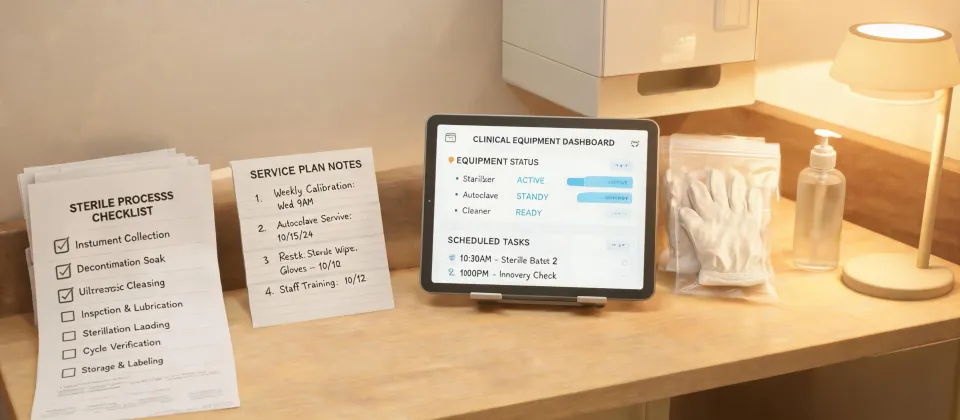
Sterilization failures almost never start with the equipment. They start with skipped verification steps. Over 11 years of reviewing sterile processing departments—autoclave logs, scope washer cycles, maintenance records—most contamination events I've seen trace back to a missing check, not a malfunctioning machine. Fix the verification process and you prevent the majority of sterilization problems.
I'm the quality compliance manager at a medical device company. I review roughly 200+ sterile processing audits annually—about four per week. In Q1 2024 alone, I rejected 14% of first-time vendor submissions for incomplete biological indicator documentation. Not because the equipment failed. Because someone skipped a step.
An $18,000 Autoclave Lesson
Back in 2021, we were expanding our reprocessing capacity. The decision came down to two autoclave machine options: a STERIS model with integrated cycle verification, and a budget-friendly unit from a lesser-known manufacturer. The budget unit was $9,000 cheaper. On paper, it met the same AAMI ST79 standards. My gut said the verification features mattered more than the sticker price.
I went back and forth for three weeks. Finance made a strong case—budgets are real, and $9,000 is $9,000. We bought the budget unit. Hit 'confirm purchase' and immediately thought: did I just make the right call? Didn't fully relax until the install passed FDA registration.
By month four, a cycle passed chemical indicators but failed a biological spore test. The load had already been distributed to two surgical centers. Recalls, retesting, and reprocessing cost us roughly $22,000—plus credibility damage with those customers. Net loss versus the STERIS option: $13,000. Worse than expected.
The 'budget vendor' choice looked smart until it wasn't. We haven't repeated that mistake.
Why Verification Beats Everything Else
Here's the core distinction that separates effective infection prevention from guesswork: sterile processing isn't about whether the machine can sterilize—it's about proving it did.
Why does this matter? Because sterility is a probabilistic outcome. Calibration drift, a cold spot from overloading, an air leak in the chamber—any of these can compromise a load silently. Without verification, you're flying blind.
The AAMI ST79 guideline (still the reference standard as of January 2025) is explicit: biological indicators at least weekly—ideally with every implantable load. Chemical indicators on every pack. Mechanical monitors on every cycle. These aren't bureaucratic hoops. They're the only way to know a load is safe.
What do I actually find in the field? The most common audit findings:
- Incomplete load records (cycle parameters not logged)
- Biological indicator results not reviewed before load release
- Scope washer channel connections not verified pre-cycle (yes, it happens—more often than you'd think)
- Preventive maintenance overdue by weeks, sometimes months
- Water quality tests not run on schedule
None of these are catastrophic alone. Any single one can be fixed in a day. But two or three at once? That's how contamination events happen.
The Scope Washer Gap Nobody Talks About
Endoscope reprocessing deserves special attention. A proper automated endoscope reprocessor—like STERIS' scope washer systems—standardizes the process. But here's what I see repeatedly in audits: staff connect the scope, start the cycle, and assume the internal channels are being flushed. They don't verify connection integrity.
That's a process gap. And I paid for it once.
In 2019, we didn't have a formal verification step for scope washer connections. The third time our leak test failure rate topped 5%, I finally created a pre-cycle connection checklist with a second-person sign-off. Should have done it after the first failure.
The fix cost nothing. Zero dollars. Ninety seconds of staff time per cycle. Failure rate dropped to under 1% within a month.
What About Dental Compressors?
Dental compressor maintenance is the most overlooked item in sterile processing discussions. The autoclave gets the attention—rightfully so—but the compressor feeding your surgical instruments is a silent failure point.
Moisture and particulate matter in the air line can compromise instrument drying and cause corrosion. If your autoclave machine runs perfectly but instruments come out wet or stained, the compressor is the first place I'd look. It's rarely the sterilizer's fault. The filter replacement log and moisture check on your compressor are cheap insurance compared to reprocessing a corroded instrument set.
How to Sterilize Surgical Instruments: The Sequence That Works
If you're setting up or reviewing a sterilization protocol, here's the sequence that catches problems early—based on what I've seen work in high-performing facilities:
- Clean thoroughly first. Sterilization doesn't remove bioburden; it inactivates it. Gross soil on instruments protects microorganisms from steam exposure.
- Inspect and package correctly. Packaging failures cause more contamination events than chamber failures.
- Load correctly. Overloading creates cold spots. Underloading is wasteful but safer.
- Run mechanical monitoring every cycle. Record time, temperature, and pressure.
- Use chemical indicators on every pack. They catch penetration failures immediately.
- Run biological indicators weekly—or every implantable load. Spore tests are the gold standard.
- Document everything. The load log is your evidence—both clinical and legal.
This isn't revolutionary guidance. It's the baseline standard. The challenge is consistency: doing it every single time, not only when someone's watching.
What I'd Choose If I Were Starting Over
If I were outfitting a new sterile processing department today, I'd pick STERIS sterilizers, scope washers, and washer disinfectors for the core functions. Not because other brands can't work. They can. But the integration of verification features, the global service network, and the documentation support reduce the number of decisions your staff has to get right.
That said, the equipment purchase is the easy part. Budget for verification infrastructure: biological indicators, chemical integrators, a tracking system, and ongoing staff competency assessment. That's where the real investment sits. And it's where most budget shortfalls hit—usually because the machine outranked the process in priority.
Granted, this approach requires more upfront planning. But rushing the purchase decision and figuring out verification later is how you end up with a $22,000 lesson like mine.
Where the Full Protocol Is Overkill
To be fair, not every situation needs the full verification stack. A Class I wound dressing that's terminally sterilized by the manufacturer and never reprocessed at your facility? You don't need biological indicators to open a box. But the moment you reprocess any device that contacts mucous membranes or sterile tissue, the standard applies. There's no middle ground for semi-critical and critical instruments.
I'm not 100% sure about every edge case in the updated ANSI/AAMI ST91 guidance for flexible endoscope reprocessing—it's dense in places. But the direction is unambiguous: more verification, not less. If your current protocol doesn't include a formal connection check for your scope washer, that's the cheapest safety improvement you'll make this year.