-
What exactly is a STERIS drying cabinet?
-
Where do I get a STERIS Reliance 6000 service manual?
-
What is a surgical light, really?
-
Can a C arm system and a surgical light share an OR?
-
Can a washer-disinfector process neonatal incubator components?
-
Which STERIS equipment is actually worth the capital spend?
I don't work for STERIS. I'm a quality/compliance manager for a medical device company, and I review every capital equipment spec sheet before it reaches hospital customers—roughly 50 items a year. In 2024, I rejected about 12% of first deliveries because the documentation was incomplete. So I ask different questions.
These are the six I'm asked most often.
- What exactly is a STERIS drying cabinet?
- Where do I get a STERIS Reliance 6000 service manual?
- What is a surgical light, really?
- Can a C arm system and a surgical light share an OR?
- Can a washer-disinfector process neonatal incubator components?
- Which STERIS equipment is actually worth the capital spend?
What exactly is a STERIS drying cabinet?
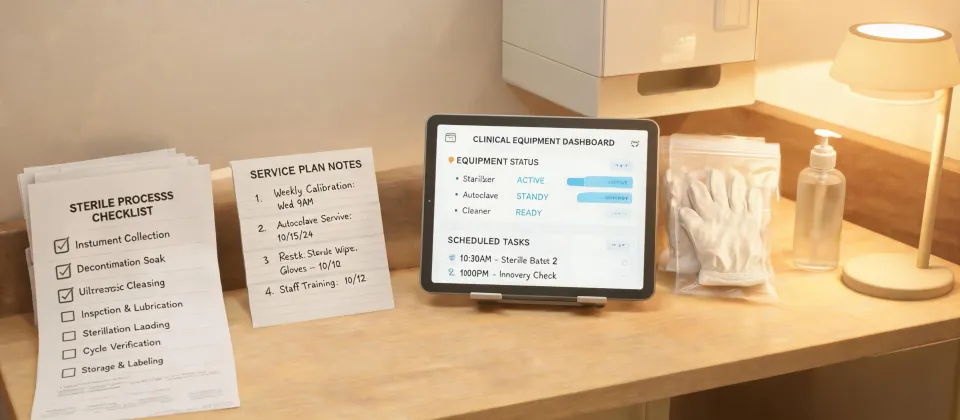
A STERIS drying cabinet is not a storage closet. It's a fan-forced, filtered cabinet that gives instruments a controlled drying cycle after washing or sterilization. I've watched hospitals treat these as nice-to-have until moisture spots show up on a tray after an overnight wait. Then the cabinet becomes the hero.
When I specify a drying cabinet, I look for three things: airflow control, filtration for sensitive items, and cycle documentation. The last one matters because your quality team needs an auditable record. If the cabinet doesn't log cycles, you're flying blind.
Honest limitation: a drying cabinet doesn't replace the dry time required by an instrument's instructions for use. If your lumen instruments need 20 minutes of vertical air drying, the cabinet has to support that, not a default demo cycle. Get that in writing.
Even after choosing a larger STERIS drying cabinet, I kept second-guessing. What if we didn't need the floor space? The two weeks until installation were stressful. Six months later, it's the right call for our volume. For a smaller facility, it would have been overkill.
Where do I get a STERIS Reliance 6000 service manual?
The right place to start is STERIS technical support with the unit's serial number. If the machine is under a service contract, the tech can load the service documentation during a PM. If it's not under contract, you may have to pay for the documentation package. That's normal, and it's worth the cost.
I only started verifying manual availability before purchase after skipping that step once. A hospital bought a used Reliance 6000, the original manual went missing, and the controller software was a revision the local tech hadn't seen. The first service call ran about $1,200 before the tech touched anything. Now every used-equipment PO includes: current STERIS Reliance 6000 service manual or equivalent factory documentation.
A random third-party download might look convenient. Don't guess. You can't validate that it matches your controller revision, and a service manual that's close but not exact is a liability.
What is a surgical light, really?
A surgical light is a focused illumination system for the operating field. It reduces shadows from hands, heads, and instruments; it manages heat; and it keeps color rendering accurate enough to distinguish tissue.
The useful specs are illuminance in lux, color temperature around 4000-5000 K, and color rendering index. But those numbers don't tell you whether the light works when a tall surgeon leans in at a bad angle.
The safety reference is IEC 60601-2-41, the standard for surgical luminaires. If a vendor can't show compliance to that standard, be cautious.
Here's a nuance I've learned the hard way: more light is not automatically better. I've rejected a spec sheet with an impressive lux number because it had no shadow-management data. A light that's too bright can glare on a monitor or fatigue the surgeon. Balance matters.
Can a C arm system and a surgical light share an OR?
Short answer: yes, but only if someone plans the arcs. A C arm system and a ceiling-mounted surgical light both need overhead space. In a hybrid OR, the C arm system's travel path and the light's rotation radius have to be mapped before you pour a single anchor.
Last year, I approved a ceiling light install without double-checking the coordinates against the C arm rail. I thought, 'what are the odds the engineer got it wrong?' They got it wrong. The light column stopped the C arm at about 30 degrees of rotation. We moved the mount and delayed two cases. That was my overconfidence fail for the year.
What to look for: the clear travel envelope for the C arm system, the light head's ability to rotate out of that envelope, and cable management that won't interfere. If you ask for a 3D model review and the rep hesitates, that's a red flag. (Note to self: never trust coordinate handoffs.)
Can a washer-disinfector process neonatal incubator components?
It can, if you use the right cycle, the right basket, and the incubator manufacturer's IFU. Neonatal incubator components like humidity chambers, mattress trays, and ducting are often heat-sensitive plastic. A general instrument program can be too aggressive.
I've supervised facilities that planned to use a STERIS washer-disinfector for neonatal incubator parts. The one thing that saved them was confirming cycle parameters with both the incubator manufacturer and the detergent compatibility. If you process these components regularly, buy the correct baskets and set up a dedicated load program.
Don't let anyone tell you 'the standard cycle handles everything.' It doesn't. If you're unsure, run a validation with temperature sensors in the load. That's exactly what a quality program is for.
Which STERIS equipment is actually worth the capital spend?
No universal best, and I'd be lying if I said otherwise. I recommend STERIS for acute-care sterile processing because the washer-disinfectors, sterilizers, and endoscope reprocessors are built for high-throughput reprocessing. If you're a low-volume clinic with one flexible scope and no steam line, a compact tabletop system might be a smarter first step.
Brand matters less than fit. Does the equipment match your load volume, utility capacity, and staff ability to validate it? If you're choosing between a surgical light upgrade and a drying cabinet for a new surgery center, put the reprocessing fundamentals first. The light upgrade can wait.