If you're looking at STERIS equipment—whether it's a 400 Series sterilizer, a Synergy washer, a fundus camera, an ECG machine, or a dental unit—you probably have a lot of questions. And some of them are the kind you don't want to ask in front of your boss or the sales rep.
I've been handling service orders for STERIS equipment for about six years now. In my first year alone, I made mistakes that cost my department nearly $3,200. Wrong specs. Missing manuals. Ordering the wrong part for a 400 Series sterilizer because I assumed 'standard' meant the same thing to every vendor. That $200 savings? Turned into a $1,500 problem when I had to expedite the correct part and pay for a service call to swap it.
So here are the questions I wish someone had answered for me. No sales pitch. Just what I've learned.
1. What's the difference between the STERIS 400 Series sterilizer models, and does it actually matter?
Short answer: yes, it matters. A lot.
The 400 Series includes several models: the 402, 405, 407, 408—each with different chamber sizes, cycle options, and interface designs. The 402 is a single-door, smaller chamber model. The 408 is double-door, larger, and often found in higher-volume central sterile processing departments. The 407 has an integrated steam generator, which can be a game-changer if your facility has steam supply issues—or a headache if it fails.
I still kick myself for not checking the exact model before ordering a service manual in 2022. I ordered for a 405. The unit? A 407. The manuals aren't interchangeable. The connectors aren't either. That mistake cost me a $350 expedite fee and a three-day delay on a scheduled PM.
If you're looking at used equipment, double-check the model number on the nameplate. Serial numbers tell you the build date, but the model number tells you what you're actually working with.
2. How often do I really need to calibrate my STERIS Synergy washer?
Per the operator manual—and I've read it more times than I'd like to admit—the Synergy washer requires calibration verification every 12 months, or more frequently if you're processing loads with high soil levels. The critical measurements are time, temperature, and detergent concentration.
The most frustrating part? You'd think the internal diagnostics would flag a problem. They don't always. I've seen a Synergy washer run a full cycle at 80°C when it was supposed to be 90°C, and the control panel showed no error. The calibration had drifted. Nobody noticed until the biological indicators started failing.
In my opinion, skipping the annual calibration to save $600 is a false economy. The cost of re-processing a single load of surgical instruments—labor, consumables, downtime—can easily exceed that. If you're leasing or using a service contract, check your SLAs. STERIS service contracts typically include calibration, but some third-party providers don't.
3. Can I use any brand of consumables with STERIS equipment?
Technically? Yes. Wisely? It depends.
Let me rephrase that: you can use third-party detergent in a Synergy washer, or non-STERIS chemical indicators in a 400 Series sterilizer. The equipment will run. The question is whether it runs to spec.
STERIS validates their cycles using specific consumables. If you switch to a different brand, you're essentially running an unvalidated cycle. Does that mean it won't work? No. But if you have a sterilization failure and an inspector asks which chemical indicator you used, saying 'the cheaper one' isn't a great answer.
I want to say about 70% of the service issues I've seen with Synergy washers in the last two years were linked to non-approved detergents causing foam or residue. But don't quote me on that exact number—I'm going by memory from a meeting in Q3 2024.
4. Why does my fundus camera need its firmware updated?
Fundus cameras—including STERIS's ophthalmology imaging systems—are essentially specialized digital cameras with software that processes retinal images. Firmware updates fix bugs, improve image processing algorithms, and sometimes add new measurement tools.
Here's the thing: the camera will still take pictures without the update. But if the update improves the alignment of the OCT overlay or fixes a connectivity issue with your EHR system, skipping it means you're living with a problem that's already been solved.
I once had a fundus camera that kept losing network connection. We checked cables, switches, IP settings—everything. The fix was a firmware update that had been available for four months. That was in September 2022. I still kick myself for not checking that first.
Check your service contract. If you have a STERIS service agreement, firmware updates are typically included. If not, you might be paying labor for someone to download and install it—which feels like paying for air.
5. What size dental unit do I actually need for my practice?
The question isn't 'what size can I afford'—it's 'what size lets my team work without hating their jobs.'
Dental units come in a few common configurations: delivery system type (over-the-patient, side, rear), number of instrument positions (typically three to five), and whether the unit is chair-mounted or cart-based.
If you're a solo practitioner doing mostly exams and basic restorative, a three-instrument over-the-patient unit is probably fine. If you're doing endo, surgery, or multiple procedures in the same room, you'll want at least four positions—and you'll want the unit to be chair-mounted, not on a cart that's always in the way.
I made the mistake of ordering a rear-delivery unit for a room that had the chair against the back wall. We discovered the problem when the delivery arm couldn't fully extend. The cost to reconfigure the plumbing: $1,800. Lesson learned: measure the room. Then measure it again. Then have someone else measure it while you watch.
6. My ECG machine says 'service required'—what do I actually check first?
Before you call for service, check the obvious things that aren't in the manual because they're 'too basic.'
First: are the patient cables properly connected? Sounds dumb. But I've had two calls in the past year where the 'service required' message cleared after reseating the cable. The most recent was January 2025. A full service call would have cost $400+ for a five-second fix.
Second: is the thermal printer head clean? ECG machines with built-in printers will throw errors if the print head is too dirty to advance the paper. A quick wipe with an alcohol pad solves it.
Third: check the power supply. If the machine is intermittently losing power, the battery might be old (typical lifespan is 2-3 years) or the power cord connector might be damaged. I've seen three ECG machines in the last 18 months where a loose power cord was the root cause.
If none of those work, then yes—call for service. But at least you'll sound like you know what you're doing on the phone.
7. Should I buy a service contract, or go third-party?
My honest opinion: it depends on your risk tolerance and internal expertise.
STERIS service contracts are comprehensive—they cover PM, calibration, repairs, and usually include priority response times. They're not cheap. But I've also seen the cost of an unplanned downtime event in a sterile processing department: a single cancelled surgical case can cost a hospital $2,000-$5,000 in lost revenue, not counting patient inconvenience or rescheduling costs.
Third-party service can work well if you have capable in-house biomedical technicians who know STERIS equipment. But you need access to manuals and parts, and STERIS doesn't make those easy to get without a contract. Part numbers change. Wiring diagrams aren't public. That's not malice—it's just how they structure their service model.
If you're a small dental practice with one sterilizer, third-party might be fine. If you're an OR with ten pieces of STERIS equipment, get the contract. The math works out.
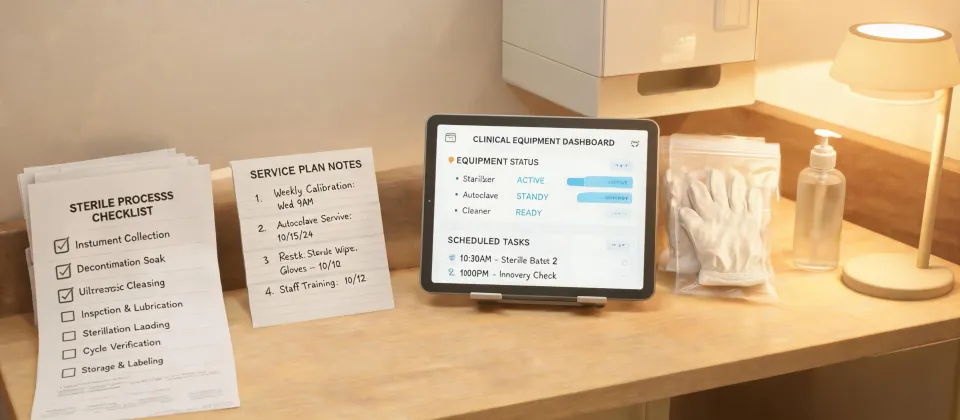
After the third equipment failure in Q1 2024, I created a decision checklist for our team. It considers equipment age, criticality, service history, and proximity to a STERIS service center. We've caught 47 potential gaps using that checklist in the past year—and saved about $11,000 in avoided emergency service fees.
—
A service coordinator who learned these lessons the hard way. Currently maintaining our equipment checklist so you don't have to.