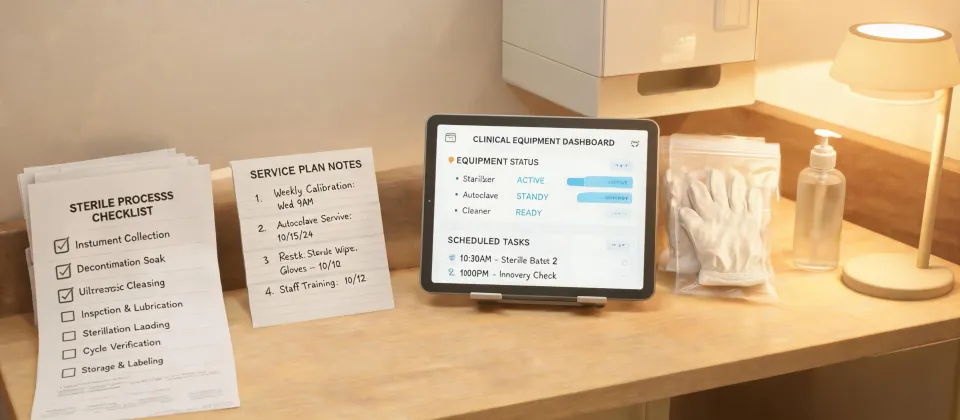
What is sterile processing, and why should you care
Sterile processing is not one step. It's the entire system that makes a reusable device safe enough to touch a patient's tissue. For a hospital, that means decontamination, cleaning, inspection, assembly, packaging, sterilization, storage, and release. For a manufacturer, it means validating exactly how those steps must be done. In our Q1 2024 audit, I rejected 3.8% of first-production instrument lots because the weakest link in the chain had broken. That number is not about bad people; it's about bad assumptions. The question everyone asks is, “Did the autoclave reach temperature?” The question I'd rather answer is, “What evidence proves the device is sterile?”
(Note: “sterile” has a formal definition too. To a quality person, it means a sterility assurance level of 10^-6, not “it looks clean.”)
Why I focus on the process, not the product
I work in quality and brand compliance at STERIS. I review every instruction-for-use and lot release document that leaves our plant—roughly 6,000 items annually over the past four years. That sounds administrative, but it is not. In 2022, I helped implement a verification step for IFU revisions after a batch of clip delivery systems almost shipped with labels that did not match the current shelf-life claim. The device itself was fine; the documentation was not. That is a quality failure.
Dodged a bullet that time. It also changed how I answer questions about products like STERIS endoscopy clips or surgical instruments. People want a yes/no answer: “Is this compatible with my scope?” “Should we reprocess this?” I start with the IFU and the validated data behind it. (Note to self: this is also why vendor training matters more than any brochure.)
What sterile processing actually covers
Here is a plain-language map of the workflow:
- Decontamination: the first soil removal step, usually done in the decontamination area. It does not sterilize anything.
- Cleaning: physical removal of blood, tissue, and debris. If this is incomplete, every later step is a waste of time.
- Inspection and assembly: checking for damage, residue, missing components, and correct arrangement in the tray.
- Packaging and labeling: protecting the sterilized device and making it traceable.
- Sterilization and release: the validated cycle plus documentation that the cycle ran correctly.
On the manufacturing side, the same chain is documented under ISO 13485:2016, the medical device quality management standard. That is part of why instructions for use contain validated cycle parameters instead of vague suggestions.
AAMI ST79 is still a widely used framework for steam sterilization in North America as of early 2025. It is a reminder that the autoclave is only one actor in a larger quality system.
The surprising pattern I keep seeing
Here is what I did not expect before I started this job. The device that fails an inspection is rarely the complex electronic one. It is often a simple-looking laparoscope with a narrow lumen that retained fluid after cleaning. A modern laparoscope is a precision optical instrument with channels that can hide tissue debris. The question everyone asks is, “How long should the cycle be?” The question they should ask is, “Where could fluid still be hiding?”
What most people don't realize is that a surgical energy device, such as an electrosurgical pencil or a vessel sealer, is not necessarily harder to reprocess. It just comes with a more detailed IFU. The challenge is human factors: someone still has to inspect the insulation, check for cracks, and decide if the instrument is safe to reuse. No autoclave can fix a cracked shaft.
How endoscopy clips, Key Surgical, and laparoscopes fit together
This is where search terms can confuse people. When someone types STERIS endoscopy clips, they may be looking for a specific clip device, but the term also pulls in the endoscopy workflow. Many endoscopic clips are single-use, sterile-packed devices. They are not meant to be reprocessed in the hospital SPD. The sterility claim comes from the manufacturer's validated process, not from the washer-disinfector. If an IFU says “single-use only,” do not treat it as a suggestion.
The STERIS Key Surgical line, on the other hand, is more about protecting reusable instruments. Tip protectors, tray organizers, and instrument identification tools do not look as critical as a vessel sealer, but they prevent the kind of damage that makes a device difficult to clean. A tiny nick in a laparoscope's outer sheath can trap bioburden. That nick might have been prevented by a simple tip protector. (Which, honestly, is one of those unglamorous details that quality people love.)
The decision framework I use
When I talk with customers, I use the same three questions every time:
- Is the device single-use or reusable? This is decided by the manufacturer, not by the hospital budget.
- Does our facility have the equipment and training to follow the validated IFU?
- Can we prove it, case after case? That means documentation, not good intentions.
That third question is where most quality breakdowns happen. I have rejected more lots for human factors than for hard engineering failures. Which is to say, the sterilization cycle might be perfect, but the setup before it was sloppy.
If you are choosing between suppliers, ask how they validate products under real-world conditions. A company that shares detailed IFUs and training material is signaling that it wants you to understand the process. I would rather spend ten minutes explaining options than deal with a mismatched expectation later.
Where this gets less clear
I need to be honest about limits. My experience is based on device quality work at STERIS and mostly North American acute-care settings. If you are in a small outpatient clinic without a Sterile Processing Department, or a specialty center using low-temperature reprocessing for heat-sensitive scopes, some of the details here will feel different. Water quality, staffing, and local regulations all change the risk picture. I cannot speak to every setting.
What I can say is this: sterile processing is not a department, a machine, or a label. It is the quality chain that connects a manufacturer's validation to a patient's safety. The next time you search for a laparoscope or a surgical energy device, ask the second-level question: “What evidence supports this product's reprocessing claim?” That is the question that changes outcomes.