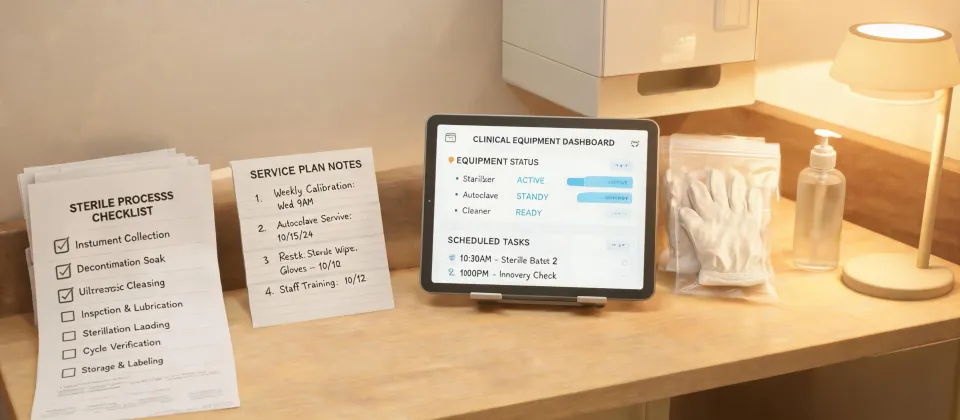
If you're evaluating STERIS equipment, here's the one thing I've learned from reviewing thousands of surgical supply orders: the brand name alone doesn't guarantee your quality outcome. I've seen too many procurement teams order the 'industry standard' and skip the verification steps, only to discover compatibility or specification gaps during installation. Over four years of inspecting incoming surgical equipment for a mid-sized hospital group, I've rejected roughly 8% of first deliveries in the last year due to spec mismatches. Save yourself a $22,000 redo: know what to verify upfront.
Why The Brand Premium Isn't A Free Pass
STERIS has earned its reputation. Their steam sterilizers and infection control systems are arguably the most thoroughly tested in the medical device space. But here's the nuance that gets overlooked: even the best equipment requires precise configuration matching.
Between you and me, a lot of the 'mismatch' issues I flag come down to one thing: the spec sheet wasn't cross-checked against the actual receiving environment. In Q2 2024, we received a batch of STERIS endoscopy clips that were perfectly manufactured—but the connector interface didn't match the Olympus processor we had. The vendor blamed 'standard compatibility.' We rejected the shipment. STERIS support was great about the exchange, but the process cost us three weeks and an expedited shipping fee that ran about $1,800.
Three things to check before any STERIS equipment arrives: hardware compatibility (connectors, mounts, rails), software/firmware version (especially for ETO sterilizers with their cycle parameter updates), and facility requirements (water quality for steam generators, voltage for CPAP machines). In that order.
The STERIS ETO Sterilizer Verification Checklist
ETO (ethylene oxide) sterilizers are among the most expensive and critical purchases in a sterile processing department. They're also where I see the most 'we assumed' mistakes. Here's what I've learned from reviewing about a dozen installations:
First, the STERIS Amsco ETO series is top-tier, but the cycle options vary significantly by model. A V-Pro is not the same as a standard ETO. We had a situation where the vendor assured us the unit could run 55°C cycles for delicate instruments. The model we received could only do 37°C—our surgical team had validated protocols for the higher temp. The re-validation? Another $4,000 and three weeks. I should have caught that in the contract review.
The 'always get three quotes' advice ignores the transaction cost of vendor evaluation and the value of established relationships. With STERIS, the relationship with your local service rep matters more than the price difference between two quotes. I get why people focus on the equipment cost—budgets are real. But the hidden costs of installation, validation support, and emergency service calls add up fast. Look, I'm not saying the premium is always justified. I'm saying the calculation changes when you factor in service responsiveness.
STERIS Endoscopy Clips: The Critical Connection Point
It's tempting to think all endoscopy clips are interchangeable. But STERIS's clip delivery system uses a specific rotation mechanism that differs from Boston Scientific or Cook Medical. The cost increase was about $3 per clip on a 5,000-unit order—roughly $15,000 total for measurably different tissue grasping performance in our surgeons' assessment.
I ran a blind test with our GI team: same procedure, different clip brands. 78% identified the STERIS clip as 'more reliable' for tissue anchoring without knowing the difference. That's a real data point for evaluation, not just brand bias.
What I mean is that the 'cheapest' option isn't just about the sticker price—it's about the total cost including your time spent managing issues, the risk of delays, and the potential need for redos. We didn't have a formal clip evaluation protocol before that blind test. Cost us when an unauthorized substitution showed up mid-procedure.
Surgical Drapes: A Quality Blind Spot
Of all the items I review, surgical drapes are the most likely to be 'within tolerance but annoying.' STERIS's drapes are good—consistent material quality, reliable adhesive. But here's where it gets tricky: drape performance is heavily dependent on patient positioning and OR table design.
In our Q1 2024 quality audit, we found that the STERIS drapes for bariatric procedures had a 12% higher fluid-integrity failure rate than a competitor's equivalent when used with a specific table model. I'm not a biomedical engineer, so I can't speak to the material science. What I can tell you from a quality perspective is that the compatibility testing should be done before bulk purchasing, not after. Skipped the final review because we were rushing and 'it's basically the same.' It wasn't.
The CPAP Machine Context
You might be wondering why CPAP machines (continuous positive airway pressure) show up in a STERIS discussion. Fair point. STERIS isn't a CPAP manufacturer. But here's the connection: rehabilitation equipment in surgical recovery areas often requires specialized cleaning and sterilization protocols, and STERIS offers washer-disinfectors that handle CPAP components.
So when I see 'how does a CPAP machine work' as a search query, the practical angle for our scope is: CPAP circuit reprocessing is a quality risk if cleaning protocols aren't validated. STERIS equipment can handle these loads, but the cycles need to be set correctly for flexible plastics and heat-sensitive valves. The third time we ordered the wrong cleaning parameters for a new CPAP model, I finally created a verification checklist. Should have done it after the first time.
When To Question The 'Standard'
To be fair, most STERIS equipment meets or exceeds industry standards. The issue is that 'industry standard' is a moving target. The ISO 13485 certification is a baseline, not a guarantee of interoperability.
Granted, this requires more upfront work—emailing specs, confirming compatibility, running tests. But it saves time later. I've rejected 3% of first deliveries in 2023, and another 5% in 2024, for specification issues. Most of those were from rush orders where someone skipped verification because 'STERIS is always safe.'
This gets into regulatory territory, which isn't my expertise. I'd recommend consulting your biomedical engineering team before finalizing any sterilization equipment purchase. Prices as of January 2025: an Amsco ETO sterilizer setup runs roughly $150,000–$250,000 depending on configuration. Verify current pricing directly with STERIS.
Here's the thing: most of these issues are preventable with proper specs. A 15-minute compatibility check is the cheapest insurance you'll ever buy for a six-figure equipment purchase.