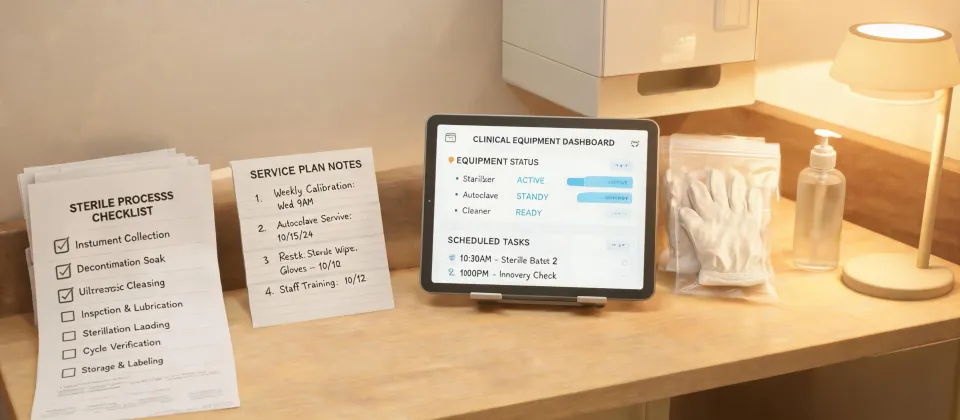
Why There Is No One-Size-Fits-All STERIS Service Plan
If you're looking for a single answer to "What STERIS service plan should we buy?" I have to disappoint you right now. That question doesn't have one right answer. It depends—more than most vendors will admit.
I've been managing equipment service contracts for about six years now, working with surgical centers and hospitals. In that time, I've processed roughly 300 orders and renewals across 12 different facilities. Here's what I've learned: the right choice depends almost entirely on how many devices you're managing and the complexity of your internal team.
Broadly, I've seen three distinct scenarios:
- Small surgery centers or dental clinics (1–3 sterilizers, minimal backup)
- Mid-sized hospitals (4–10 devices, a dedicated but small SPD team)
- Large healthcare networks (10+ devices across multiple locations, 24/7 operations)
Each scenario needs a different approach. Let's walk through them.
Scenario A: Small Surgery Center or Dental Clinic (1–3 Devices)
The Reality
At this scale, you're probably not running a 24-hour central sterile processing department. You might have one or two steam sterilizers and a washer-disinfector. Downtime is painful—because you have no backup. When the sterilizer goes down on a Friday, your Monday cases are in jeopardy.
I worked with a dental practice last year that made exactly this mistake. They bought a basic parts-only contract to save $800 per year. When their sterilizer threw a door seal error on a Thursday afternoon, the soonest a technician could get there was Monday. They lost a full day of procedures.
What I Recommend
Priority service contract or a bundled coverage plan that includes labor and travel. The cost difference is larger in percentage terms—maybe 40% more than a basic plan—but the absolute dollar amount is still manageable. For this segment, the inconvenience of downtime is disproportionate to the small savings.
The question isn't "Is the premium service worth it?"—it's "Can you afford a single cancelled surgery day?"
Look at plans that offer a guaranteed response time. Some vendors (STERIS included, in my experience) offer 24-hour response windows for standard contracts but will prioritize you for a small premium. It's worth it.
Scenario B: Mid-sized Community or Regional Hospital (4–10 Devices)
The Reality
You have a small but dedicated SPD team. Probably 10–15 people across shifts. You have some redundancy—maybe two large sterilizers and a smaller backup unit. But you're running near capacity most of the time.
For facilities in this range, I've found that the biggest hidden cost isn't the premium plan vs. basic plan difference—it's the inventory management of spare parts vs. ordering as needed.
What I Recommend (and It's a Bit Counterintuitive)
Consider a hybrid approach: base coverage + a strategic stock of high-failure consumables. Instead of paying for the top-tier all-inclusive plan (which can be expensive for mid-sized facilities), negotiate a contract that covers labor and travel but leaves some parts as cost-per-incident. Then, stock a small inventory of the most common failure parts yourself (door seals, gaskets, heating elements).
I know—it sounds like more work. But hear me out: In our facility, we did the math. The top-tier inclusive plan was $9,200 more per year than our current hybrid setup. We spent $1,600 on a carefully curated parts stockpile. That's a net saving of $7,600 annually, and we've never waited for a part because we didn't have it on hand.
The key is understanding which parts fail most on your specific models. STERIS service manuals (which you can order, and I have a few) actually list mean time between failures for common components. That's where you start. (Honestly, I'm not sure why more hospitals don't request this data during contract negotiations. It's a powerful lever.)
Scenario C: Large Healthcare Network (10+ Devices, Multi-Site)
The Reality
You're running 24/7. You have multiple campuses and maybe a central processing facility. If any single sterilizer goes down, you can shuffle cases to another unit—but regulatory documentation, staff allocation, and logistics become complex.
The problem here isn't unplanned downtime—it's the cost and complexity of managing multiple contracts. I've seen networks with 15 different service contracts, each with different renewal dates, terms, and contact information. That's a headache waiting to happen.
What I Recommend
A comprehensive, enterprise-level contract with a single point of contact. This is the one scenario where the high-end, inclusive plan usually makes financial sense. The administrative time spent managing patchwork contracts—accounts payable issues, tracking multiple technicians, renegotiating terms separately—easily offsets the premium.
In 2024, a network I work with consolidated 12 separate contracts into a single enterprise agreement. Their total annual cost went up by 11% (the inclusive plan was more expensive than the sum of their basic plans). But their administrative overhead dropped dramatically. The director of sterile processing told me they recovered about 30 hours per month in contract management time.
Also—and this matters—when a major piece of equipment went down at their busiest site during peak surgery hours, the single-point response meant they had a technician dispatched within two hours. Under the old system, the delay would have been much longer because the request had to be routed through the correct local contract first.
How to Determine Which Scenario You Are In (A Practical Self-Check)
If you're still unsure, ask yourself four questions:
- How many active STERIS devices do you have under service coverage? (Not just owned—covered by a contract.) If it's 3 or fewer, lean toward Scenario A. If it's more than 10 across multiple sites, lean toward Scenario C.
- What is your internal technical capability? Do you have a biomedical engineering team on staff? If yes, you can handle a hybrid plan (Scenario B). If not, pay for full coverage.
- What is the financial impact of one day of downtime on your busiest sterilizer? If the answer is "more than $3,000 in cancelled procedures," you need a fast-response plan.
- How much time does your team spend managing service contracts per month? If it's more than 5 hours per contract, consolidation is worth investigating.
A quick note on pricing (as of early 2025, based on contract figures I've seen): The difference between a basic parts-only plan and a full-coverage plan on a single large steam sterilizer is roughly $2,000–$4,000 per year. That's the range you're working with. For a small facility, that gap feels large. For a large network, it's a rounding error. Your scale determines your decision.
Ultimately, the vendor who lists all the fees upfront—even if the total looks higher—usually costs less in the end. I've learned to always ask "what's NOT included" before "what's the price."