Not All Mistakes Are Created Equal
If you've spent any time in a sterile processing department, you know the phrase 'learn from your mistakes' gets thrown around a lot. I've been in SPD for about 8 years now (started in 2017, fresh out of certification). In that time, I've personally made — and documented — 14 significant errors, totaling roughly $12,000 in wasted supplies and reprocessing costs. This isn't a humble brag; it's a confession.
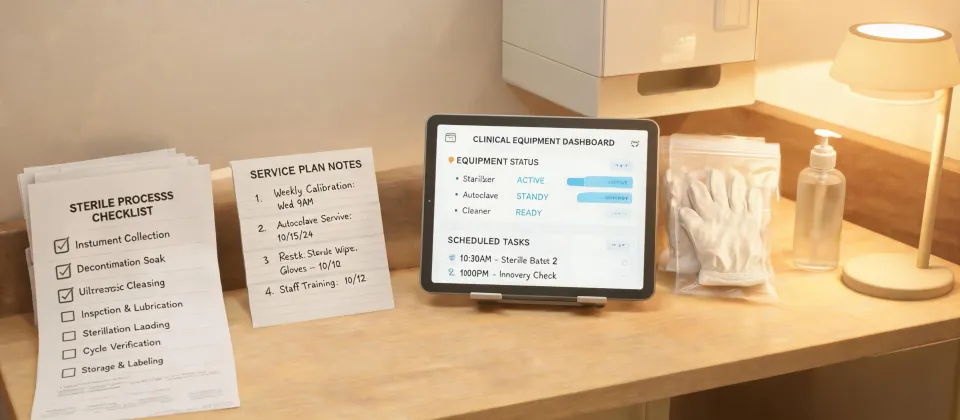
The thing is, not all mistakes have the same root cause. Some come from misreading instructions. Some come from trusting the wrong shortcut. And some come from trying to save a few bucks. After the third rejection in Q1 2024, I created a pre-check list that's caught 47 potential errors in the past 18 months. This article is built around that list.
Here are the three most common error patterns I've seen (and fallen into), broken down by scenario. Your situation might differ, so I'll help you figure out which one fits you best.
Scenario A: The RESI Test That Kept Failing
Key products involved: STERIS RESI test strips, biological indicators, and a steam sterilizer that suddenly wouldn't pass.
In early 2022, I was running the weekly biological indicator (BI) cycle for our main sterilizer. The RESI test had been our go-to for years — reliable, easy to read. But for two consecutive weeks, the result showed growth. Red light. Fail.
I panicked. My first instinct was to blame the sterilizer — maybe the temperature probe was off, or the vacuum pump had a leak. We called the manufacturer, scheduled a service visit ($1,200 for the emergency call), and wasted three production days reprocessing that week's loads. Turns out, the issue wasn't the sterilizer. It was the test strip lot number.
Never expected the RESI test itself to be the culprit. Turns out we'd received a batch that had been improperly stored — exposed to high humidity in our receiving dock. The instructions for use (IFU) clearly state: "Store at 15-30°C, humidity below 60%. Use only within expiration date." But who checks humidity on the receiving dock? (Not me, obviously.)
What I do now: I have a small hygrometer next to the BI storage cabinet. I also keep the lot numbers and storage logs in a spreadsheet. (Should mention: that spreadsheet has caught two more bad lots since.) The lesson: don't assume the test is right — validate its storage history first.
Scenario B: The Pre-Klenz Instructions I Didn't Read (Carefully)
Key product involved: STERIS Pre-Klenz enzymatic cleaner — the instructions for use are printed in a tiny font on the back of the bottle.
I once ordered 12 cases of Pre-Klenz (about $800) because we kept running out. Checked the price myself, approved the purchase, processed the order. Two weeks later, our endoscopic staff started complaining that the cleaner wasn't "breaking down protein" as before. A few scopes came back with residual soil after reprocessing.
I dug into the instructions for use — really read them this time. There it was, bolded deep in the text: "For maximum efficacy, Pre-Klenz must be pre-warmed to 35-40°C for instruments with dried-on soil. Do not exceed 60°C." Our sink's hot water was barely 30°C. We'd been using it cold (ugh, rookie move). The enzyme activity was drastically reduced.
The fix was simple: we installed a small inline heater to bring the soak bath to 38°C. Cost $150. The wasted enzyme solution (we'd been using double concentration to compensate) cost about $400. Plus the embarrassment when I had to admit it to the OR manager. (She was surprisingly nice about it.)
My checklist addition: Before adopting any new chemical, I now physically test the water temperature at the point of use. The IFU says one thing; your actual plumbing might say another. Also, I always check if there's a temperature requirement printed anywhere — even if it's in fine print. (Or rather, especially if it's in fine print.)
Scenario C: The Slit Lamp That Nearly Got Destroyed
Key product involved: slit lamp — an ophthalmology diagnostic device that looks delicate but is surprisingly expensive ($15,000+).
This is the scenario that still makes me cringe. Our infection control policy required all patient-contact surfaces to be disinfected after every use. The slit lamp's chinrest and forehead rest are obviously high-touch. But when the cleaning staff used a generic alcohol-based wipe on the optical surfaces — the eyepieces, the lenses — it stripped the anti-reflective coating. Two weeks later, the ophthalmologist saw blurring and sent it to the manufacturer for repair. Estimate: $2,000 to replace the optics.
The surprise wasn't the cost of the repair. It was how much the manufacturer's service rep emphasized that only approved disinfectants (e.g., 70% isopropyl alcohol wipes on non-optical surfaces, and a specific mild soap for optics) should be used. The SPD had no say in this — it was a clinical device. But because we'd never trained the environmental services team on device-specific IFUs, the damage happened.
From my perspective, the root cause wasn't the cleaning agent. It was the assumption that one disinfectant fits all. I now maintain a "Critical Device Cleaning Chart" posted in every eye clinic room. It lists the allowed disinfectants for each surface. Cost to create: two hours of my time. Potential savings: $2,000 per incident plus reputation damage.
Bonus: What Is Dental CAD/CAM Doing in Sterile Processing?
I've had to explain this more than once. What is dental CAD/CAM? It stands for Computer-Aided Design/Computer-Aided Manufacturing — used in dental labs to mill crowns, bridges, and implants from ceramic blocks. Many dental practices now have their own milling machines (like CEREC). The question I hear: "Do those milled restorations need sterilization?"
Yes, they do — but it's tricky. The blocks themselves are sterile when sealed, but once you touch them, they need to be processed. However, many dental CAD/CAM materials cannot withstand steam sterilization (they crack or discolor). The IFU from the material manufacturer (e.g., Ivoclar, Dentsply) often specifies ethylene oxide (EtO) or low-temperature hydrogen peroxide gas plasma (like STERIS STERRAD). If you're in an SPD that handles dental lab items, you need to know which material you're dealing with.
I once processed a batch of zirconia crowns in a steam autoclave at 132°C for 4 minutes (my standard 'quick cycle' for instruments). The crowns came out looking fine — but a week later, the dentist called furious because two crowns had micro-cracks. The recommended sterilization method for that specific zirconia brand was dry heat at 150°C for 2 hours or STERRAD. My mistake: using a one-size-fits-all approach. (Take this with a grain of salt — I'm not a dental expert, just someone who learned the hard way.)
How to Know Which Scenario Fits You
If you're reading this and thinking, "That could be me," here's how to prioritize:
- You work in a busy SPD with high throughput: Focus on Scenario A — verify your BI storage and test strip handling. A false fail costs you more than the test itself.
- You're responsible for purchasing chemicals: Scenario B — always, always test the IFU conditions at your point of use. The cheapest cleaner isn't cheap if it doesn't work.
- You deal with multi-specialty instruments (ophthalmology, dental): Scenario C and the dental CAD/CAM piece — create a device-specific cleaning chart. It's a small investment that prevents big repair bills.
This was accurate as of Q4 2024. The sterile processing landscape changes, especially with new materials and IFUs, so verify current standards before budgeting. Personally, I've learned that value over price applies to every decision in sterile processing — from test strips to cleaning solutions to device repairs. That $200 savings on a bulk bottle of cleaner turned into a $1,500 problem when we had to re-process 40 contaminated scopes. (Oh, and I should add: we now buy Pre-Klenz in smaller quantities to rotate stock faster. That alone saved us a lot of headaches.)
If you've made similar mistakes — or have your own checklist items — I'd love to hear them. For now, I'll keep updating my pre-check list. It's saved me from at least two disasters this year already.