Look, I'm not a procurement expert. I'm a sterile processing supervisor who got stuck ordering parts and manuals for our STERIS equipment because I was the one who "knew the part numbers." That was a dangerous assumption.
This article is for anyone who's been handed the responsibility for sourcing anything from a STERIS 3080 surgical table service manual to a filter for a Washer/Disinfector, and felt that cold sweat of "I hope I get this right."
I've been making these orders for about four years now. In that time, I've personally made (and documented) about 12 significant mistakes, totaling roughly $4,200 in wasted budget. I now keep a checklist on my desk. Here are the five biggest lessons I learned, and the checklist item that fixes each one.
1. The Classic Model Number Blunder
The Mistake: In my first year (2017), I needed a STERIS 3080 surgical table service manual. I typed "3080 service manual" into our system and ordered the first PDF link that looked right. It cost about $85. The result came back—it was for the 3080-MP variant, and we have the 3080-SP. The wiring diagrams were useless. $85 down the drain, and a one-week delay on a scheduled PM.
Checkpoint #1: Always verify the full model number off the physical nameplate. Don't trust memory or a purchase history from six months ago. The nameplate on the back of the table or the side of the sterilizer tells you everything. I still kick myself for not walking the 20 feet to go look at it.
2. The "Universal Part" Trap
The Mistake: I once ordered a set of gaskets for a STERIS advantage plus washer. The sales rep said, "Oh, these gaskets fit all Advantage Plus models." They were wrong. The Advantage Plus line has multiple chamber configurations (single vs. dual door, pass-through vs. straight-through). The gaskets didn't match our unit's door hinges. We caught the error when the technician was on site and couldn't install them. $340 wasted, plus a two-day reschedule.
Checkpoint #2: If a part is described as 'universal' or 'fits all', ask for the exact STERIS part number for your specific unit's revision level. A part that fits 90% of units doesn't fit ours. I learned to always ask for the part number, not just the description.
3. The Phantom Stock Issue
The Mistake: I found a part number for a circuit board for an Endoscopy Reprocessor on an old parts list. It said the part was in stock. I placed the order. Two days later, I got a call saying the part was actually obsolete and had been replaced with a different, more expensive unit. No one told us when the original list was published. The delay was likely caused by the holiday backlog, but the core issue was relying on outdated info.
Checkpoint #3: Before ordering any critical or high-value part, ask STERIS service (or your rep) to confirm current stock status and any superseding part numbers. That 30-second phone call saves a week of waiting.
4. The Manual Match Game
The Mistake: I needed the service manual for a Washer/Disinfector to do a software reload. I found a listing for a manual that covered the software version we thought we had. We ordered it, downloaded it, and the procedure for the software reload was different. The manual was for a slightly newer software build. That error cost $150 for the manual plus an emergency service call fee. I should have checked the software version on the unit's main screen.
Checkpoint #4: For software and firmware related manuals, document the exact software version displayed on the equipment's screen. A manual for a "Reliance Vision" is different from a "Reliance Vision v4.2." Match the software build level, not just the product line.
5. The Service Contract Blind Spot
The Mistake: Our department needed a detailed parts list for a STERIS 3080 surgical table service manual, specifically the hydraulic cylinder assembly. I spent an hour pulling part numbers from industry forums and cross-referencing them. Later, I found out that our existing Service Contract for the table included access to an online portal with a complete, verified parts breakdown. I wasted my time reinventing the wheel.
Checkpoint #5: Always check your STERIS service contract terms first. Your contract may include online portal access, technical support hotlines, or discounted parts pricing that you are paying for anyway. Use the resources you have before spending money on manuals or parts from third-party sources. So glad I finally looked at the contract terms. Almost spent another $200 on a book I could have downloaded for free.
Final Checklist (The One I Use)
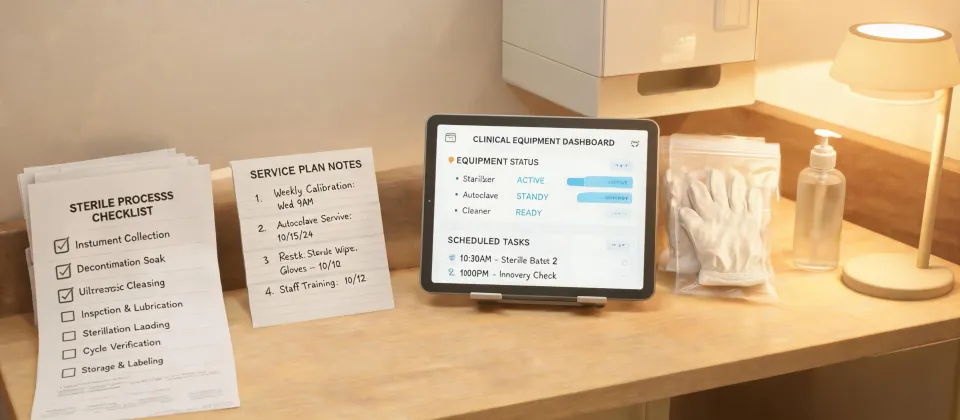
Here's what I physically print and check now for every non-trivial order:
- Model Number: Confirmed from physical nameplate.
- Part Number: Exact STERIS number, not just a description or a rep's verbal confirmation.
- Stock Status: Verified current availability and check for superseded parts.
- Software/Manual Version: Matched to the specific level on the machine.
- Contract Check: Confirmed what's included in our existing service agreement.
One more thing: If you're a smaller clinic or a single-department buyer, don't feel bad about asking these questions. When I was ordering parts for a small surgical center, the vendors who treated my $200 part orders seriously are the ones we still use for our larger system orders. Small doesn't mean unimportant—it means you're learning to be efficient.