My neighbor cornered me at a cookout last spring with a question I've heard about a dozen times since.
"How much are dental implants? You work in healthcare, right?"
I gave him the ballpark — single implant, somewhere in the $3,000 to $4,500 range depending on the region and the practice (as of early 2025, at least) — and then I stopped myself. That number is just the visible part. It doesn't include the imaging, the temporary restoration, the follow-up visits, or the cost of running a surgical suite that meets sterile standards. A dental implant isn't a product. It's a process with a price tag.
I thought about that conversation a lot over the next three months. Not because of any dental work. Because the exact same thing was happening at my hospital, with a much bigger number attached.
The report that started it
Last January, our CFO dropped a quarterly report on my desk. Sterile processing had run over budget by 22% for the second year in a row. We're a 200-bed community hospital, so that's not a rounding error — that's real money the board wants back.
"Find out where it's bleeding," she said.
I've been procurement manager here for six years. I've negotiated contracts with at least 40 vendors in that time and documented every order in a cost tracking spreadsheet that has somehow outlived three CFOs. Since 2019, I've analyzed somewhere around $180,000 in cumulative sterile processing spend. I thought I knew our costs cold.
I was wrong. And it took a binder on the wall in the workroom to prove it.
The Pre-Klenz instructions were in the room the whole time
The first red flag showed up in our consumables line. We use STERIS Pre-Klenz for manual pre-cleaning of surgical instruments before they go into the washer-disinfectors. Straightforward product: you dilute it, you soak or wipe the instruments, you let it sit for the contact time, you rinse. Done.
Our orders had grown 35% year over year. I initially blamed surgery volume, which was up about 11%. But 35% isn't 11%. Something else was going on.
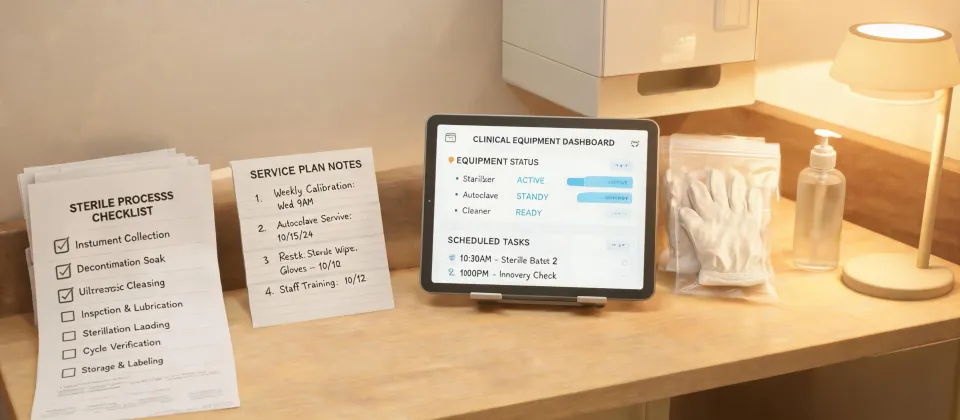
I walked down to sterile processing and asked the team lead how the staff was actually using it. She pulled out the STERIS Pre-Klenz instructions for use — the IFU — from the binder and walked me through their process. That's when we spotted the gap. Somewhere along the way, someone decided that "a little extra kills more" and it stuck: they were using roughly double the listed dilution for soaking. We weren't buying more detergent because we had more patients. We were pouring twice the required amount down the drain.
The second issue was less obvious and more expensive. In the push to turn trays around before first case, staff were skipping the recommended contact time. So instruments went into the washer-disinfector still carrying soil. The wash cycle on about 8% of our weekly instrument sets had to be re-run — I found that number by asking for the re-run logs, which nobody had thought to compare against chemical usage.
Every re-run means extra detergent, extra water, extra utilities, and an extra 45 minutes of staff time on a tray that should have been done right the first time. The re-run rate also explained our "tray shortage," which had pushed us into buying replacement instruments we didn't actually need. We weren't short on instruments. We were short on throughput, because we were cleaning roughly a fifth of them twice.
The IFU isn't a paper for the compliance file. It's a cost control lever. We had the right product, the right people, and the wrong instructions in use.
The IFU matters for another reason too: it's part of the FDA clearance for the product. The safety and performance data were generated under those specific dilution and contact time conditions — which is another way of saying the validated process is usually the cheapest process, because it's the one that actually works the first time.
What a service contract actually costs
While I was digging through the consumables, the renewal notice for our STERIS sterile processing service contract landed on my desk. The base quote looked reasonable — about 8% above last year, roughly in line with inflation for medical equipment service.
The renewal also came with a 10-day decision window before the price stepped up 4%. I wanted three quotes. I got two plus the incumbent, and ran the numbers on a Friday afternoon.
The catch with service agreements is rarely the headline. It's the exclusions. Our existing contract said "unlimited emergency callouts," which sounded great until I actually read what it didn't cover: after-hours labor, parts beyond the first year, and anything related to water quality in the sterilizer loop. A broken door gasket on a washer-disinfector had cost us $1,780 in parts the previous July. I approved that invoice without thinking twice.
A different vendor's quote came in $4,200 under our current renewal. The spreadsheet said switch. But something felt off, so I called their service desk with three questions: what's your average response time for a down sterilizer, what's your after-hours rate, and what exactly does "parts included" exclude? Twenty minutes on hold should have been my answer.
So I priced out the worst case instead of the average case: one after-hours callout plus a major part failure. That turned the $4,200 "savings" into a $2,600 projected loss before we even talked about uptime risk. For a hospital that answers to CMS surveys, a down sterilizer isn't just a cost problem. It's a compliance problem. We stayed with STERIS, renegotiated the renewal to include first-year parts coverage, and dropped a bundled service option we hadn't used in three years. Final contract came in $3,100 over the cheap quote — and about $6,000 under what our old contract was going to cost us once expected after-hours calls were factored in. I'll take that trade every time.
The CT scanner, nuclear medicine, and the miscommunication nobody saw
Here's the part I still can't fully laugh about. A few weeks later, the radiology director pulled me into a meeting about the CT scanner. It was going down for preventive maintenance twice as often as the manufacturer's benchmark, and service costs were spiking.
After forty minutes of speculating about hardware failure, the answer turned out to be cleaning. The scanner was shared between radiology and our nuclear medicine team, which uses it for SPECT/CT cases in the afternoons. Radiology cleaned the suite with one set of disinfectant wipes. The nuclear medicine team used a different wipe from their own supply cabinet. The wipe on the nuclear medicine side contained a solvent that wasn't compatible with the scanner's protective coatings. Nobody had done anything wrong, exactly. Each team was using the products they had been given. But nobody had ever sat both teams down in the same room and compared the two lists.
We fixed it in one afternoon. Everyone wrote down which disinfectants are approved for the scanner surfaces, which are approved for the nuclear medicine equipment, and we found a single product that works for both. Estimated savings: about $9,000 in unplanned maintenance calls this year, plus a service engineer who no longer groans when he sees our scheduling request.
Same lesson as Pre-Klenz, different disguise. Read the instructions. Follow them. And make sure every department touching a piece of equipment is reading the same instructions — because they almost certainly are not.
What the numbers added up to
When I handed the summary to the CFO, I kept it short:
- Correcting Pre-Klenz dilution and following the contact time: about $6,800 saved per year in detergent, plus re-run labor.
- Cutting the washer-disinfector re-run rate roughly in half: an estimated 915 staff hours recovered per year.
- Renegotiating the STERIS service contract: about $6,000 in projected annual savings versus the old terms.
- Fixing the CT scanner cleaning protocol: about $9,000 in avoided unplanned service calls.
Total: over $22,000 in annual savings, from a couple of wasted afternoons and one awkward meeting. Plus a rework pile that doesn't show up on any budget line.
So, back to dental implants
By the second cookout, my neighbor was back with the same question. Here's what I told him: "You asked how much implants cost. The implant itself might be the smallest number you see. The real cost is the imaging before, the sterilized instruments during, the training of everyone in that room, and the service contracts that keep the equipment running. A cheap price that skips any of those will cost you more in the end."
He went with the mid-range practice and asked about payment plans. I think he understood.
Three things I changed after this
- Read the IFU before you sign off on the consumable — not just for compliance reasons. The way a product was validated is almost always the cheapest way to use it. When staff improvise the dilution or the contact time, the product still works, but the budget and the workflow start leaking.
- Price service contracts line by line, not as a bundle. Ask what's excluded. Ask about after-hours and parts. Run the worst-case numbers, not the average ones. The cheapest quote is a good story until the door gasket breaks.
- Connect departments before you connect equipment. The CT scanner didn't fail because of bad engineering or careless staff. It failed because two teams were using two different sets of instructions on the same machine. That's a coordination problem, and it costs real money.
We're rolling out digital tracking for instrument sets this year, and I expect it'll help — automation is great at standardizing a process. But the biggest wins here were old-fashioned: correct instructions, correct execution, and a spreadsheet that asks the right questions. In hindsight, I should have been auditing these instructions annually, not just when the budget blew up.
If you're staring at your own sterile processing budget, don't start with the contract. Start with the instructions for use. The IFU, the service agreement, and the cleaning supply cabinet. That's where the money is hiding.