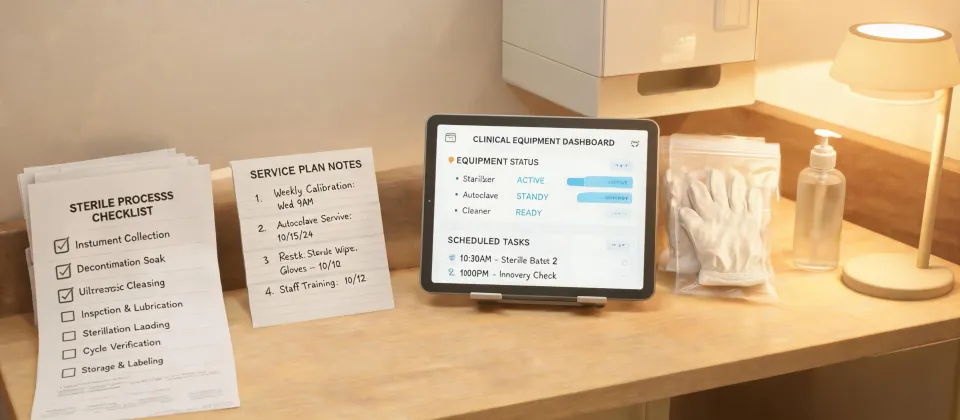
February 2024. Our STERIS 444 washer-disinfector — the machine that had kept our sterile processing department running since 2016 — beeped twice, flashed an error code I didn't recognize, and stopped mid-cycle.
Six surgical trays were trapped inside. A full room of instruments was waiting. The next morning's first case needed arthroscopy tools from that load. I remember standing there while the sterile processing technician looked at me like I had somehow caused it.
The immediate fix wasn't pretty. We air-dried and manually re-processed the trapped instruments at our second site — a two-hour round trip for a technician, plus three hours of overtime. Our backup washer was a small tabletop unit that handled maybe a third of our daily volume. The next two weeks were a scramble of staggered shifts and short-cycle runs.
"It's been struggling for months," the tech told me. "I mentioned the error codes to Dave back in December."
Dave was our STERIS service rep. That message never reached me. The disconnect between clinical staff, service reps, and administration — that's exactly what this story is about.
The Chain Reaction
I'm the administrator for a 400-person outpatient surgery center network across three locations. I've managed equipment purchasing since 2020 — roughly $1.2 million annually across 20+ vendors. I report to both operations and finance. If a department needs something, it eventually lands on my desk.
My first instinct was simple: replace the 444 with the same model. Same specs. Same vendor. Done. That's how I'd always handled equipment replacement. Get three quotes, compare prices, pick the lowest reputable bid. It worked fine for supply carts and exam tables.
But Dave, while he was inspecting the failed unit, asked a question I wasn't prepared for:
"What are you doing for wash chemistry verification?"
Good question. Our sterile processing manager shipped test strips and water samples to an outside lab every month. Results took four to five days and cost roughly $600 per batch. Per AAMI's sterilization standards, washer-disinfectors need regular verification of cleaning chemistry. We were technically meeting the requirement — but the delay meant that if anything drifted off spec, we'd be reprocessing instruments with bad chemistry for days before we knew it.
The newer 444 models are designed to work with an on-site chemistry analyzer: run a sample after a cycle, get concentration results in minutes, watch the digital log build itself. No third-party lab. No handwritten tracking sheets. No blind spot.
That was my first "wait a minute" moment. We were buying certified STERIS washers and chemicals, but we were monitoring the process like it was 2015. The technology had evolved. Our habits hadn't.
The service records showed three emergency repair visits in 2023, including a pump seal replacement that cost $4,800. The 444 wasn't just aging; it was getting expensive to keep alive. Replacing it was overdue in ways I hadn't wanted to see.
The OR Manager's Wishlist
The longer I worked on the replacement, the bigger the project became.
Our OR manager pulled me aside one afternoon during a walkthrough. She'd heard about the washer issues and wanted to talk about OR 2. The lights there had been fine for years, but surgeons were increasingly complaining about shadows during deep-cavity cases, and the manual repositioning was eating time between surgeries.
She asked for the STERIS Harmony air G series ceiling lights. I'd heard the name but never dug into it.
"What makes them different?" I asked.
She explained the depth of field, the ability to adjust light patterns without touching anything, and the integration with the surgical table's positioning data. And then she dropped the phrase that changed the scope of the whole project:
"If we're upgrading lights, we should also look at the pressure mapping system for the tables."
Pressure mapping, she explained, is a sensor layer on the surgical table surface that tracks patient pressure distribution in real time. For our growing bariatric and longer-duration procedures, preventing pressure injuries was a genuine clinical concern. Our nurses were manually tracking how long a patient stayed in one position — and documentation gaps happened. With a pressure mapping system, the data records itself and flows straight into the patient chart.
Suddenly the light upgrade wasn't just a light upgrade. The OR was becoming an integrated system: lights, table, pressure sensors, patient records. The value was in how they worked together.
The $2,400 Word: "Mostly"
But this story wouldn't be complete without the mistake.
Around the same time, I found out our anesthesia tech had been quietly buying off-brand components for the anesthesia machines. Filters, breathing circuits, connector valves. He defended it the moment I brought it up:
"These are 65% cheaper than OEM parts."
"Are they compatible?" I asked.
"Mostly."
That word. One word. Cost us $2,400.
In November 2024, during a vendor consolidation push, we placed a bulk order for anesthesia machine components from an online distributor we hadn't used before. I'd learned my lesson about verifying vendors after a 2021 invoicing disaster, so we requested samples first. The samples looked fine. But the production batch wasn't the samples. A faulty connector on a breathing circuit failed during a scheduled procedure — the case was aborted and rescheduled. A valve seized on a second machine later that week. No patient was harmed, but the surgeon documented the equipment issue, and suddenly this was an incident report, not a purchasing issue. The accreditation implications made it a leadership issue.
And the invoice? Handwritten. Finance rejected it. I ate the full $2,400 out of my department budget and placed an emergency order with a certified distributor (who confirmed FDA-cleared status on every component). The "cheap" components became the most expensive anesthesia supplies we'd ever bought.
Look, I'm not saying third-party parts are always bad. I'm saying that when you're buying clinical components, the word "mostly" is not a risk you can absorb.
The Phased Upgrade
We moved forward. New STERIS 444 washers at two of our three locations (site three goes live this quarter), an on-site chemistry analyzer at each site, Harmony air G series lights in two ORs, and pressure mapping systems on two new surgical tables.
The rollout was not smooth. Not even close.
The surgical team needed time to adjust to the gesture controls — the first week looked like a group of people trying to silence an invisible smoke alarm. The install in OR 3 ran three weeks late because ceiling reinforcement wasn't scheduled correctly (ugh). The sterile processing team distrusted the chemistry analyzer after one false-positive reading in October and went back to manual logs for two weeks before we sorted it out.
But by December 2024, the results were real:
- Instrument turnaround time in sterile processing dropped from 90 minutes to about 45.
- Chemistry verification went from 5-day external lab turnaround to same-day in-house results.
- Pressure mapping data started feeding directly into patient charts.
- Our January Joint Commission tracer survey in OR 2 found no documentation gaps — a first in my five years there.
What I'd Tell Another Purchasing Admin
I have mixed feelings about vendor consolidation. Part of me wants to keep multiple suppliers for leverage and redundancy. Another part knows that the fragmentation we lived with — nine vendors, each with separate service contracts, training schedules, and spare parts inventories — created gaps that never showed up on a purchase order. I've landed on a primary-plus-backup model: STERIS for the clinical equipment and supply chain, budget vendors only for non-clinical items like office supplies.
Here's the thing: most buyers focus on the sticker price of medical equipment and completely miss the chain of costs around it. The monthly lab fees. The manual documentation. The shadow-cast lights that slow down a surgical team. The "compatible" components that fail at the worst possible moment. Add it all up, and the expensive route is often the cheap one.
The industry is evolving. What was best practice in 2020 — buy in pieces, compare per-unit prices, manage 20 vendors — may not apply in 2025. Integrated systems are becoming the baseline, not a premium option. But the fundamentals haven't changed. You still need vendors who invoice properly, who answer the phone at 2 a.m., and who stand behind their equipment when something goes wrong. You still need to verify before you buy. And you still need to understand how a machine fits into the system around it.
If I could go back and tell my 2020 self one thing, it would be this: when you buy a piece of medical equipment, you're not buying a machine. You're buying the system it plugs into, the workflow it changes, and the service team behind it. Check how it interacts with everything else before you sign.
When we finally decommissioned the old 444 in March 2024, I took a photo as it was rolled out. It felt strange to be sentimental about a washer-disinfector. But that machine — and everything that happened after it stopped — taught me more about medical equipment purchasing than five years of spreadsheets did.
The sticker price is just the beginning. Period.