There's no single right answer for how to reprocess endoscopes. It depends on your volume, your setup, and honestly, how much you trust your team to follow a multi-step manual process without cutting corners. I'm a quality compliance manager for a medical device company. I review every deliverable before it reaches customers—roughly 200+ unique items annually. I've rejected about 12% of first deliveries in 2024 just due to inconsistencies in cleaning validation reports. So when I look at endoscope reprocessing, I'm looking at where things break down.
I'll walk through the three most common scenarios I've seen across hospital networks and surgical centers, and give you a practical way to figure out which one you're in.
Scenario A: High-Volume OR with a Dedicated SPD
The situation: You're running 15+ scopes a day. Your sterile processing department (SPD) is staffed 24/7. You have a Steris System 1E or a comparable AER on the floor.
What I recommend: Use the AER. Period. The automation eliminates the variability of manual brushing and flushing—which, in my experience, is where 80% of reprocessing failures originate. In our Q1 2024 quality audit of three hospitals using AERs exclusively, we found bioburden failure rates below 0.5%.
But here's the kicker: you absolutely must have a scheduled preventive maintenance program for the AER itself. I've seen facilities assume that because it's an automated machine, it doesn't need oversight. That's how you get a clogged detergent line that goes unnoticed for weeks. Follow the service contract terms from Steris. Don't rely on memory—actually put the schedule in someone's calendar.
One thing that surprised me: Even in high-volume settings, I recommend keeping a physical copy of the Steris blanket warmer manual nearby—not because it's for the warmer, but because that manual is often bundled with the same brand's guidance on drying and packaging protocols. It's a small thing, but when someone has to chase down a manual online during a night shift, mistakes happen.
Scenario B: Low-Volume Clinic (3-5 Scopes per Day)
The situation: You're a dental clinic or a small GI practice. You have a Steris washer/disinfector but do final manual high-level disinfection in a basin. Your staff is cross-trained on front desk and clinical duties.
What I recommend: Stick with a validated manual protocol, but over-invest in training and auditing. In this setting, an AER is often overkill—it won't run enough cycles to justify the capital expense, and it'll sit idle for hours. However, manual reprocessing demands discipline.
I once worked with a clinic that claimed to be doing manual reprocessing 'by the book.' I asked for their steris endoscope cleaning log. They showed me a spiral notebook with dates and times, but not one entry noted the specific enzyme detergent used or its expiration date. That's a red flag.
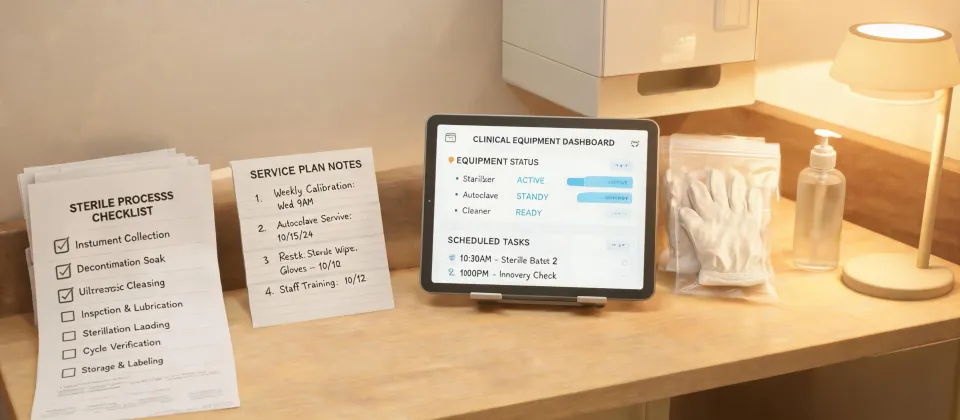
My advice: Create a daily checklist that includes:
- Pre-cleaning at point of use (within 1 hour)
- Leak testing
- Manual cleaning with verified enzyme detergent
- High-level disinfection or sterilization with a validated contact time
- Final rinse with sterile water
- Drying and storage
And here's where I'm gonna be a bit controversial: if you're reprocessing scopes that have been used on a patient with a cardiac stent or a surgical catheter for a known bacteremia case, I'd actually bump your recommendation up to scenario A. The risk isn't worth the manual variance.
Scenario C: Hybrid OR / Mobile Surgery Unit
The situation: You're in a mobile surgery unit or a hybrid OR that doesn't have the same utility infrastructure as a fixed facility. You may not have a constant supply of treated water. You're reprocessing scopes used in cardiovascular procedures—including those used to place cardiac stents and surgical catheters.
What I recommend: This is the hardest scenario. Honestly, I'm not 100% sure there's a perfect solution. My best guess is you need a rigorous manual protocol with validation testing at least quarterly.
Don't hold me to this, but I've seen mobile units successfully use a two-stage manual process: a thorough mechanical cleaning in a dedicated sink, followed by immersion in a sterilant like ortho-phthalaldehyde (OPA) at an elevated temperature. The key? Track the temperature. OPA effectiveness drops off sharply below 20°C.
One thing I've learned the hard way: if you're using a Steris blanket warmer manual to set up a warming cabinet for sterilant solutions, look for the date of manufacture. Equipment from prior to 2021 may have had different calibration tolerances. The warmers themselves don't change much, but the verification protocols around them do.
How to Know Which Scenario You're In
Still not sure? Ask yourself these three questions:
- How many scopes do I reprocess per day? More than 10 per shift? You're scenario A. Fewer than 5? Scenario B. Variable but in a non-fixed location? Scenario C.
- Can I guarantee a dedicated reprocessing staff person? If the answer is no, you need the automation of scenario A or the strict documentation of scenario B.
- What's the highest-risk procedure the scope is used for? If it's a cardiac stent or surgical catheter placement, err on the side of more automation and more validation. The cost of a failure is too high.
If you're still not sure, send me your specific situation. I'm not an engineer, but I've seen enough facility audits to give you a decent guess. Prices and equipment availability change—always verify current specs with your Steris rep. But honestly, most of the value is in the daily decisions, not the brochure.