It started with a Tuesday morning email that made my stomach drop.
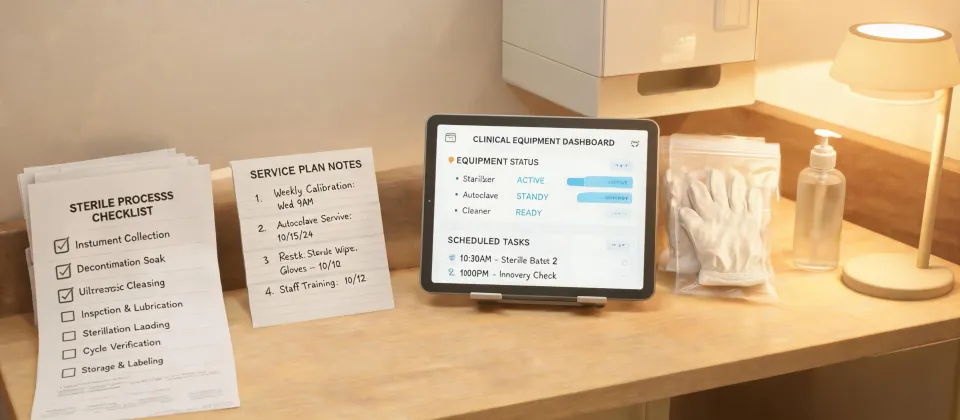
The subject line: "Lab Washer Down - Steris 7052". Our main research lab's STERIS parts lab washer had faulted out during its final sterilization cycle. The head of the lab was copied on the email. My heart sank.
I've been the office administrator for a 150-person biomedical research firm for about six years now. I manage all our vendor relationships for equipment maintenance and parts—roughly $60,000 annually across 8 different suppliers. When I took over purchasing in 2020, I inherited a system of sticky notes and verbal promises. I've learned to demand written quotes and verified lead times. But in that moment, none of that mattered. The washer was down. Experiments were waiting.
My usual approach: get three quotes, check payment terms, confirm lead time. That process takes about three days—or rather, closer to four when you factor in chasing down sales reps. But this was an emergency. The lab was going to lose a week's worth of cell cultures if we didn't have that washer running by Friday.
The first call.
I called our preferred STERIS parts distributor. They quoted me the necessary components for the parts lab washer—a control board assembly and a specific valve kit—for $1,200. Well, $1,275 with shipping. Standard delivery: 5-7 business days. That was too late. I asked about rush shipping. That would add $200. Two hundred dollars for shipping.
I had mixed feelings. On one hand, that felt like price gouging. On the other, I've seen the operational chaos that idle equipment causes. Maybe it's justified.
The numbers said to wait—save $200, push the lab to find a workaround. My gut said to pay the rush fee. My gut won. I'm glad it did.
Then the curveball hit. The distributor said the valve kit wouldn't ship from their main warehouse until Thursday. That meant Friday delivery—maybe. Maybe is the most dangerous word in B2B procurement.
I have a personal rule now: after getting burned twice by 'probably on time' promises in 2022 (one cost us a client presentation), I budget for guaranteed delivery in emergency situations.
The cart washer conversation.
While I was on the phone, the operations manager walked by my desk. "Hey, while you're on a roll, we need to talk about the new cart washer for the sterile processing room."
We'd been approved for a STERIS cart washer installation as part of a Q3 facilities upgrade. The capital expense was approved at $45,000—actually, $48,000 after installation costs. My job was to coordinate the vendor, the delivery, and the plumbing contractor.
This felt different. No rush. No emergency. For once, we had a timeline: eight weeks until the new cart washer needed to be operational. I had time to do this right. Get multiple quotes. Check references.
But here's the thing about facility projects: they never stay calm. The contractor we'd used before told us they were booked solid for six weeks. That meant our timeline just shrank to two weeks for the actual install. It was tight, but we made it work. We paid a 15% premium to the contractor to prioritize our job. That bought us certainty.
They called it an 'efficiency charge.' I called it the cost of not missing our deadline.
Meanwhile, the dentist needed CAD/CAM parts.
My job isn't just lab equipment. I also handle purchasing for our affiliated dental clinic. They use a dental CAD/CAM system for same-day crowns. The milling unit needed a replacement diamond burr—special order, $85 each. They wanted six of them. The supplier said they'd ship out within two days. Standard delivery was free. I didn't even think twice—standard shipping was fine.
No rush. No drama. It was almost refreshing after the lab washer panic.
The centrifuge problem.
Same week, our sample prep lab needed a new centrifuge machine. Their old one had been making a noise that sounded 'like a washing machine full of rocks,' according to the lab tech.
This was a planned replacement. The budget was approved—$12,000. We had a preferred vendor. The price was fair. The delivery was three weeks out. The only hiccup was the vendor's standard invoice format. I'd learned my lesson in 2020 when a supplier's handwritten receipt cost me $2,400 in rejected expenses from finance. So I double-checked that their invoicing system matched our AP requirements before placing the order. Simple. Done.
The endoscopy tower confusion.
And then there was the endoscopy tower.
One of our surgeon partners asked me a question that stopped me cold: "What is an endoscopy tower?"
He was joking—sort of. He knew what it was, but he was testing whether our team could articulate the specs for a new tower we were considering. And honestly, even after five years of managing this stuff, I had to pause.
An endoscopy tower is the physical cart that holds the monitor, light source, processor, and insufflator for endoscopic procedures. It's the backbone of a minimally invasive surgery suite. We needed a new one because our current tower was from 2016 and didn't support the new 4K monitors our surgeons wanted.
The distributor quoted us $85,000 for a complete STERIS tower with a 32" monitor, a new processor, and all the accessories. That felt ... a lot. But I did the math: the old tower was almost 9 years old. The average lifespan is 7-10 years. We were due.
I had to decide: buy new now, or kick the can down the road and risk a failure during a procedure? The risk of a tower failure during a colonoscopy is low, but the consequence is a cancelled procedure and a very unhappy surgeon.
I approved the purchase. No rush fee this time—the delivery was standard 4-6 weeks. But the certainty of having a new, reliable system was worth the full price.
Looking back.
That one week covered the full spectrum of my job: a frantic emergency with the lab washer's parts, a planned project with the cart washer, a routine reorder of CAD/CAM burs, a straightforward centrifuge machine purchase, and a big-ticket endoscopy tower decision.
What did I learn? Three things.
First: time pressure decisions require accepting a premium. The $200 rush shipping fee on the lab washer parts? That was the cost of keeping the lab running. Missing that deadline would have cost us easily $3,000 in lost productivity and sample waste. The 15% premium on the contractor? That was the cost of keeping the cart washer installation on schedule. Delaying the installation by a month would have delayed the entire Q3 facilities plan.
Second: not every decision needs to be rushed. The centrifuge machine and the CAD/CAM burs? Standard process, standard shipping, no drama. The trick is knowing which is which.
Third: I need to have a better system for the middle ground. The endoscopy tower was a big decision, but it didn't have a hard deadline. So why did it feel so high-pressure? Because the surgeons were getting impatient. That pressure was real, but it was internal. Not a supply chain emergency.
In March 2024, we paid almost $400 extra in rush fees and premiums across those orders. The alternative was missing deadlines that would have cost us far more—maybe $10,000 in lost time and productivity. The math is clear: uncertainty costs more than a premium.
The lab washer's parts arrived on Thursday afternoon, not Friday. The rush shipping worked. The valve kit arrived on Friday morning. The service tech had it running by noon. The lab only lost 3 days, not 5. The contractor finished the cart washer installation two days before the deadline. The centrifuge arrived on schedule. The CAD/CAM burrs were delivered in two days. The endoscopy tower is being installed next month.
It all worked out. But it was a week of hard decisions.
If you're an admin buyer like me, here's my advice: budget for the emergency premium. Not every order needs to be rushed. But when you're on a tight deadline, pay for certainty. The rush fee is rarely the real cost—the real cost is the opportunity you lose when you don't have the part on time.
And always, always verify the invoice before you order. Finance doesn't care about your story. They care about a PO number and a proper invoice.