When I first started handling equipment purchasing for our multi-specialty surgical center back in 2020, I assumed that sterilization was a sterile processing department (SPD) issue, patient monitoring was a nursing issue, and patient transfer devices were a facilities issue. Three separate budgets, three separate vendor relationships, and—naturally—three separate points of failure. It took me until our 2024 vendor consolidation project to realize that siloed approach was costing us a lot more than departmental goodwill.
I'm pretty convinced now that treating STERIS equipment like it's only about sterilizers (or only about surgical tables) is a mistake that too many healthcare facilities make. And honestly, I don't think it's the clinicians' fault—it's how procurement gets structured.
My initial misjudgment: Sterilization is a standalone category
I used to think the washer/disinfector contract and the surgical table contract were completely separate conversations. They're in different parts of the hospital, right? Different departments sign off. Different clinical teams use them. Makes sense to treat them as independent procurement events.
But here's what I missed: STERIS's value isn't just in any one piece of equipment—it's in how those systems interact across the patient care pathway. A surgical table that's designed to work with specific transfer devices reduces patient handling risks. An endoscopy reprocessor that integrates with the same data system as your sterilizers gives you a unified view of your instrument processing workflow.
I still kick myself for not seeing this sooner. If I'd pushed for a consolidated equipment review across departments when I started, we'd have standardized on compatible systems much earlier. Instead, we ended up with a mix of interfaces and service contracts that weren't designed to talk to each other.
What I've learned about patient monitoring and sterilization overlap
Here's where it gets interesting—and where I think most administrative buyers miss the boat. When you're evaluating patient monitoring systems, you're thinking about vital signs, alarms, and nurse call integration. When you're evaluating sterilizers, you're thinking about cycle times, load configurations, and biological indicators. These seem like completely unrelated product categories.
But the operational reality is different. The most frustrating part of equipment management across these categories: maintenance scheduling conflicts and service contract overlaps.
- Both require preventive maintenance that takes equipment offline
- Both have service contract renewals that happen on different cycles
- Both need parts availability that can vary dramatically by vendor
- Both generate documentation that compliance teams need to track
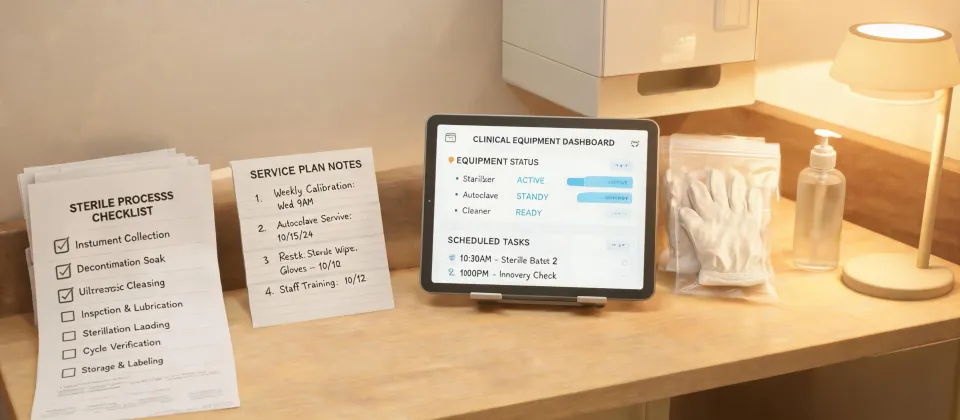
After the third time our SPD was down for sterilizer maintenance while our monitoring system was also being serviced—both from different vendors, both with different emergency contact numbers—I was ready to pull my hair out. What finally helped was centralizing our service contracts under a single vendor (in our case, expanding our STERIS service contract to cover our surgical tables and washer/disinfectors in the same agreement).
Patient transfer devices: the category everyone forgets
This one still annoys me. A patient transfer device seems like such a simple product—it's basically a slide board or a roller system, right? But the cost of poor patient handling is enormous. Back injuries to staff. Pressure injuries to patients. Delays in operating room turnover.
I initially bought transfer devices from whoever gave us the cheapest price per unit. Big mistake. When you look at total cost of ownership (i.e., not just the unit price but durability, ease of cleaning, and compatibility with your surgical tables and beds), the cheap options end up costing more. One vendor's transfer board didn't fit properly with our newer surgical tables—we didn't catch it until the clinical team tried to use it. That's a frustration I still deal with in my yearly vendor reviews.
5 minutes of verification beats 5 days of correction. The compatibility checklist I created after that incident has saved us an estimated $4,000 in potential rework and prevented at least two patient handling incidents.
How does an MRI machine fit into this picture? (Spoiler: it doesn't, but the principle does)
I'm not 100% sure if this analogy works perfectly, but thinking about how does an MRI machine work actually helped me structure our equipment procurement better. An MRI scanner requires specific room shielding, specialized cooling, and magnetic field management that affects everything within a certain radius. You can't treat the MRI as an isolated purchase—it changes the entire room environment.
Same principle applies to infection prevention equipment. A sterilizer isn't just a box that kills microbes. It needs steam supply lines, water treatment systems, ventilation, and workflow planning. A washer/disinfector needs specific chemical supplies, drain lines, and loading configurations. These are systems that interact with the facility infrastructure, not standalone appliances.
So when we were planning our SPD renovation last year, I made sure the same project manager who oversaw our surgical suite layout also reviewed the sterilizer placement. It sounds obvious in hindsight, but that cross-departmental coordination eliminated three potential workflow bottlenecks that would have cost about 15% in processing efficiency.
What I'd tell other administrative buyers
You might be thinking: "That sounds like more work upfront. I don't have time to coordinate across five departments for every equipment purchase." Fair point. I'd have said the same thing three years ago.
But here's the thing: the upfront coordination takes hours. The rework from incompatible systems takes days. And the trust you lose with clinical teams when equipment doesn't work as expected? That's harder to quantify but far more costly.
When I look at our STERIS washer test records from before and after our consolidation, the improvement isn't just in cycle times. It's in fewer failed tests, fewer emergency service calls, and fewer conversations with frustrated SPD staff. I can't put a dollar value on that last one, but I'd argue it's worth more than any first-year discount a vendor could offer.
Here's the 12-point checklist I created after my third compatibility mistake—it's saved us an estimated $8,000 in potential rework across equipment categories:
- Define which departments will use the equipment
- List all existing equipment those departments rely on
- Check physical footprint and infrastructure requirements
- Verify service contract compatibility with existing vendors
- Confirm parts availability and lead times
- Check training requirements for your staff
- Review regulatory documentation the equipment generates
- Assess data integration with your existing systems
- Calculate total cost of ownership (not just unit price)
- Identify any workflow dependencies across departments
- Get written compatibility confirmation from vendors
- Build a handoff schedule for implementation
Take this with a grain of salt—your facility might have different needs than ours. But I'd argue that most equipment incompatibility costs happen because we're too siloed in how we think about procurement. Sterilization isn't just an SPD issue. Patient monitoring isn't just a nursing issue. Patient transfer isn't just a facilities issue. They're all part of the same patient care pathway, and the sooner procurement reflects that reality, the fewer headaches everyone will have.