It was a Tuesday morning in late January when I finally opened the spreadsheet I'd been avoiding for three weeks. Our 2024 procurement numbers. I'd been proud of the savings I'd squeezed out of our equipment budget in Q2. By the end of Q4? Not so much.
Let me back up.
Where the Cost-Cutting Started
I'm the procurement manager at a 60-person outpatient surgery center. I've managed our equipment and consumables budget—roughly $180,000 annually—for six years. I've negotiated with more vendors than I can count, and I've documented every order in our cost tracking system. That system is about to become the main character of this story.
Last year, our CFO asked every department to trim 8% from discretionary spending. For me, that meant one thing: scrutinize every equipment purchase. Probably 80% of my Q1 and Q2 went to comparing quotes, negotiating prices, and hunting for what looked like savings.
The problem? I was looking at the wrong number.
The Surgical Lights Decision
Our ORs needed two new surgical lights. We had quotes from three vendors. One was STERIS at $14,200 for the pair (pricing as of Q2 2024—verify current quotes since rates may have changed). Another was a regional dealer offering a lesser-known brand at $11,800. The third was an online distributor at $9,400.
Guess which one I wanted to go with?
Here's where I almost made a mistake that would've cost us far more than the difference. Most buyers focus on the sticker price and completely miss what happens after installation. I was about to become one of those buyers.
But I'd been burned before. I built a TCO (total cost of ownership) spreadsheet after getting caught paying hidden fees on a "free setup" offer—that's a story for another day. So I ran the numbers.
The online distributor's "warranty" covered parts only. Labor was extra. After year one, a service visit cost $480 per call. The STERIS quote included full labor coverage for three years.
The cheaper lights used a proprietary LED driver board. If it failed after year two, the replacement part alone was $1,100—a quote that came straight from the distributor. The STERIS surgical lights didn't have that same exposure. Their service plan covered parts and labor. Simple.
The STERIS package also included their Connect Care integration, which lets our biomed team track maintenance status and receive alerts from connected equipment. That sounds like marketing fluff until a light flickers mid-procedure and you realize you could've known about the issue beforehand.
Over five years, the cheap option would've cost us roughly $16,800 in service fees, downtime, and parts. The STERIS lights? $14,200 all-in. To be fair, the online distributor makes sense for someone who plans to replace equipment in two years. We don't. Surgical lights live in our ORs for a decade.
The difference was hiding in the fine print. I signed the STERIS contract.
Then I Made the Mistake Anyway
You'd think that experience would've reset my instincts. It didn't.
Two months later, our clinical director asked for new suction units for the pre-op area. The old ones were held together with tape and optimism. I found a unit online for $780. The equivalent from our primary medical equipment supplier was $1,150. The cheaper one had decent reviews (though I now wonder how many of those reviews came from people who'd owned the unit for more than a year).
I bought it.
Big mistake.
The first failure was a cracked regulator. The seller shipped a replacement part—after two weeks of back-and-forth emails. The second failure was worse. The pump just stopped. Mid-use. In front of a nurse.
Not ideal. To put it mildly.
The manufacturer's "tech support" was a contact form on their website. I'm still waiting for a response.
We rented a backup unit for $85 per day for nine days while a replacement shipped. Total cost of that "cheap" suction unit? $780 for the unit, plus $765 in rentals, plus two days of my life chasing tech support. And we still didn't have a reliable unit.
I ordered the new unit from our usual supplier in October. It's been running daily since. No issues.
Same pattern with the blood pressure monitors. I bought three budget models at $214 each. The units from our established supplier were $340 each. The budget ones worked for about four months. Then the calibration drifted. Our nurses noticed readings that didn't match manually-taken vitals. We swapped them out in January. The total cost—including the labor to recheck every abnormal reading and the clinical team's lost trust in the equipment—far exceeded the $378 I'd saved upfront.
What Is Sterile Barrier Packaging? My $4,800 Education.
And then there was the packaging.
In August, we switched our sterile barrier packaging to a lower-cost supplier. Projected savings: $1,200 per quarter. The product looked fine. Same blue color. Same peel-away design. Same self-seal adhesive.
It was not fine.
For anyone who hasn't spent six years elbow-deep in procurement docs: what is sterile barrier packaging? It's the material—usually pouches or wraps—that keeps surgical instruments sterile after they come out of the autoclave. It has to do three jobs at once: let steam penetrate during sterilization, block bacteria afterward, and maintain a seal strong enough to survive handling and storage. It's not a bag. It's a medical device in its own right.
The cheap pouches had a noticeably higher seal failure rate. Our sterile processing supervisor caught it during her daily quality checks. Roughly 1 in 30 pouches had seal integrity issues—pinholes, incomplete seals, tears at the edges.
Per AAMI ST79, the consensus standard for steam sterilization in healthcare facilities, packaging materials must maintain seal integrity throughout the device's expected shelf life. Our own testing aligned with what that standard recommends. The problem wasn't the standard. It was that I hadn't verified the new supplier's product against it before switching.
We had to reprocess an entire cart of instruments for the next day's surgeries. Staff worked 90 minutes late. We ran extra sterilization cycles. We used our remaining stock of the old packaging to make up the shortfall. The total cost: about $4,800 when I factored in overtime and wasted materials.
Skipped the quality review because "it's basically the same as what we've always used." It wasn't. That's the exact kind of overconfidence that ends up in a spreadsheet as red ink.
What I Should've Known All Along
Looking back at 2024, I made the same mistake three times in slightly different forms:
- I optimized for unit price instead of total cost of ownership.
- I didn't factor clinical risk into equipment decisions.
- I let one bad service experience with an established vendor push me toward cheaper alternatives.
To be fair, the service experience was legitimate. We'd had a slow, frustrating repair on a sterilizer in 2023. But the issue wasn't the equipment. It was the service contract—we'd chosen the lowest-tier plan to save money, and we paid for it in response time when the machine went down.
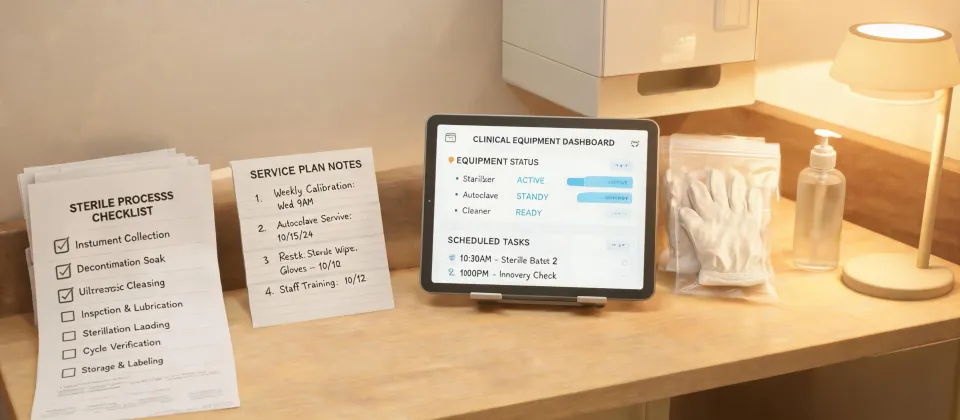
The fix wasn't to abandon the brand. It was to buy a service plan that matches our operational needs. When we added STERIS Connect Care to our sterilizers last fall, it wasn't about the dashboard (which is genuinely useful, don't get me wrong). It was about shifting from "fix it when it breaks" to "prevent it from breaking in the first place."
I've now built a 12-point supplier evaluation checklist. It includes seal strength testing for packaging, calibration documentation for monitoring equipment, and service response time guarantees for capital equipment. Five minutes of verification beats five days of correction.
The Cost of Failure Is the Price That Matters
I've always tracked costs. What I hadn't done was honestly account for what a failure costs.
My spreadsheet now has a column for clinical risk. A column for downtime. A column for the cost of the service call you hope you never need. These aren't just numbers—they're the difference between a $1,150 suction unit that works and a $780 one that doesn't.
I'm not saying STERIS is always the right answer. I still buy plenty of consumables from smaller suppliers, and some of them are excellent. The key is knowing which purchases belong in which category.
For anything that touches sterile processing or patient safety, I've learned to ask one question first: "What's the cost of failure?"
That's the question everyone should ask. Most people, including me last year, ask "what's the price?" The better question is "what happens when it fails?" Because in medical equipment, the line between an inconvenience and a patient safety event is thinner than you'd think.
In Q2 2024, I was proud of the $12,000 I'd saved on equipment purchases. By year-end, those decisions had cost us an estimated $24,700 in service fees, reprocessing labor, rental equipment, and wasted materials.
I'll take the $12,000 hit to my ego. Our budget—and our patients—can't afford another year like that.